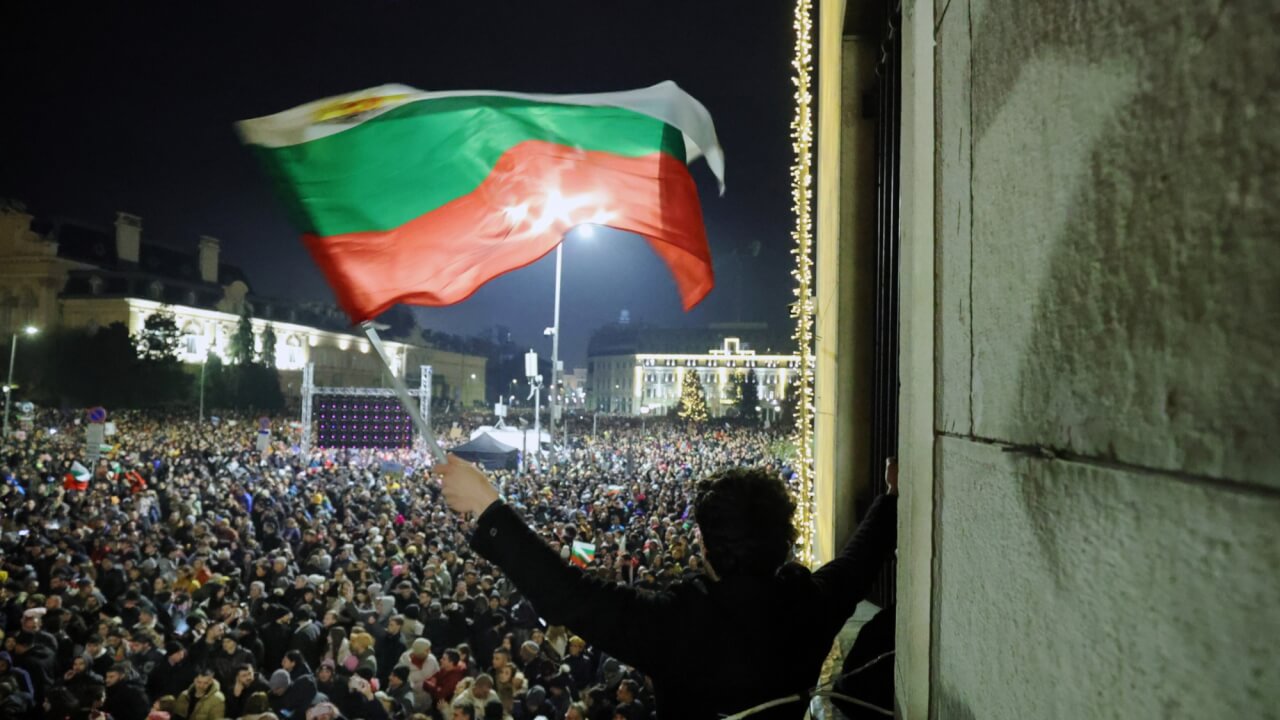
Following weeks of mass protests that mobilised broad segments of society, Prime Minister Rosen Zhelyazkov’s resignation on 11 December 2025 brought Bulgaria back onto Europe’s political agenda. In a country trapped in a chronic cycle of “electoral instability,” what do these protests signify? What socio-economic and political dynamics lie behind the most extensive wave of mass mobilisation Bulgaria has witnessed in the past thirty years? And does this resignation truly have the potential to open a new chapter in Bulgarian politics?
The Trigger of the Crisis: The 2026 Budget
The immediate trigger of the protests, which erupted in Sofia and spread to many other cities under slogans such as “resignation,” “no to corruption,” “mafia out,” and “fair elections,” was the 2026 budget. The budget drew widespread criticism for increasing pension contributions for private-sector employees while favouring the security apparatus, the judiciary, and the public bureaucracy more broadly. Public discontent was further deepened by the perception that the ruling coalition had prepared and passed the budget in open disregard of procedural rules, reinforcing long-standing concerns about opaque and unaccountable decision-making.
The government’s decision to withdraw the budget following the mass protests in early December failed to defuse the crisis. This was because the problem went far beyond the budget’s fiscal content. There was a widespread belief that public resources were being distributed behind closed doors, in a non-transparent manner, and in the interests of specific power networks . As a result, the anger on the streets was directed not merely at a legislative proposal, but at a deeper, structural distrust of the opaque and informal relationships between political actors and state institutions.
“State Capture” as the Most Sophisticated Form of Corruption
One of the most illuminating concepts for understanding Bulgaria’s political discontent is “state capture,” as developed by Joel Hellman and Daniel Kaufmann. While classical definitions of corruption focus on bribery and favouritism in the implementation of laws, state capture refers to corruption occurring at an earlier stage, during the very formation of laws, rules, and regulations.
According to Transparency International, Bulgaria ranks second after Hungary in perceived corruption within the European Union. In Bulgaria, this phenomenon manifests itself in what can be described as “oligarchic pluralism.” Actors who control economic and political power shape legislative processes from the outset, setting the rules of the game in line with their own interests. This is less about violating laws than about designing laws in ways that actively legitimise corruption.
In this context, the Bulgarian Parliament has ceased to function as a forum for deliberating the public good and has increasingly become an approval mechanism for rent distribution and regulatory capture among oligarchic groups.
Shadow Cabinets and Delyan Peevski as a “Veto Player”
At the centre of this structure stands Delyan Peevski, described by Reporters Without Borders as the embodiment of the “toxic triangle between media, politics, and oligarchy.” Sanctioned by the United States under the Global Magnitsky Act since 2021, Peevski is not formally part of the three-party minority government. Nevertheless, through his informal influence over the judiciary and security institutions, as well as his extensive media network, he possesses the capacity to block or enable legislative processes.
This “shadow power” effectively renders democratic procedures dysfunctional. According to widespread allegations, Peevski and his surrounding networks of interest use the judiciary, particularly the Prosecutor General’s Office, as a tool of political pressure and elimination, sidelining rivals while safeguarding their own economic interests. His dominance over the media constitutes the epistemic infrastructure of the state capture process.
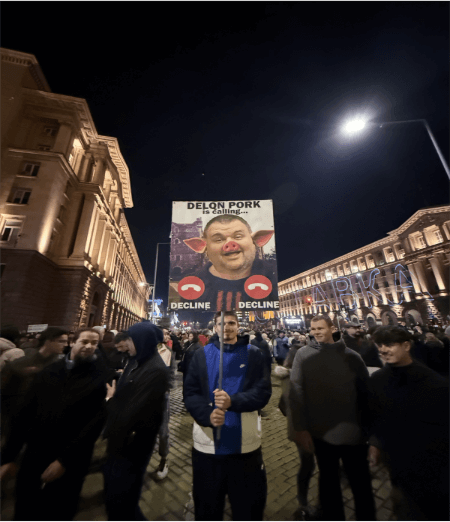
Figure 1. During the protests, Peevski was depicted as a pig, symbolizing oligarchic greed.
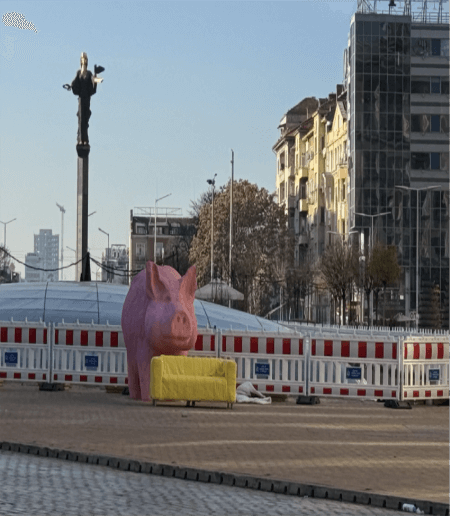
Figure 2. Protesters placed a pink pig statue within the symbolic triangle formed by the government, the presidency, and parliament, referencing both Peevski and the Movement for Rights and Freedoms (DPS), widely portrayed in public discourse as a “Turkish party.”
GERB and the Institutionalisation of Patronage Networks
The other pillar of the system is Boyko Borisov and his party GERB, which has dominated Bulgarian politics since 2009. Rather than functioning as a conventional centre-right party, GERB has evolved into a vast patronage network enveloping the bureaucracy and local administrations. In what the literature describes as “party–state fusion,” public procurement, EU funds, and state aid have been transformed into rent-distribution mechanisms exchanged for political loyalty.
By using its parliamentary majority and executive power, GERB has acted as an institutional facilitator that translates oligarchic demands into legal frameworks. This is why the protests of 2013, 2020–2021, and most recently 2025 have consistently targeted Borisov and GERB. Large segments of society no longer view the party as a normal actor in political competition, but as a key operator of a captured state.
Negative Coalitions, Electoral Instability, and the Pivotal Role of the Turkish-Origin Electorate
Over the past four years, Bulgaria has gone to the polls seven times, becoming trapped in a chronic cycle of what political science terms “electoral instability.” The fragmented structure produced by proportional representation and a low electoral threshold pushes parties not toward a shared reform agenda, but toward exclusionary “negative coalitions” aimed at blocking rivals.
Under constitutional procedure, President Rumen Radev is expected to first assign the mandate to form a government to Boyko Borisov, leader of GERB, the largest parliamentary group. However, Borisov has already signalled reluctance to take on this task. The deep mistrust between the reformist bloc (PP-DB) and the status quo parties (GERB and the Peevski faction) severely limits the prospects for compromise. As a result, even if procedural mandates are exhausted, an early election appears the most likely outcome.
The fate of such an election will hinge on two key factors. The first is whether voter turnout, which fell to as low as 39 percent in the 2024 elections due to systemic distrust, can be increased by re-mobilising disillusioned reformist voters. If successful, this could strengthen the reformist bloc in parliamentary arithmetic and open the door to systemic change. The second decisive factor is the direction of the votes of Bulgaria’s Turkish and Muslim minority.
Within Bulgaria’s fragmented parliamentary system, the Movement for Rights and Freedoms (MRF/DPS), long led by Ahmed Dogan, has mobilized Turkish and Muslim minority voters for decades, consistently securing between 10 and 15 percent of the vote and positioning itself as a kingmaker. While Dogan’s personal background as a former State Security (DS) operative has always sat uneasily with the party’s self-presentation as a representative of historically marginalized minorities, his long-standing role behind the scenes largely obscured this contradiction.
This equilibrium was disrupted when Delyan Peevski effectively seized control of the party and established a separate faction under the label “DPS–New Beginning.” This split exposed the patronage and brokerage mechanisms that had long operated implicitly within the party, significantly eroding its claim to being the “natural” and “inevitable” representative of minority voters. In the October 2024 elections, the Peevski faction secured 11.5 percent of the vote through the use of state power, local-level coercion, and the mobilization of so-called “purchasable” Roma votes, while the Dogan-aligned Movement for Rights and Freedoms Alliance fell to 7.5 percent.
This outcome is significant for two reasons. First, the electoral choices of Turkish-origin voters hold the potential to marginalize Peevski and remove him from the centre of Bulgarian politics. Second, the emerging fragmentation opens a historic window of opportunity for alternative forms of political representation among Turkish, Muslim, and Roma communities. As such, the preferences of Turkish-origin voters in the upcoming elections will not merely shape the electoral outcome, but will constitute a critical threshold determining whether Bulgaria continues to reproduce the cycle of state capture or begins to break free from it.
Tuba Eldem
Assoc. Prof. Dr. Tuba Eldem is a Gerda Henkel Research Fellow at the Center for Advanced Study (CAS) in Sofia, where she conducts research on authoritarianism and populism. She is also a faculty member in the Department of Political Science and International Relations at Fenerbahçe University. Her research lies at the intersection of comparative politics and international security, with a focus on political regimes, the international dimensions of regime change, civil–military relations, digital transformation, and strategic connectivity. Dr. Eldem received her PhD in Political Science from the University of Toronto with a dissertation entitled “Guardians Entrapped: The Demise of the Turkish Armed Forces as a Veto Player” (2013). She previously served as a postdoctoral researcher at the Research College “The Transformative Power of Europe” at Freie Universität Berlin and as a researcher at the Centre for Applied Turkey Studies (CATS) at the German Institute for International and Security Affairs (SWP).
To cite this work: Tuba Eldem, "Captured Institutions and Recurrent Elections: Bulgaria at a Crossroads – Tuba Eldem" Global Panorama, Online, 17 December 2025, https://www.globalpanorama.org/en/2025/12/captured-institutions-and-recurrent-elections-bulgaria-at-a-crossroads-tuba-eldem/
Copyright @ 2025 Global Academy. Design & Development brain.work
All on-line and print rights reserved. Opinions expressed in works published by the Panorama belongs to the authors alone unless otherwise stated, and do not imply endorsement by the IRCT, Global Academy, or the Editors/Editorial Board of Panorama.
Newsletter Subscription
Subscribe to our newsletter to stay informed about updates.