This paper presents the consolidated findings of the project “Türkiye–Iraq Relations: Opportunities and Tensions in Security and Connectivity”, carried out under the CATS Network between 2024 and 2025. The project set out to explain the recent rapprochement between Türkiye and Iraq, to map Ankara’s evolving goals, strategies and tools in Iraq, and to identify the implications for regional order and for EU–Türkiye cooperation. It did so through three substantive lenses: security, economic reconstruction and connectivity (including water), and finally, it also included the European/NATO dimension.
The research design combined desk research with multi-sited fieldwork: interviews and stakeholder conversations in Ankara, Istanbul and Brussels; close reading of official documents from the Turkish and Iraqi central government, Kurdistan Regional Government (KRG) and EU institutions; and sector-specific data on trade, logistics and water governance. These methods were applied across four linked case studies (security, water, connectivity, and the EU dimension).
Over the course of the project, the team produced several policy-oriented outputs.1 Taken together, these studies show that Türkiye–Iraq relations have moved from a narrow, threat-centric framework to a multi-layered relationship in which security, connectivity and external (especially European) actors are deeply entangled.
2. Security: from fragmented frontier to co-managed space
2.1 Dual-track security policy
A first core finding is that Türkiye’s Iraq policy has become a dual-track approach that combines intensified military operations with sustained diplomatic and institutional engagement, and entails simultaneous engagement with both Baghdad and Erbil. Since 2020 and especially after the formation of the al-Sudani government, Ankara has sought to normalise ties with the federal government while maintaining its dense relations with the KRG. The long-standing priority of containing the PKK and maintaining Iraq’s territorial integrity remained central, but is now embedded in a broader strategy that includes political dialogue, economic statecraft and corridor politics.
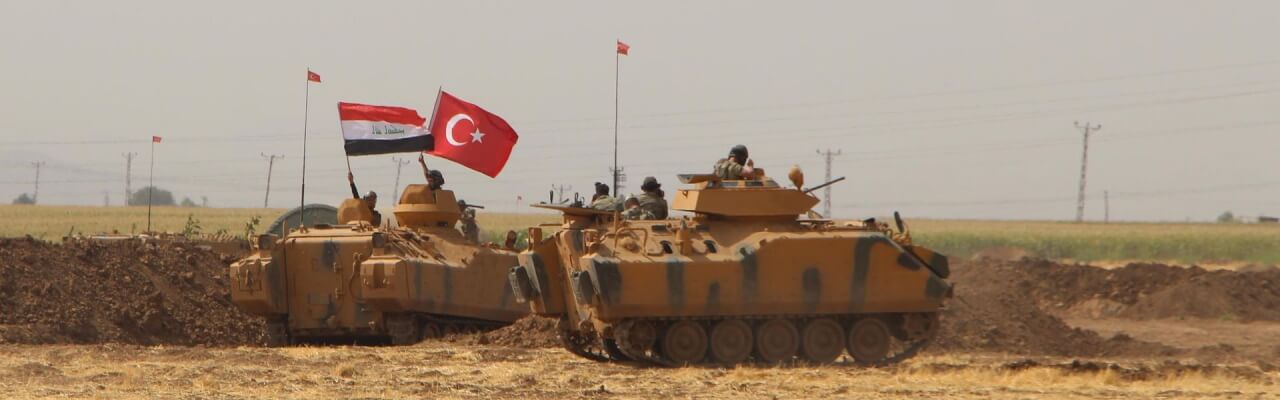
This dual-track logic became evident in 2020, with the coexistence of military and diplomatic tools. On the one hand, Türkiye expanded its cross-border operations in northern Iraq (Metina, Zap, Avaşin and adjacent regions), framing them as necessary to dismantle PKK infrastructure and to cut the logistical and human links between PKK cadres in Iraq and PYD/YPG forces in Syria. On the other hand, we witnessed increased institutionalisation of relations with both Baghdad and Erbil, characterized by high-level visits, joint committees, Memorandum of Understandings (MoUs) on security and military cooperation, and Iraq’s designation of the PKK as a “prohibited organisation” in 2024—all signalling a move away from purely unilateral action towards co-managed security arrangements.
As a result, Iraq has increasingly shifted in Turkish discourse from a fragmented security frontier to a central regional node where Ankara’s domestic peace agenda, counter-PKK strategy, and regional aspirations intersect. The “recalibration” lies not in the abandonment of hard power, but in the attempt to embed it within a more predictable framework negotiated with both Baghdad and Erbil. More recently, the “Türkiye without Terror” project has added a new domestic-regional dimension to Ankara’s Iraq policy. Although ultimately a domestic project, it has a clear regional component in which cooperation with both Baghdad and the KRG is critical. At the same time, both Erbil and Baghdad have shown close interest in the process and its success, as it is likely to shape their relations with Ankara and help ease existing latent tensions.
2.2 NATO and the alliance dimension
The project also finds that Iraq can be depicted as a testing ground for NATO’s evolving out-of-area posture and for Europe’s geopolitical ambitions, with the NATO Mission Iraq (NMI) sitting at the intersection of allied interests, US drawdown, and intra-alliance divergences. Turkey features here both as an indispensable ally, with its critical geographic positions, and other anchors such as the İncirlik base and also as a source of complexity, due to its operations in northern Iraq, its insistence on recognition of the PKK as a threat, and its preference for flexible coalitions and regionally “owned” solutions.
The project’s security outputs therefore converge on the argument that NATO’s viability in Iraq is partly contingent on how Ankara’s recalibration is managed by Türkiye itself, by allies, and by Iraqi counterparts. If Turkish–Iraqi cooperation on counter-terrorism and border security can be aligned with NMI’s advisory role and with EU efforts on security sector reform, Iraq could become a showcase for adaptable collective security. If not, alliance instruments risk being sidelined by more ad hoc, Türkiye-centric arrangements.
2.3 Risks and constraints
Across the security-focused studies, three constraints recur:
- Iraqi domestic fragmentation (Baghdad–Erbil disputes, intra-Kurdish/intra-Iraq competition, militia politics) can both enable and obstruct Türkiye’s security agenda. Ankara’s close alignment with the KDP, and tense relations with the PUK, or general political fragmentation in Iraq complicate any truly “national” Iraqi framework with which Türkiye can engage with.
- Iran’s entrenched networks in Iraq limit the scope for a purely Türkiye–Iraq security condominium. While the weakening of Iran’s regional position after 7 October opens windows for Ankara, Tehran retains leverage through armed groups, economic ties and alternative connectivity projects.
- Domestic politics in Türkiye and Iraq (electoral cycles, nationalist discourse, governance crises) set hard limits on de-escalation. Turkish decision-makers must balance the need for Iraqi cooperation with domestic expectations for assertive action against the PKK; Iraqi leaders face criticism for tolerating Turkish incursions and for failing to secure a binding water and security settlement with Ankara.
Overall, the project concludes that security relations are moving towards co-management, but on an asymmetric basis where Türkiye retains significant initiative and leverage, and where Iraqi buy-in hinges on perceived benefits from economic and water cooperation.
3. Connectivity: Trade, Corridors and Water as Strategic Assets
3.1 Türkiye’s middle-power economic statecraft
The core analytical contribution of the connectivity outputs is to frame Türkiye’s Iraq policy as a case of middle-power economic statecraft, in which Ankara uses trade, infrastructure, construction and logistics to shape its strategic environment. Elements of this economic statecraft practice include:
- Iraq has become one of Türkiye’s top export markets, with bilateral trade hovering around the mid-teens (in USD billions) in recent years.
- The Kurdistan Region of Iraq (KRI) is pivotal: roughly one-third of registered foreign companies in the KRI are Turkish, and a large share of Türkiye’s exports to Iraq transit via KRI border crossings such as Habur/Ibrahim Khalil.
- Turkish firms dominate construction and infrastructure contracts in the KRI and are increasingly present in federal Iraq, aided by the resolution of double-tariff issues and by Baghdad’s interest in diversifying partners.
The project finds that Türkiye’s economic statecraft is sectorally uneven: highly effective in construction, retail and low-to-mid-tech manufacturing; more constrained in energy (due to legal disputes and competition from Gulf and Emirati actors) and in high-standard infrastructure finance, where EU and multilateral actors retain an advantage.
3.2 The Development Road and competing corridors
A second cluster of findings concerns the Development Road Project (DRP) / Dry Canal, envisaged as a 1,200-km rail and highway corridor linking the Grand Faw port in Basra to the Turkish border, and, through Türkiye, to Europe. The April 2024 quadrilateral MoU among Iraq, Türkiye, Qatar and the UAE can be interpreted as
- an attempt to embed Iraq in a Gulf–Türkiye–Europe connectivity axis, partly bypassing the Strait of Hormuz and the Red Sea chokepoints;
- a vehicle for Türkiye to leverage its construction, logistics and port sectors to consolidate a Türkiye-centric economic zone reaching into Iraq and the Gulf;
- a site of competition with alternative connectivity projects (Basra–Shalamcheh railway towards Iran; the New Levant initiative linking Iraq–Jordan–Egypt; potential Mosul–Aleppo lines) that diversify Iraq’s options and complicate Ankara’s ambitions.
Our findings on the KRI perspective add a crucial sub-national dimension. For Erbil, the DRP is opportunity and risk at once: it supports the project in principle, but fears being bypassed if Baghdad and Ankara open new crossings (such as Ovaköy) that circumvent KRG-controlled gateways like Fish Khabur. Past joint Turkish–Iraqi military exercises after the 2017 KRI referendum are read as signals that Baghdad could seek to assert more direct control over border zones critical for corridor politics.
3.3 Economic rivals and regional fragmentation
The connectivity outputs also map the competitive field in which Türkiye operates:
- The UAE has emerged as a primary rival, particularly in high-profile infrastructure and energy projects in both the KRI and federal Iraq.
- Iran, under heavy sanctions, still maintains substantial trade with Iraq (including the KRI) and is seeking to deepen economic ties via new free-trade zones and cross-border projects, especially after President Pezeshkian’s outreach to the KRI.
- China and India remain major trade partners for Iraq, especially in hydrocarbons, but their role is more distant and commodity-centric; this leaves space for Türkiye’s proximity-based, diversified engagement and for EU firms that can navigate regulatory and political obstacles.
In this setting, Türkiye’s connector-producer role is fundamental but not uncontested. It depends on maintaining access to KRI markets, managing relations with Baghdad, and navigating competition from Gulf and Iranian actors.
3.4 Water as a critical connectivity and legitimacy issue
The project concludes that water has moved from a latent source of tension to a test of cooperative statecraft.
Key findings include:
- The 10-Year Water Management Agreement of 2024 and the appointment of a Turkish special envoy, former minister of environment and forestry between 2007-2011, Veysel Eroğlu, mark a shift toward institutionalised bilateral cooperation, including plans for joint dams (Abu Takiya in Sinjar, Abyad 2.0 in Karbala, al-Kharaz in Samawah) and land-reclamation projects.
- Yet domestic discontent in Iraq remains high: protests in Basra and other southern provinces link water scarcity and electricity cuts to corruption, mismanagement and to perceived Turkish over-exploitation. Critics fear that, in a context of weak Iraqi dam capacity and governance, water cooperation could entrench asymmetric dependence, including potential future reliance on imported Turkish hydroelectric power.
- Building on the 2024 framework, in November 2025 Ankara and Baghdad signed a new “mechanism” agreement under which revenues from Iraqi oil exports to Türkiye will be used to finance large-scale water infrastructure projects in Iraq implemented by Turkish companies, which Foreign Minister Hakan Fidan has described as the biggest infrastructure investment in Iraq’s history and a potential turning point for rehabilitating the country’s water systems.
- While officials on both sides have presented this “oil-for-water” accord as a historic breakthrough that can ease Iraq’s water crisis and deepen economic interdependence, domestic critics in Iraq warn that tying scarce oil revenues to projects executed by Turkish firms risks entrenching asymmetric dependence and reproducing opaque, elite-driven decision-making.
Our project finds that water cooperation is both a lever and a vulnerability for the relationship: it can underpin connectivity and boost institutionalisation of bilateral relations, but especially in the context of the global environmental crisis, water can also become a focal point for nationalist backlash and for criticism of both governments if tangible improvements in water quality and access do not materialise.
4. European dimension and policy suggestions
4.1 The EU as economic, regulatory and security actor
Across the security and connectivity outputs, the EU and its member states appear as indirect but significant shapers of Türkiye–Iraq relationship.
- On the economic side, total EU–Iraq trade in goods was about USD 12 billion in 2020, with EU exports at roughly USD 3.9 billion; yet European investors often report poor communication with Iraqi authorities and legal uncertainty concerning licensing, taxation and property rights.
- In infrastructure and energy, European (especially Italian) firms are involved as contractors and consultants in the Development Road and port projects, while the EU’s Global Gateway and sustainability standards shape the broader discursive environment around “quality infrastructure”.
- On the security side, the EU Advisory Mission in Iraq (EUAM Iraq) and individual member states’ contribution to NMI situate Europe as a partner in Iraqi security sector reform, border management and rule-of-law efforts, even as intra-EU priorities and risk appetites differ.
The project’s findings suggest that Iraq is one of the few domains where, despite the stalled accession process, Türkiye and the EU share converging long-term interests: a stable, territorially intact Iraq that functions as a predictable energy, trade and transit partner, and that does not become a vacuum for rival great-power projection.
5. Conclusion
The project finds that security and connectivity collaborations in bilateral relations are emphasised by the state and civil society actors in both sides. Türkiye-Iraq security cooperation has intensified in recent years, involving both Baghdad and Erbil. Türkiye’s policy has combined military instruments with increasingly institutionalized forms of cooperation. With the initiation of “Türkiye without Terror” process, this engagement has reached a new level. Nevertheless, cooperation continues to face significant challenges stemming from domestic political dynamics in all involved actors, the involvement of regional and extra regional actors, and ongoing tranformations in regional politics.
The Development Road Project (DRP) has already evolved less as a pure engineering venture and more as a political–institutional project. In practice, corridor governance has required coordination among Baghdad and Ankara, federal and KRI authorities, local stakeholders along the route, and—where relevant—private-sector and external partners. Türkiye’s handling of KRI participation has been central: maintaining some form of Kurdish Regional Government involvement has so far eased fears of economic marginalisation in Erbil and reduced incentives for spoiler behaviour. At the same time, European actors have not only appeared as contractors but, where they engage on governance, environmental and social standards, and customs/transport facilitation, the DRP tends to be more closely aligned with broader European connectivity agendas and less prone to fragmentation between competing corridors.
The research shows that water has emerged and can continue to evolve as the flagship domain where Turkish technical capacity, Iraqi needs and European expertise intersect. Implementation of the 10-Year Water Management Agreement has already generated new practices of monitoring, data-sharing and basin-level planning, and, at least discursively, has begun to separate water cooperation from day-to-day bargaining over security incidents. In parallel, EU institutions and member states have the oppportunity to increasingly position their engagement around technical assistance on demand-side management, basin restoration and leak reduction, thereby tying water governance to both countries’ climate and adaptation commitments and to EU Global Gateway priorities. As a result, water is a key site where sustainability concerns, domestic legitimacy and regional interdependence are negotiated simultaneously.
Taken together, the findings indicate that Iraq functions as a low-visibility but high-impact arena in which Türkiye and the EU are already moving, albeit unevenly, beyond reactive crisis management. On the connectivity side, there is a growing pattern of joint or coordinated programming around customs harmonisation, border infrastructure and the digitalisation of trade procedures. In the security field, NATO and EU instruments on the one hand and Turkish bilateral initiatives on the other have produced complementary roles in certain areas of security sector reform, even if this complementarity is not always strategically planned and remains filtered through Iraqi ownership. Finally, emerging triangular dialogues—formal and informal—between Türkiye, the EU and Iraq on water governance and climate security show that existing EU–Iraq and EU–Türkiye frameworks can be repurposed to manage shared risks in a more pragmatic way. In this sense, Iraq operates as a laboratory for experimenting with modalities of Türkiye–EU cooperation that are decoupled from the stagnation of the accession process yet still anchored in overlapping interests.
In sum, the project’s collective work shows that Türkiye–Iraq relations have evolved into a densely interdependent relationship where security, connectivity and the European dimension are inseparable. The key challenge for all actors is not whether this interdependence will deepen—it already has—but whether it can be governed in ways that reduce asymmetries, manage regional rivalries and deliver tangible benefits to societies on both sides of the border. As the US recalibrates its presence in and approach to the region, and Iran and Syria are going through critical transformations, the Middle East region is increasingly unstable and fluid. Türkiye-Iraq relations become ever more important, not just for their own societies but also for their shared neighbors and for the engagement of extra-regional powers.
*This paper is part of a research project: “Turkey-Iraq Relations: Opportunities and Tensions in Security and Connectivity” is a project of CATS Network. The Centre for Applied Turkey Studies (CATS) at the Stiftung Wissenschaft und Politik (SWP) in Berlin is funded by Stiftung Mercator and the Federal Foreign Office. CATS is the curator of the CATS Network, an international network of think tanks and research institutions working on Turkey. “Turkey-Iraq Relations: Opportunities and Tensions in Security and Connectivity” is a project of CATS Network.