The long- scheduled expiration of the New START Treaty between Russia and the USA in the first week of February has predictably brought the outpouring of commentary deploring the disappearance of the last remaining framework for strategic arms control and predicting greater risks of nuclear conflict. In reality, any treaty is only as strong as the political will to observe its conditions is firm, and it is clearly not the case with this bilateral agreement to set reasonable numerical limits on strategic offensive capabilities. Signed in Prague in April 2010, the New START was an odd blend of the Cold War tradition of limiting the costs of the arms race and the attempt to “reset” the US-Russia relations damaged by the August 2008 Russo-Georgian war. The deal on extending it for five years made in early 2021 was a key part of the Biden administration’s efforts at steering Russia’s behavior toward a “stable and predictable” pattern. Russia’s aggression against Ukraine signified a fiasco of those efforts, and the suspension of the Treaty in February 2023 amounted to a confirmation of its irrelevance.
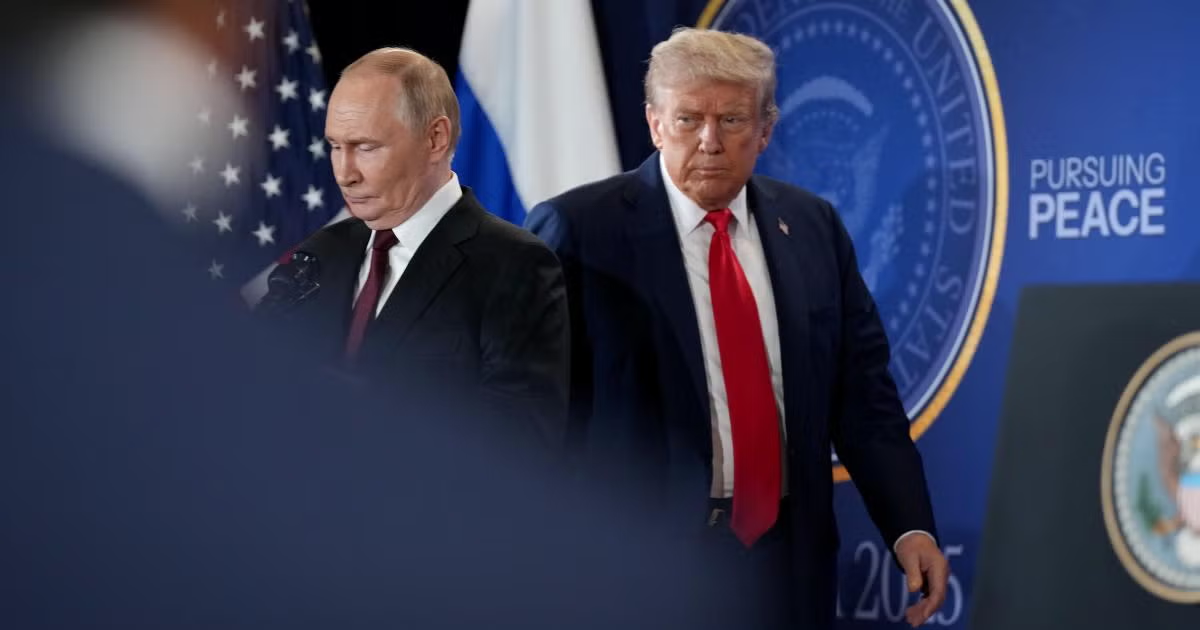
President Putin’s offer in September 2025 to maintain the “ceilings” set by the Treaty for another year was trumpeted by Moscow commentators as an event of “global significance”, but in fact, it was a disingenuous attempt to engage the Trump administration in a conversation on matters more important than the deadlocked peace process in Ukraine. President Trump is by no means an enthusiast of legally binding obligations, and the New START, introduced by President Obama and prolonged by President Biden, had no chance to gain his positive attention, so he shrugged off Putin’s initiative, to the dismay of Moscow experts. The disappearance of limitations may result in some increase in deployed strategic capabilities, as both parties can upload additional nuclear warheads on their intercontinental missiles, but the shortcomings of the old Treaty are too profound to take its expiration for a major deterioration of global security.
For once, the newly expired document has never created any obstacle for Russia’s extensive and hugely expensive program of modernisation of its strategic arsenal. The key element of this program is the construction of the new Borei class of nuclear submarines (SSBNs), and last July, President Putin attended the flag-raising ceremony at the Severodvinsk shipyard on Knyaz Pozharsky, the eighth submarine of this class. Deployment of a new generation of land-based intercontinental missiles (ICBMs) is progressing not that smoothly, and the unexplained explosion at the Yasny/Dombarovsky base (Orenburg region) on 28 November 2025 marked another failed test of the Sarmat heavy ICBM, which Putin announced as ready for service in March 2018. A compensation for this fiasco was the back-to-back tests of two unique weapon systems – the nuclear-propelled Burevestnik cruise missile and the nuclear-propelled Poseidon underwater vehicle – also advertised by Putin back in 2018. While definitely strategic in nature, these experimental arms are not covered by the New START, and President Trump responded asymmetrically – by ordering a resumption of nuclear testing. Russian experts were astounded by the depth of his apparent ignorance in matters of arms control, but no breach of the Comprehensive Test Ban Treaty has been registered in the ensuing months.
Another obvious deficiency of the New START Treaty is the exclusive definition of strategic capabilities, which leaves outside its framework many crucially important and nuclear-capable weapon systems. For that matter, in the Russian Long-Range Aviation, only the Tu-95MS and Tu-160 bombers are counted, while the Tu-22M3 bombers are not, and all these air platforms are heavily engaged in performing combat missions against Ukrainian cities. The new intermediate-range ballistic missile Oreshnik, used for the second time on 8 January 2026, isn’t included in the treaty limits, but it constitutes a grave security concern for Europe. The issue with delivery systems is aggravated by the problem of Russian non-strategic nuclear warheads, estimated in the wide range of 1,000-2,000, with no reliable data. When President Trump asserts that the US nuclear arsenal is larger than that of Russia, he most probably doesn’t include these warheads. The European states cannot afford such miscount, so both France and the UK are investing in upgrades of their nuclear capabilities, and even in Northern Europe, opinions are ventured on the need for regional nuclear deterrence.
Yet another flaw in the old Treaty, and clearly the most important one from the US perspective, is the non-inclusion of China, which builds up its nuclear arsenal but resolutely refuses to accept any limitations on it. The estimates of the expansion of the Chinese capabilities give the approximate figure of 600 nuclear warheads, slightly more than France and the UK combined and far below Russia and the US, but for the Trump administration, the task of setting a limit to this growth is pivotal. Moscow is aware of Chinese ambitions, but is not overly concerned about this matter, assuming that for at least a decade, the bilateral Russia-US format of talks on strategic stability would serve its interests better and ensure its special status as the nuclear super-power. While the degradation of most elements of state power compels Russia to increase the reliance on nuclear instruments for political purposes, China prefers to rely on its economic and technological might and to downplay the nuclear matters. This divergence diminishes the opportunities for establishing a trilateral or a five-parties format for nuclear arms control in the near perspective.
The sum total of shortcomings has not only made the New START Treaty irrelevant but also turned it into a false promise. It has not prevented Putin from resorting to nuclear blackmail against the Western coalition supporting Ukraine or brandishing new nuclear-capable weapon systems. It has not curtailed Trump’s desire for building the “Golden Dome” missile defense system, which even on the early design stage is seriously detrimental for strategic stability. The erosion of global nuclear non-proliferation regime is caused primarily by the erratic US behavior on various geopolitical arenas, and the dismantlement of outdated arms control formats makes little difference. Various initiatives on nuclear-free zones and campaigns for abolishing nuclear weapons are clearly in disarray, but the expiration of the old Treaty could hardly add to this collective dismay. The risks of nuclear conflict are growing, and traditional “bean-counting” approaches are unhelpful for mobilizing new energy focused on preventing this disaster.