Abstract
This article examines how Israeli Prime Misinster Benjamin Netanyahu discursively has used the language of security to frame the Gaza War in his 2024 and 2025 U.N. General Assembly Addresses; also examining how the international community responded to these frames of security. The article aims to understand the role that political language plays in shaping the international community’s response to a humanitarian disaster that has endured for years. The article examines the UN General Assembly speeches (as moments of global communication) to see how a humanitarian disaster was framed as an existential threat to national security.
The analysis draws on the Copenhagen School’s theory of securitization, which conceptualizes security as a performative speech act through which political actors justify extraordinary measures. Instead of viewing Securitization as a single instance of linguistics, the study applies Critical Discourse Analysis to Holger Stritzel’s Three-Layered Framework (textual, discursive-contextual, and Positional Power) for analyzing Netanyahu’s rhetoric as a socially constructed process.
At the textual level, the Study identifies the use of moral absolutism, dehumanizing metaphors, and temporal compression, which are especially evident in the framing of 7 October 2023 as the sole starting date of the conflict. The Use of these strategies constructs Hamas, and therefore Gaza, as a civilizational adversary and positions Israel as a reactive victim.
At the discursive-contextual Level, the study demonstrates how Netanyahu is engaging in macro-securitization by placing the Gaza War into Broader Narratives of a Global “War on Terror” and an Iranian-led “Axis of Terror”, while at the same time Securitizing Criticism of Israel through Holocaust analogies and accusations of Anti-Semitism.
In addition, the positional power analysis clearly shows, although Netanyahu’s domestic political authority is powerful; the international movement to securitize, as well as to secure an international acceptance of this security frame, has been a complete failure. International reactions to the speech included large-scale diplomatic walkouts, General Assembly resolutions calling for a ceasefire, and the UN’s institutionalized frames of reference prioritizing humanitarian considerations over those framed in terms of security. This article suggests that while Netanyahu’s speech performances exemplify a securitizing performance, they have not succeeded in gaining international acceptance, thereby demonstrating the limitations of securitization in contested global arenas.
Introduction
More than two years have passed since the Hamas attack of 7 October 2023 on Israel. Since then, Gaza has been in a state of humanitarian catastrophe. Many international organisations, from Amnesty International to the United Nations itself and its various bodies, have repeatedly warned that the scale of destruction and civilian suffering in Gaza amounts to genocide. Yet despite these grave assessments, nothing has changed on the ground, and the situation in Gaza remains catastrophic.
This grim continuity raises a crucial question that goes beyond the battlefield: How did the world allow this humanitarian crisis to become so prolonged and devastating? The answer lies not only in military actions but also in the global political narratives that shape international responses. At the centre of these narratives is Israel’s Prime Minister, Benjamin Netanyahu. As one of the most visible figures framing the conflict for global audiences, his speeches, specifically those delivered at the UN General Assembly, serve as key moments where he attempts to persuade, justify, and securitise the Gaza conflict before the international community.
This paper turns its attention to Netanyahu’s UN General Assembly addresses in 2024 and 2025. By analysing how he constructs threats, assigns blame, and defines Israel’s role, we can better understand how political discourse shapes international inaction or action in moments of profound crisis. To do so, the discussion draws on the Copenhagen School’s securitisation framework, which examines how leaders use language to transform political issues into existential threats requiring extraordinary measures. Through this lens, we can begin to understand how the Gaza conflict has been framed, legitimised, and defended on the world stage as well as how such framing contributes to the ongoing humanitarian tragedy.
In addition to the content of both speeches, the humanitarian and political environments in which they took place provide a critical framework through which to analyze the two speeches. The periods immediately prior to the 2024 and 2025 UN General Assembly (UNGA) sessions featured rising conflict in Gaza, increasing instability in the region, and growing exasperation on the part of the international community with regard to the Security Council’s failure to take action. Thus, these factors also influenced the level of urgency associated with the debates at the global level as well as the environment in which Netanyahu attempted to legitimize Israel’s actions. Therefore, placing each speech in its specific historical context will help to provide insight into the ways in which threats are framed; legitimacy is created, and securitization strategies can be used to target various audiences.
Securitization as a Framework for Understanding Security
The Copenhagen School (by Barry Buzan and Ole Waever) reconceptualizes security via the notion of securitization. There is no objective condition called ‘security’, but a speech act which tells or discursively constructs specific issues to be existentially threatening enough to warrant the use of special accommodation of extraordinary measures. More specifically, a single act of speaking is understood as a securitizing move, that is, the speech act of danger turns an issue into one of survival (Waever 1995, p. 55; Buzan et al. 1998, p. 23-25). In this perspective, securitization is not an objective condition but a performative practice in which the articulation of danger transforms an issue into a matter of survival. A securitizing move thus involves three constitutive components: the securitizing actor (who performs the speech act), the referent object (that is portrayed as threatened), and the audience (whose acceptance determines whether securitization is successful) (Buzan et al., 1998, p. 32).
Buzan and Wæver argue that securitization most effectively occurs at the middle level of world politics, where collective political units, often states, construct relationships of amity or enmity with one another (Buzan & Wæver, 2009, p. 253). They present the ideas of security constellations and macrosecuritizations – individual or regional securitizations find a home in other, overarching narratives (Buzan & Wæver, 2009, pp. 257-259). These macroseciruitizations align multiple ‘local’ securitisations under a common ideological or civilisational logic. The speech of a political leader such as Netanyahu can thus be read as ‘macro’, as part of a wider security constellation and globalising Israel’s national security discourse to a wider Global Security narrative.
In order to understand how Netanyahu reacts to the Gaza catastrophe via his speeches, I employ Critical Discourse Analysis (CDA) to investigate how Netanyahu’s 2024 and 2025 UN General Assembly addresses discursively construct Gaza as an existential threat to Israel and the broader international community. CDA allows for identifying how language and power operate to normalize specific worldviews and legitimize political action (Fairclough 1992, p.67; Wodak & Meyer 2001, p.5).
Following Holger Stritzel’s (2007) reformulation of the Copenhagen School, I treat securitization as a socially embedded process rather than a singular linguistic event. Stritzel differentiates between internalist analyses that focus on the performative moment of speech and externalist approaches that locate the meaning ascribed to speech acts in discursive and institutional settings (Stritzel, 2007, pp. 363-365). He proposes, therefore a threefold analytical layer:
- Textual layer: Analysis of language and rhetoric as well as the textual strategies used by actors to construct threats, including metaphors, enemy images and temporal urgency (Stritzel, 2007, p. 372);
- Discursive/Contextual layer: The larger narratives, ideologies, and historical contexts that provide the interpretive lens for understanding what is meant by a particular threat (Stritzel, 2007, pp. 374-376);
- Positional Power layer: Examination of the relative authority of the actor and their position in the global order, and the reactions of the audience (Stritzel, 2007, pp. 377-379).
These dimensions provide a basis for understanding and interpreting Netanyahu’s speeches via the lenses of language, political and social context, and international audience reaction. The study will first locate the explicit securitizing statement(s) in Netanyahu’s speech(es) and describe their linguistic forms; second, it will establish the broader contexts of both the discourse (beyond the words alone), and geopolitical factors that surround these statements; third, it will analyze how the international audience responds to and engages Netanyahu’s framing. Ultimately, the embedded securitization framework will serve as the analytical lens used to critically examine Netanyahu’s speeches at the UN.
Analysis of Netanyahu’s speeches
Although this article will not attempt to validate the veracity of Netanyahu’s statements, it should be noted that many of Netanyahu’s statements, for example the alleged beheadings of babies, have been publically refuted. International media and organizations have questioned the legitimacy of these statements and described them as components of a highly emotive and moralistic narrative intended to legitimize the use of force by Israel (Al Jazeera, 2024; Anadolu Agency, 2024; TRT World, 2024). The purpose of these examples is to illustrate how emotionally compelling, morally absolute and simplistic imagery serves Netanyahu’s overarching move to securitize Hamas and, in turn, Gaza as an expression of uncivilized, evil and an existential danger to “civilization.”
The textual level: Constructing the Enemy and Moral Absolutism
Before Prime Minister Netanyahu addressed the UNGA on September 27th, 2024, UN agencies were documenting that the humanitarian situation in the Gaza Strip and the West Bank was worsening. The displacement of Palestinians in Gaza continued. They experienced (and still experience) extreme shortages of food, fuel, and clean water. Already stressed by an underperforming humanitarian system (UNRWA, 2024), the humanitarian disaster in Gaza had reached an even higher level. The OHCHR stated a serious concern regarding compliance with International Humanitarian Law because of the extensive use of explosives by Israel in densely populated areas (OHCHR, 2024). OCHA reported that there were significant restrictions on humanitarian access and severe shortages of medical supplies (OCHA, 2024). In addition, the volatile regional situation had further escalated, both outside of the Gaza conflict, such as the detonation of thousands of pagers throughout Lebanon on September 17, 2024. Reports at first indicated that at least nine people died and approximately 2,750 other people were injured as a result of the explosion; however, it remained unclear if all those who were killed or injured were with Hezbollah (Al Jazeera, September 17, 2024). As a result of increasing tensions and escalation, there had been increased scrutiny on the Security Council’s failure to act, particularly in the UN framework. For example, the Secretary-General publicly criticized the Security Council for its inability to halt the Gaza war (Al Jazeera, September 13, 2024); additionally, the DPPA emphasized the need for dramatically expanded humanitarian access into Gaza during its September briefing (UN, 2024).
In comparison to his prior speech, Netanyahu’s September 26, 2025 speech at the 80th session of the UN General Assembly occurred within an atmosphere of even more escalation than before. Less than one week prior to Netanyahu’s address, the U.S. vetoed yet another Security Council resolution for a ceasefire and unimpeded access to humanitarian aid (Reuters, 18 September 2025). During the same month, the United Nations Commission of Inquiry published its report concluding that Israel was committing genocide in the Gaza Strip. It urged all states to act to prevent and punish such acts (OHCHR, 2025). The violence increased throughout the area as well, which included the Israeli military’s attacks against Hamas leadership in Qatar (Al Jazeera, 9 September 2025); the ongoing bombing of Gaza which killed civilians (Al Jazeera, 25 September 2025); and the earlier conflict between Israel and Iran (the 12-day war) (Al Jazeera, 26 June 2025). There were also reports indicating rising levels of internal instability within Israel regarding the continuation of the conflict (Al Jazeera, 31 May 2025). Additionally, states increasingly expressed their frustration with repeated vetoes by stating publicly their disapproval of the Council’s inability to act due to those vetos. This is illustrated by China’s public criticism of the Council’s paralysis (China Mission to the UN, 2025) and high-level briefings of the worsening situation (Security Council Report, 2025).
In this context, Prime Minister Netanyahu employed a distinctively moralistic and polarized vocabulary that is common in securitizing discourse when speaking at the UN General Assembly in 2024 and again in 2025. In each instance, Netanyahu has constructed Hamas and by extension Gaza as a non-human entity, as well as a civilizational adversary. For example, in his 2024 address, Netanyahu described Israel’s enemies as “savage monsters,” who “butchered innocent men, women and children” and pledged that Israel would “continue until total victory.” This type of language serves as a clear example of what Stritzel (2007, pp. 371-374) refers to as the textual aspect of securitization through metaphors, enemy images, and appeals for urgent action that transforms a political issue into an issue of survival.
Netanyahu uses rhetorical techniques to continually frame the conflict as a simple binary moral opposition. He instructed the Assembly to “choose between the forces of civilization and the forces of barbarism” (UNGA 2024), which is an overt appeal to the concept of good vs. evil. The net effect of such rhetoric is to narrow the options available to respond to the conflict to those consistent with “self-defensive actions as part of a civilized community,” which is similar to the definition of a successful speech act developed by Buzan et al. (1998, p. 32). Netanyahu’s dramatic presentation is also reliant upon vivid and visceral imagery, “babies beheaded”, “families burned alive”, and “women raped before being executed”. While many of Netanyahu’s claims have been disputed by international media outlets (Al Jazeera, 2024; TRT World, 2024; Anadolu Agency, 2024), it is the way in which Netanyahu’s claims enhance emotional resonance and contribute to an existential moral panic that is analytically significant in this context.
Another important textual technique used by Netanyahu is time compression, which positions 7 October 2023 as the single moment from which the conflict began (“everything changed on that day”), thus eliminating previous cycles of violence, and framing Israel solely as a reactive victim. This is a recontextualization of history in the terms of Fairclough (1992, p. 67), where the complexities of historical events are collapsed into a single rupture that provides justification for emergency action. The 2025 speech repeated this same narrative with increased determination: “We are winning. We will not let the world force us to accept a terror state” (The Times of Israel, 2025). Repeating the victory and endurance tropes reinforces Israel’s representation of itself as both under siege and justifying a dual identity that is critical to the success of securitizing rhetoric.
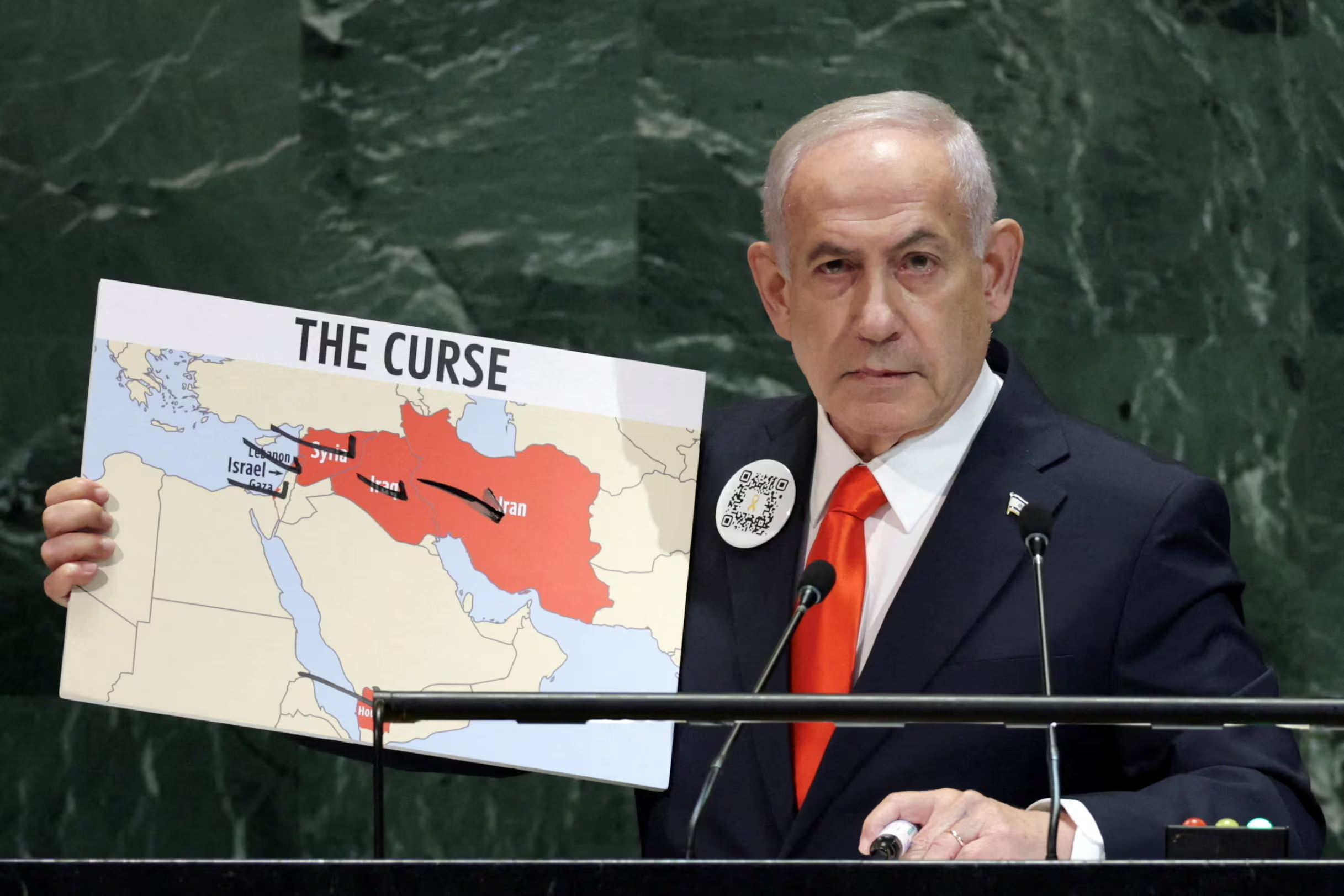
In his speeches, Netanyahu explicitly defines who he wants to securitize. He names Hamas as his primary existential threat; in both speeches he consistently calls Hamas “ISIS,” and says Hamas has a “genocidal” goal – which he states directly when he declares “Hamas is ISIS,” and claims the Oct. 7 attacks are part of the same global extremist violence that threaten Western civilization. Beyond Hamas, Netanyahu extends the threat to include Iran, describing it as the strategic mastermind behind the region’s instability; in 2024 he labels Iran the leader of an “Axis of Terror”; in 2025 he strengthens this label and warns about Iran’s “expanding empire of aggression”, thereby elevating the Gaza war to be a civilizational conflict engineered by Tehran. The threat formulation for Hezbollah follows the same pattern; Netanyahu constantly portrays Hezbollah as an Iranian surrogate within this larger network threatening Israel. As such, Netanyahu creates a unified threat cluster of Hamas, Iran, and Hezbollah, claiming they all work together to destroy Israel. Therefore, at the international level, Netanyahu portrays Israel as facing not just a non-state actor in Gaza, but a transnational, ideologically-based coalition.
Discursive and Contextual Level: Civilizational Narratives, Antisemitism, and Macrosecuritization
The discursively constructed space by Netanyahu’s speeches is greater than Gaza and extends to the securitization of Israel as part of a macro-securitization (Buzan & Wæver, 2009, pp. 257-259) as a global battle for “civilization” against terrorism. The epicenter of this larger arc is Iran; “Iran’s malignant axis of terror and chaos reaches across the Middle East” (UNGA 2025). By situating Hamas as part of an Iranian “arc of evil,” Netanyahu incorporates Gaza into a historical “war on terror” context (as seen throughout history) to receive legitimacy from the Western security community by virtue of that shared experience.
Netanyahu also attempts to reinforce this alignment using analogies of America’s own trauma: “What would the United States do if thousands of rockets fell on New York or Los Angeles?” (UNGA 2024). Analogical reasoning creates a moral equivalence of U.S. counter-terrorism efforts post-9/11 to the actions of Israel. Additional examples include parallel biblical allusions (“Moses,” “King Solomon,” “the blessings and curses”) and the reference to “the moral arc of history” to create a universalized Israeli cause that expands the referent object from being the State of Israel to the entire civilized world.
One of the most powerful dimensions of this discourse is Netanyahu’s use of antisemitism accusations and Holocaust analogies. He frames international criticism of Israel as continuing the historic antisemitism, stating “the same evil that burned our people in the ovens of Auschwitz now seeks to destroy us again” (UNGA 2024) and denounces the United Nations as a “bile of antisemites” (UNGA 2025). By utilizing Nazi imagery and the collective trauma of the Holocaust, Netanyahu displaces opposition to Israel today onto a moral continuum of persecution; he thus securitizes criticism of Israel itself. Although emotionally powerful, this move limits dissent because it positions humanitarian appeals to the plight of Palestinians as morally equivalent to supporting antisemitic forces.
However, these macro- and civilizational securitizations occur in a contested environment at the discursively constructed level. By 2025, 150 countries have formally recognized the State of Palestine (Al Jazeera, 2025); leaders such as Indonesia’s President Prabowo and Jordan’s King Abdullah II utilized their UNGA addresses to emphasize humanitarian catastrophes and a two-state solution (Indonesia UNGA Speech, 2025; Europe Pulse, 2025). Even Germany, Israel’s closest ally in Europe, urged it to “do more to allow humanitarian aid and protect civilians” (German Federal Foreign Office, 2025). Stritzel describes this as the contextual dimension of securitization (Stritzel, 2007, p. 376), where meaning and legitimacy are created through the interaction of various discourses as opposed to one-way imposition.
Positional and Power Level: Institutional Authority and Audience Reception
Ultimately, with regards to positionality, Netanyahu’s securitizing power comes from the structural dominance he has within Israel’s decision-making apparatus. In addition to being the Prime Minister, he is also chairman of the Security Cabinet and therefore has significant influence on the development of Israel’s defense and foreign policies. According to Freilich (2022, p. 74), Israeli prime ministers have considerable authority in presenting major security issues “as a fait accompli” which reinforces how institutional arrangements give the executive branch significant amounts of authority.
Thus, this creates conditions under which Netanyahu can easily convert his securitizing rhetoric into real policy options. However, securitization is only effective if the audience accepts the framing or characterization of an issue as a security problem (Buzan et al., 1998, p. 32). The UNGA reaction to Netanyahu’s speech clearly indicates that the global public is not accepting his securitizing frame. In fact, the United Nations institutional framework in 2024 and 2025 largely pushed back against it. The theme of Gaza appeared frequently throughout the General Assembly plenary sessions. Many speakers, such as the President of Indonesia and Jordan’s King Abdullah II, devoted considerable time to condemn the humanitarian crisis and call for an immediate ceasefire (Euronews, 2024; Middle East Eye, 2024). Additionally, Palestinian President Mahmoud Abbas called on the UN to “stop the war” (Reuters, 26 September 2024), which suggests that the majority of States are framing Gaza as a humanitarian disaster rather than an Israeli security threat.
The UN Security Council’s actions following Netanyahu’s speeches clearly showed how little international support there was for Netanyahu’s efforts to frame the Israeli-Palestinian conflict as a security issue. Rather than continuing to build upon Netanyahu’s threat-framing, the Security Council sessions after his speeches consistently prioritized calls for a ceasefire, and access to humanitarian aid. This was very evident at the end of 2025, when the United States used its veto to block a draft resolution that would have called for an immediate ceasefire and free access to humanitarian aid, a position that was opposed by the vast majority of Security Council members (Reuters, Sept. 18, 2025). Similarly, during each of these two years, the Security Council debates were primarily concerned with the humanitarian conditions in Gaza and finding ways to deliver aid, not supporting Israel’s counter-terrorism narrative. Therefore, these developments after Netanyahu’s speech show that the main concern of the Security Council’s institutional culture was to protect civilians and reduce the violence, not to validate Netanyahu’s framing of the conflict as a threat from the podium at the General Assembly.
In addition, audience reaction in the General Assembly hall also demonstrates the split between both sides. When Netanyahu spoke at the UN, several delegations walked out, and others appeared visibly uninterested or disapproving (Al Jazeera, 26 September 2025). Additionally, when the U.S. vetoed Security Council resolutions repeatedly in order to prevent a resolution from being adopted by the Security Council; the General Assembly reassembled its Emergency Special Session in December 2024, and adopted a resolution calling for an immediate cease fire, with almost all other UN member state voting in favor of it. As such, it was evident to everyone in attendance that most members of the United Nations reject Israel’s securitization of the issue and preferred humanitarianism and de-escalation.
Netanyahu’s framing was supported by a relatively small number of states. Primarily the United States and other countries that were close to Israel, which continued to block or vote against all ceasefire proposals and provided diplomatic cover for Israel. Additionally, the 2025 report from the UN Commission of Inquiry on the Occupied Palestinian Territory, including East Jerusalem and Israel (the “Occupied Palestinian Territory”) which concluding that Israel had engaged in genocide in Gaza (OHCHR, 2025), reinforced the international consensus against Israel’s justification for their actions.
Conclusion
As shown by above illustrations, Netanyahu’s language follows the standard format for securitizing language; he creates an enemy by dehumanizing them, he uses dualistic morality (good vs evil), and he invokes past traumas (historical memory). The continued reference to “antisemitism” and “the Nazis,” strengthens the moral justification for Israel’s actions while framing criticisms as hostile to the very existence of the State of Israel. Through the embedding of the Gaza war into a larger story of civilization and an anti-Iranian story, Netanyahu positions Israel’s struggle as part of the Western security discourse. However, walkouts by audiences, humanitarian counter-narrative responses, and international recognition of the Palestinian people show that there has been limited success in gaining acceptance internationally. Rather than endorsing Netanyahu’s framing of Gaza as an existential security threat, the dominant response among UN member states and institutions has consistently re-articulated the conflict as a humanitarian catastrophe requiring de-escalation and civilian protection. Consequently, although Netanyahu’s speeches constitute highly developed securitizing performances, they ultimately amount to a case of international discourse failure, as the relevant global audience has refused to grant legitimacy to his security claims.
This outcome raises important questions for future research. While Netanyahu’s international securitization has largely failed, the material reality on the ground in Gaza remains largely unchanged, with violence and civilian suffering continuing despite widespread rhetorical rejection. Future studies could therefore examine the disconnect between failed securitization at the international level and the persistence of political inaction, focusing on the role of structural power asymmetries, veto politics, and enforcement gaps within the international system. Such research could help explain why humanitarian framing, even when widely accepted, often fails to translate into effective political constraint or protection for civilian populations.
Bibliography
Al Jazeera. (2024, September 13). UN head slams Security Council for failure to end Gaza, Sudan, Ukraine wars. https://www.aljazeera.com/news/2024/9/13/un-head-slams-security-council-for-failure-to-end-gaza-sudan-ukraine-wars
Al Jazeera. (2024, September 17). Dozens injured after pagers explode in Lebanon. https://www.aljazeera.com/news/2024/9/17/dozens-of-hezbollah-members-wounded-after-pagers-explode-in-lebanon
Al Jazeera. (2025, May 31). Divided Israel faces internal unrest as Gaza conflict escalates. https://www.aljazeera.com/news/2025/5/31/divided-israel-faces-internal-unrest-escalating-gaza-conflict
Al Jazeera. (2025, June 26). Visualising 12 days of the Israel–Iran conflict. https://www.aljazeera.com/news/2025/6/26/visualising-12-days-of-the-israel-iran-conflict
Al Jazeera. (2025, September 9). Israel attacks Hamas leadership in Qatar: All you need to know. https://www.aljazeera.com/news/2025/9/9/israel-attacks-hamas-leadership-in-qatar-all-to-know
Al Jazeera. (2025, September 25). Live: Israel bombs family home in Gaza with children among 11 killed. https://www.aljazeera.com/news/2025/9/25/live-israel-bombs-family-home-in-gaza-with-children-among-11-killed
Al Jazeera. (2025, September 26). UN General Assembly 2025 live — audience reactions.
Buzan, B., Wæver, O., & de Wilde, J. (1998). Security: A new framework for analysis. Lynne Rienner.
China Mission to the United Nations. (2025). Statement expressing deep disappointment regarding repeated vetoes. https://un.china-mission.gov.cn/eng/hyyfy/202510/t20251002_11722773.htm
Euronews. (2024, September 25). World leaders demand ceasefire in Gaza at United Nations General Assembly. https://www.euronews.com/2024/09/25/world-leaders-demand-ceasefire-in-gaza-at-united-nations-general-assembly
Freilich, C. (2022). Israel’s security strategy: At a crossroads? Oxford University Press.
Middle East Eye. (2024). UNGA 2024: War in Gaza dominates world leaders’ speeches on day one. https://www.middleeasteye.net/news/un-general-assembly-2024-war-gaza-dominates-world-leaders-speeches-day-one
OCHA. (2024). Humanitarian situation update 211 — Gaza Strip. https://www.ochaopt.org/content/humanitarian-situation-update-211-gaza-strip
OHCHR. (2024). Israeli use of heavy bombs in Gaza raises serious concerns under laws of war. https://www.ohchr.org/en/press-releases/2024/06/un-report-israeli-use-heavy-bombs-gaza-raises-serious-concerns-under-laws
OHCHR. (2025). Israel has committed genocide in the Gaza Strip, UN Commission finds. https://www.ohchr.org/en/press-releases/2025/09/israel-has-committed-genocide-gaza-strip-un-commission-finds
Reuters. (2024, September 26). Palestinian President Abbas urges UN to stop the war in Gaza. https://www.reuters.com/world/middle-east/palestinian-president-abbas-urges-un-stop-war-gaza-2024-09-26
Reuters. (2025, September 18). US vetoes UN demand for ceasefire and aid access in Gaza. https://www.reuters.com/world/middle-east/us-vetoes-un-demand-ceasefire-aid-access-gaza-2025-09-1
Security Council Report. (2025). The Middle East, including the Palestinian question — High-level briefing. https://www.securitycouncilreport.org/whatsinblue/2025/09/the-middle-east-including-the-palestinian-question-high-level-briefing.php
Stritzel, H. (2007). Towards a theory of securitization: Copenhagen and beyond. European Journal of International Relations, 13(3), 357–383.
UK Government. (2024). Israel and Hamas must agree a deal urgently: UK statement at the UN Security Council. https://www.gov.uk/government/speeches/israel-and-hamas-must-agree-a-deal-urgently-uk-statement-at-the-un-security-council
UNRWA. (2024). Situation Report 121: Gaza Strip and West Bank, including East Jerusalem. https://www.unrwa.org/resources/reports/unrwa-situation-report-121-situation-gaza-strip-and-west-bank-including-east-Jerusalem
United Nations. (2024). Security Council briefing by DPPA: The Middle East, including the Palestinian Question. https://www.un.org/unispal/document/sc-briefing-dppa-04sep24
United Nations General Assembly. (2024). 10th Emergency Special Session — Ceasefire resolution (December 2024).
United Nations Security Council. (2025). Draft resolution demanding ceasefire and humanitarian access (vetoed by the United States).