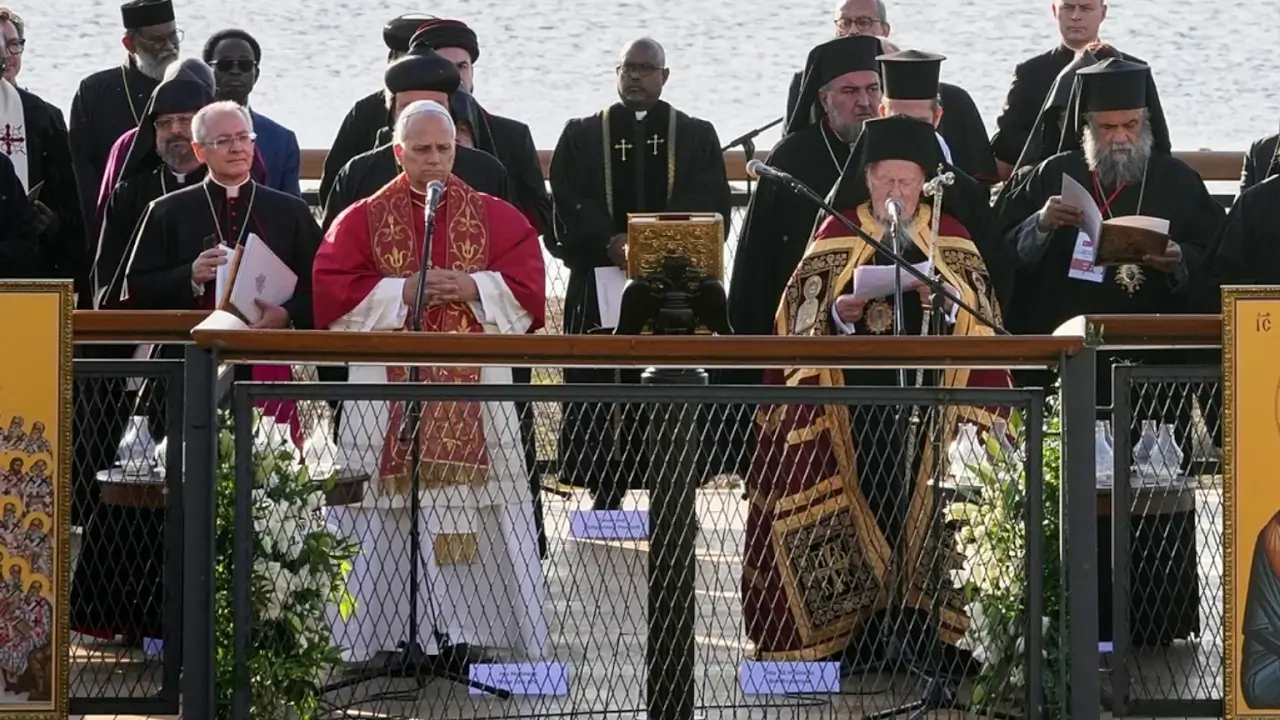
The Pope’s visit to Türkiye—and his quiet but unmistakable call for a new council in Nicaea—has reopened a long-dormant conversation about Turkey’s civilisational inheritance. This is not simply a matter of ecclesiastical protocol. It goes to the heart of how Türkiye perceives its identity, its sovereignty and its place in the global order.
Few countries stand at the intersection of Islam and Christianity with the depth, breadth and historical gravitas that Türkiye possesses. Antioch, where the earliest followers of Jesus gathered. Nicaea, where Christian doctrine took shape. Ephesus, home to the House of the Virgin Mary. Cappadocia’s cave churches. The Byzantine metropolises of Istanbul, Trabzon and Mardin. This is not a catalogue of archaeological sites; it is a map of religious civilisation on which Türkiye sits as custodian. The Pope’s arrival merely reminded the world—and perhaps Türkiye itself—of this unique position.
The Fener Question: A Reality to Shape, Not Resist
For decades, most of the Orthodox world—Russians, Ukrainians, Greeks, Bulgarians, Georgians, Armenians—has recognised the Ecumenical Patriarch in Istanbul as their symbolic spiritual leader. Ankara’s official stance has not altered that reality; it has simply placed Türkiye outside a conversation that it could, and should, shape. The question is no longer whether the Patriarch is seen as ecumenical. He already is. The real issue is whether Türkiye will continue to deny a de facto reality, or instead design a framework—rooted in its own sovereignty—that defines the Patriarchate’s scope, symbolism and limits. Great states do not manage historic institutions by diminishing them. They manage them by setting the terms.
Keeping the Patriarchate under the administrative authority of a district governorate in Fatih (İstanbul) may have served a bureaucratic purpose decades ago, but it sits uncomfortably with Türkiye’s historical weight and strategic interests today. It neither protects the state nor projects authority. If anything, it reduces Türkiye to a posture of perpetual defensiveness. A more mature, confident approach is both possible and overdue.
Owning a Heritage That No Other Country Possesses
Türkiye’s Christian heritage does not weaken its Muslim identity. On the contrary, it enhances Türkiye’s standing as a civilisational state—one whose legitimacy is grounded not only in modern sovereignty but in the accumulated weight of centuries. The Ottoman Empire’s governance of multi-faith communities remains one of history’s most sophisticated political models. Jerusalem’s status quo regime—which still governs the city’s sacred sites—is an Ottoman legacy that continues to shape interfaith relations today. Small wonder that, during Byzantium’s last days, Orthodox clergy famously declared: “Better the Ottoman turban than the Latin crown.” Not out of romance, but because Ottoman rule offered predictability, dignity and relative fairness—qualities the region still struggles to secure. Türkiye need not revive Ottoman structures. But it can indeed reclaim the confidence that once underpinned them.
Demography, Property and the Future
A second dimension requires sober assessment: Rising foreign property purchases in Fener, Balat and Fatih, mirrored by Gulf capital and the citizenship-for-real-estate model. Unmanaged demographic shifts generate future claims—on language, education, worship, cultural space, even political representation. Europe is replete with such examples. Türkiye has every sovereign right to regulate these dynamics with care. This is not an exclusion. It is prudent statecraft.
Nicaea: A Point of Pressure or a Strategic Opportunity?
Nicaea is more than a site of Christian antiquity. It is the birthplace of doctrinal Christianity—an intellectual and spiritual anchor for a global community. If Türkiye chooses, hosting a symbolic council there (under clear, Turkish-defined conditions) could transform the narrative from one of external pressure to one of Türkiye projecting cultural authority. The Pope’s proposal is therefore not a challenge but a mirror: Does Türkiye see itself merely as a modern nation-state managing sensitivities, or as the keeper of a civilisational legacy unmatched by any of its neighbours?
Türkiye’s long-term interest lies in three calibrated steps: (1) treating the Patriarchate not as an existential threat but as an institution to be governed with clarity; (2) defining a symbolic ecumenical status circumscribed entirely by Turkish law; (3) regulating foreign property ownership and demographic change, including relocating the Patriarchate to a more suitable setting such as Heybeliada if necessary. These steps would not weaken the Turkish state. They would strengthen its sovereignty and stabilise the issue for decades.
Conclusion: Türkiye Must Move Not Under Pressure, But Under Its Own Will
The Pope’s visit, the Nicaea proposal and the ongoing Patriarchate debate represent a crossroads, not a crisis. Handled intelligently, they can become a diplomatic and cultural asset rather than a point of friction. Türkiye should act neither defensively nor reactively, but confidently—consistent with the weight of its history. A Türkiye that owns its Christian heritage, manages it with legal precision and turns it into strategic value will not need to compete with any Christian centre. It will stand above them— because it already possesses a civilisational legitimacy that no other country can replicate.