For much of the modern energy era, “proven oil reserves” have been presented as the hard, technical bedrock of petroleum economics: a figure grounded in geology, engineering, and commercial feasibility, seemingly insulated from politics. Yet within OPEC—where numbers translate into status, leverage, and narrative power—this category has gradually evolved from a neutral measurement into a strategic instrument. Venezuela’s post-2011 declaration that it possessed the world’s largest proven oil reserves is one of the most revealing episodes in this transformation, not simply because of the scale of the revision, but because of what the claim was designed to do politically.
This piece reads Venezuela’s reserve surge less as a story of technical discovery and more as a case study in reserve inflation: a practice that can reshape intra-OPEC power balances, signal national prestige, and support geopolitical messaging in moments of economic strain and international contestation. To place Venezuela’s experience in a wider comparative frame, the analysis draws parallels with earlier reserve-reporting dynamics in Iraq and Kuwait, where dramatic upward revisions similarly raised questions about how “proven” is defined, who benefits from the definition, and how reserve numbers travel as political capital. The final section then turns outward, interrogating a familiar assumption in public debate: whether U.S. interventions and pressure campaigns toward Venezuela are best understood as oil-centric, or whether oil is only one strand in a broader strategic rationale that includes regional order, credibility, and domestic political calculations.
Reserve Inflation: From Technical Definition to Political Instrument
In principle, “proven reserves” refer to volumes of oil that can be recovered with a high degree of certainty under prevailing technological and economic conditions. In practice—particularly within OPEC—this definition has become far more elastic, because the assumptions that make reserves “proven” are not purely technical and are often set domestically. Price and cost expectations, for instance, are frequently determined by national authorities rather than applied through a common, externally verified standard, meaning that what counts as economically recoverable can expand or contract with political and strategic convenience. Compounding this, there is no independent, mandatory international auditing regime that consistently verifies reserve declarations across producers, leaving substantial room for discretionary reporting and reputational signalling. Finally, reserve size—while not formally equivalent to production capacity—has long been entangled with perceptions of political weight inside OPEC, shaping bargaining power and, indirectly, the logic through which quota expectations and hierarchy are discussed. The combined effect is that reserve figures can operate less as a neutral description of geological reality and more as a strategic declaration: a number that communicates status, leverage, and intent as much as it measures recoverable oil.
Reserve inflation becomes attractive when reserve figures do more than describe what lies underground. They can shape expectations about quota entitlements, reinforce national prestige, and sustain the “energy superpower” narrative in front of domestic audiences. They can also serve as an investor-facing message: a promise of long-term scale designed to attract capital, even when current institutional conditions make that promise hard to deliver. Venezuela is distinctive because these motivations converged at once. As production capacity weakened and political risk rose, the incentive to use reserves as a compensatory narrative became stronger: the country’s energy identity could be preserved on paper even as its production reality deteriorated.
Venezuela: Numerical and Structural Analysis of the Reserve Increase
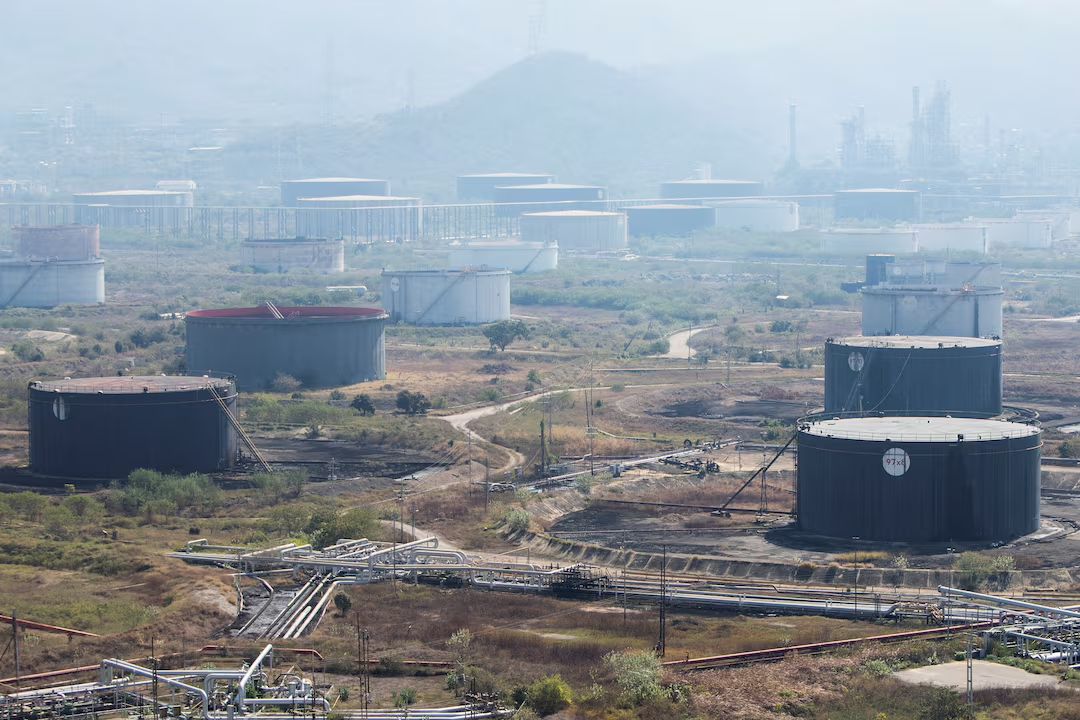
Venezuela’s reserve story is, in many ways, a tale of numbers moving faster than barrels. In the early 2000s, the country’s proved reserves were commonly reported in the “tens of billions” range, before a dramatic leap in the late 2000s and early 2010s. By 2010, Venezuela was claiming proved reserves of 211.17 billion barrels, a figure explicitly linked to additions “mainly from the Orinoco heavy oil belt.” By 2023, widely cited estimates place Venezuela’s proved crude reserves at roughly 303 billion barrels—again, with the caveat that the bulk of these reserves are concentrated in the Orinoco Belt and are predominantly extra-heavy crude.
What defines this surge is not a string of headline discoveries, but the reclassification of extra-heavy resources into the “proved” category. As several analyses note, Venezuela’s reported reserve expansion was driven largely by redefining Orinoco Belt heavy oil as proved, rather than by exploration-driven breakthroughs or a corresponding rise in production capacity. The technical characteristics of Orinoco crude help explain why this matters. Much of it sits at roughly single-digit API gravity (often cited around 9.5–12), meaning an extremely dense, viscous crude that is expensive to move, process, and refine relative to lighter benchmarks. Its production chain is also unusually dependent on diluents condensate or naphtha blends—to make the crude transportable and processable, and this has historically created vulnerabilities when Venezuela’s access to inputs and logistics is constrained.
The economic implication is straightforward: “proved” on paper does not automatically translate into “viable” in practice. Even where the resource base is unquestionably vast, the commercially recoverable portion is highly sensitive to price, sanctions, infrastructure, and investment conditions. Reuters’ Breakingviews commentary, for example, notes that OPEC’s reserve figure is self-reported and likely inflated; it highlights that Orinoco economics can require very high price thresholds (with Wood Mackenzie cited as putting average breakevens for new Orinoco production above $80 per barrel), and it points to Rystad Energy’s view that a more realistic recoverable figure under “ideal conditions” could be on the order of roughly 60 billion barrels. Read this way, the reserve surge looks less like a purely technical correction and more like a structural rebranding: a shift that turns a difficult-to-monetise resource into a headline claim, one that carries obvious domestic prestige and international signalling value, even as a large share of the “official” stock remains functionally stranded under prevailing constraints.
The Reserve–Production Paradox
Venezuela is the clearest reminder that “proven reserves” and “energy power” are not interchangeable. On paper, the country sits atop one of the world’s largest reserve bases; in practice, its production capacity has collapsed compared to historic peaks. The striking contrast between rising reserve claims and falling output is not a minor discrepancy—it is the core puzzle. Reserve numbers can be expanded through classification choices and political signalling, but production requires institutions, skilled labour, capital, stable governance, and functioning infrastructure. When those foundations erode, reserves become a promise that cannot be operationalised.
In Venezuela’s case, reserve inflation increasingly operated as a reputational substitute for weakened capacity: a way of sustaining the image of an “energy superpower” even as the ability to deliver barrels to the market deteriorated. This gap is what turns reserve data into a political instrument rather than a neutral geological statement.
Petróleos de Venezuela, S.A.(PDVSA) and the Institutional Break
The structural roots of Venezuela’s decline lie less in geology than in institutional rupture. The 2002–2003 confrontation around PDVSA marked a decisive turning point. The removal of experienced technical and managerial personnel, followed by politicisation and chronic underinvestment, produced a long-term loss of operational competence. Over time, the company’s internal incentives changed: technical excellence and long-horizon maintenance gave way to short-term political priorities, while the system’s ability to attract and retain expertise weakened. Once a national oil company loses its “knowledge spine”—engineers, planners, project managers, and maintenance systems—production typically falls faster than any political narrative can compensate. In that environment, publishing ever-higher reserve figures can become a way to redirect attention from present-day capacity constraints toward a future-oriented story of abundance and inevitability.
Iraq and Kuwait: OPEC’s Reserve Politics in Comparative Perspective
Venezuela is not an outlier in the political use of reserve data. Iraq is often described as the most overt illustration of reserve inflation in OPEC’s modern history: dramatic upward revisions that coincided with quota politics and bargaining over status, rather than with a clear sequence of new discoveries that would normally justify such a jump. The analytical significance of Iraq’s case is not simply the size of the increase, but the way it illuminates the incentive structure: if reserve numbers are perceived to translate into organisational weight, then “revising” reserves can become a strategic act.
Kuwait offers a different but equally revealing pattern: not necessarily a headline-grabbing surge, but a credibility shock once internal technical assessments became visible through leaks. The Kuwaiti case underscored how large the gap can be between official declarations and internal estimates, and how limited transparency can turn reserve figures into contested political artefacts. Together, Iraq and Kuwait show that reserve reporting within OPEC can function as an arena of signalling, reputation management, and bargaining—often with only partial external scrutiny.
U.S. Intervention: Oil-Centric or Something Larger?
Venezuela’s headline reserve figure makes oil a natural suspect in any discussion of U.S. pressure and intervention. If one accepts the official reserve claims, the country appears as a strategic prize. It is therefore tempting to reduce American policy to an “oil grab” storyline. Yet the oil-only explanation is too neat—precisely because it ignores the gap between reserves and deliverable barrels. Even if Washington has an interest in shaping Venezuelan oil flows and revenues, the short-term market impact of Venezuela is constrained by its limited production capacity and the scale of investment required for a meaningful recovery. Restoring output to historic levels would demand long-term political stability, massive capital commitments, and sustained institutional repair—conditions that cannot be willed into existence by a single intervention cycle. Oil matters, but it does not operate as an immediate, low-cost payoff.
A more convincing reading is that oil functions as a lever inside a broader strategy of geopolitical competition. Venezuela’s energy sector has long been entangled with external partnerships, debt arrangements, sanctions-evasion networks, and supply relationships that carry strategic implications beyond price and barrels. From Washington’s perspective, intervention can be understood as a contest over access, alignment, and influence—who can rely on Venezuelan crude, under what terms, and with what geopolitical consequences. In this framing, oil is not merely a commodity; it is an infrastructure of leverage. Sanctions policy, maritime interdiction, and financial restrictions become tools not simply to “capture oil,” but to constrain rival powers’ room for manoeuvre and to shape the strategic map of the Western Hemisphere.
The Venezuela case ultimately demonstrates two interlinked realities. First, reserve size does not automatically translate into energy power; production capacity, institutional competence, investment conditions, and infrastructure determine whether reserves can become influential. Second, in an environment where reserve figures carry political weight, reserve inflation becomes a form of strategic communication: a way of manufacturing salience, prestige, and bargaining leverage even when material capacity is eroding.
For analysts, the implication is straightforward. U.S. intervention narratives should not exclude oil considerations, but explaining intervention solely through oil interests is analytically insufficient. Oil operates as an instrument within a larger architecture of geopolitics, sanctions, and competitive influence. And reserve inflation—far from being an obscure accounting issue inside OPEC—can function as a perceptual weapon that fuels and amplifies global power competition.