I still remember my early days in the Ministry of Foreign Affairs, working in the NATO department. The alliance’s infrastructure planning regularly ground to a halt because of the endless tug-of-war between Türkiye and Greece. Years later—after a career spent analysing security dynamics across regions—I listen to Athens’ new defence doctrine and see far more than a technical military upgrade. I sense a psychology, a fear, and perhaps a dose of misguided confidence.
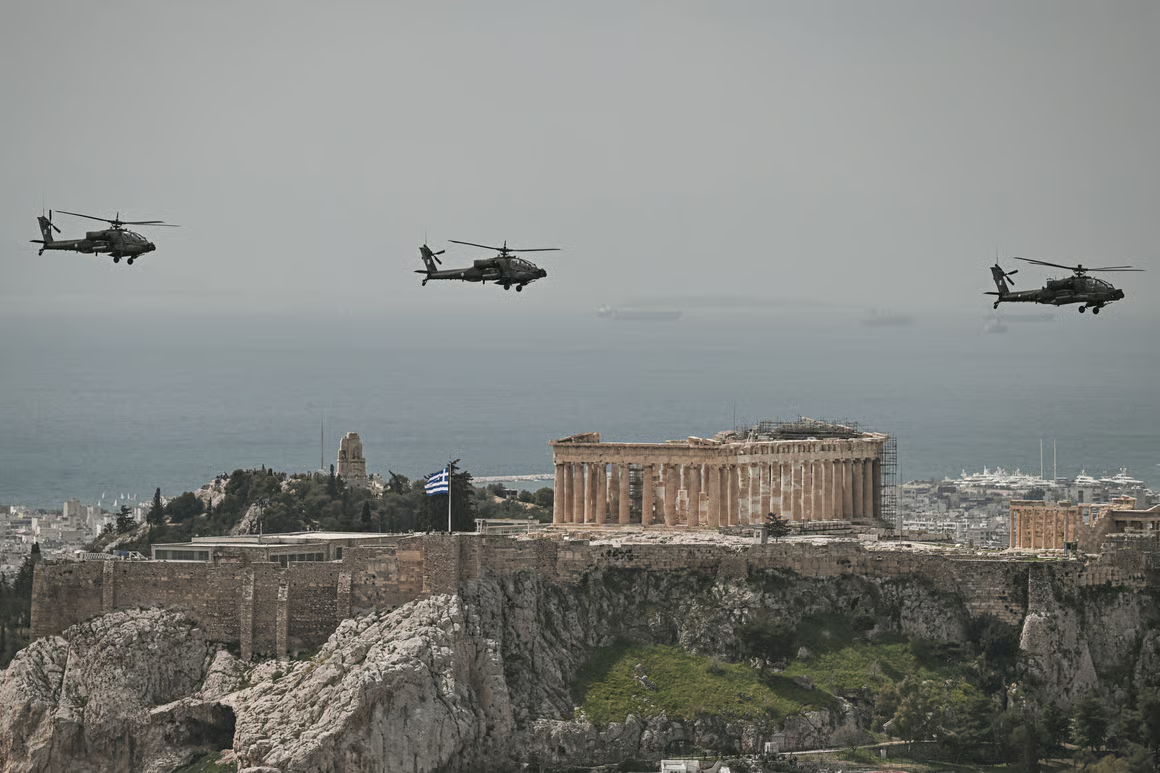
Greece’s defence minister has recently taken to describing Türkiye as the country’s “principal threat.” I heard him repeat the same message at the Anglo-Hellenic conference in Cambridge, where I also spoke. He outlined plans to fortify Aegean islands with heavy weapons, deploy new missile systems and essentially re-engineer Greece’s entire defence posture. As I listened, one thought kept returning to me: “I wish our neighbour would not place such a heavy burden on itself; this strategy risks boomeranging back and harming Greek interests more than it protects them.” No country tolerates the militarisation of islands lying just off its shores. This is not a uniquely Turkish reflex. The United States would never accept a militarised Cuba; the UK would not allow France to fortify the Channel Islands; Japan would resist similar moves around the Kurils; and China’s sensitivity in the South China Sea speaks for itself. Geography dictates power; proximity defines threat.
Understandable Motives, Faulty Methods
Greece’s desire to feel safer is legitimate. Historical trauma, the Cyprus conflict, periodic tensions in the Aegean, and economic fragility all shape Athens’ threat perception. But the pursuit of security requires the right strategy. Today’s path—expanding US basing rights, deepening defence pacts with France and Israel, militarising islands—does not enhance Greece’s security. It makes the region more brittle. Every new weapons system placed on the islands provokes a stronger Turkish security reflex. Every additional US facility revives Ankara’s strategic anxieties. Every military exercise structured around excluding Türkiye undermines the fragile but real diplomatic thaw between the two capitals. None of Greece’s partners, rhetoric aside, would enter a military confrontation with Türkiye on Athens’ behalf. This is neither a humiliation for Greece nor a triumph for Türkiye. It is merely how international politics works.
Status of the Islands is not a Slogan—It is Written Law.
There is often confusion in public debates, but the relevant treaties leave little room for ambiguity:
Under the 1923 Lausanne Treaty, Lesvos, Chios, Samos, and Ikaria were ceded to Greece on the condition of a limited military presence. The Paris Peace Treaties (1947) transferred the Dodecanese to Greece under a strict demilitarised status, and the Montreux Convention of 1936 altered the Straits regime but did not change the demilitarisation provisions for the islands. These clauses were inserted to preserve the delicate strategic balance of the time.
Today, Greece’s deployment of missile batteries, air-defence systems, and military installations on these islands raises not only military but also legal concerns. It has led some nationalist circles in Türkiye—who have long questioned the legitimacy of the islands’ transfer—to ask: “If the conditions of sovereignty are being violated, is the sovereignty itself still valid?” Nobody should wish to walk down that dangerous path. But Athens’ recent steps are giving hardliners on both sides the arguments they crave.
Two NATO Allies Calling Each Other a Threat Makes No Sense
NATO exists so that its members protect one another—not to designate one another as enemies. The notion that Türkiye, a candidate EU member for decades, would launch an attack on an EU state defies strategic logic. Yet Athens’ actions are expanding American basing rights, advocating the end of the US arms embargo on Southern Cyprus, joining exercises that deliberately exclude Türkiye, and codifying Türkiye as its “primary threat” in official doctrine. These are all weakening Greece’s security rather than strengthening it. They also strain NATO cohesion at a time when Russia’s war in Ukraine is already stretching the alliance’s bandwidth.
The Regional Reality: Understanding Türkiye’s Weight
Today’s Türkiye is, by any measure a nearly $1.5 trillion economy, a military power with expanding deterrence capabilities, a rapidly evolving defence industry, a diplomatic actor from the Balkans to Africa and Central Asia, and a state with deep strategic ties to China, Russia, Germany and the Gulf.
Historically, every expansion of Greek security, status or borders—from independence in 1821 onward—occurred within a balance calibrated with Türkiye. That remains true today. Preserving the status quo is overwhelmingly in Greece’s interest.
Cayenne Pepper on a Fragile Dish
Militarising the islands is not deterrence; it is a psychological reflex dressed up as strategy. The risks of militarisation are the following:
- The islands become the first targets in any crisis.
- Türkiye’s defence doctrine hardens further.
- Legal battles spill into international forums.
- NATO unity erodes.
- The Aegean’s fragile stability fractures.
- Greece inadvertently strengthens Türkiye’s case regarding 12-mile territorial waters—a long-standing casus belli for Ankara.
Athens may believe it is building resilience. In reality, it could be stepping onto a far more perilous stage.
A Friendly Reminder, from a Neighbour Who Cares
Having known Greece and the Greek people for decades—its islands, its warmth, its refined sensitivity—I offer this reflection sincerely: Strength does not come from militarising the Aegean, but from stabilising it. Türkiye is the region’s geopolitical constant. It cannot be ignored, bypassed or wished away. Seeing this as a threat is misguided; ignoring it is dangerous. Reading it correctly is wisdom. Both Athens and Ankara today show signs of wanting a diplomatic spring. At such a moment, no one should be allowed to sabotage the fragile yet promising rapprochement.
I remain convinced that Turkish-Greek relations can move forward on the basis of mutual interest, genuine dialogue and shared prosperity. Because good neighbourliness is not only knowing one’s own power, but understanding the power of the neighbour as well. If Athens recognises this, the Aegean can once again become a sea of cooperation rather than confrontation.