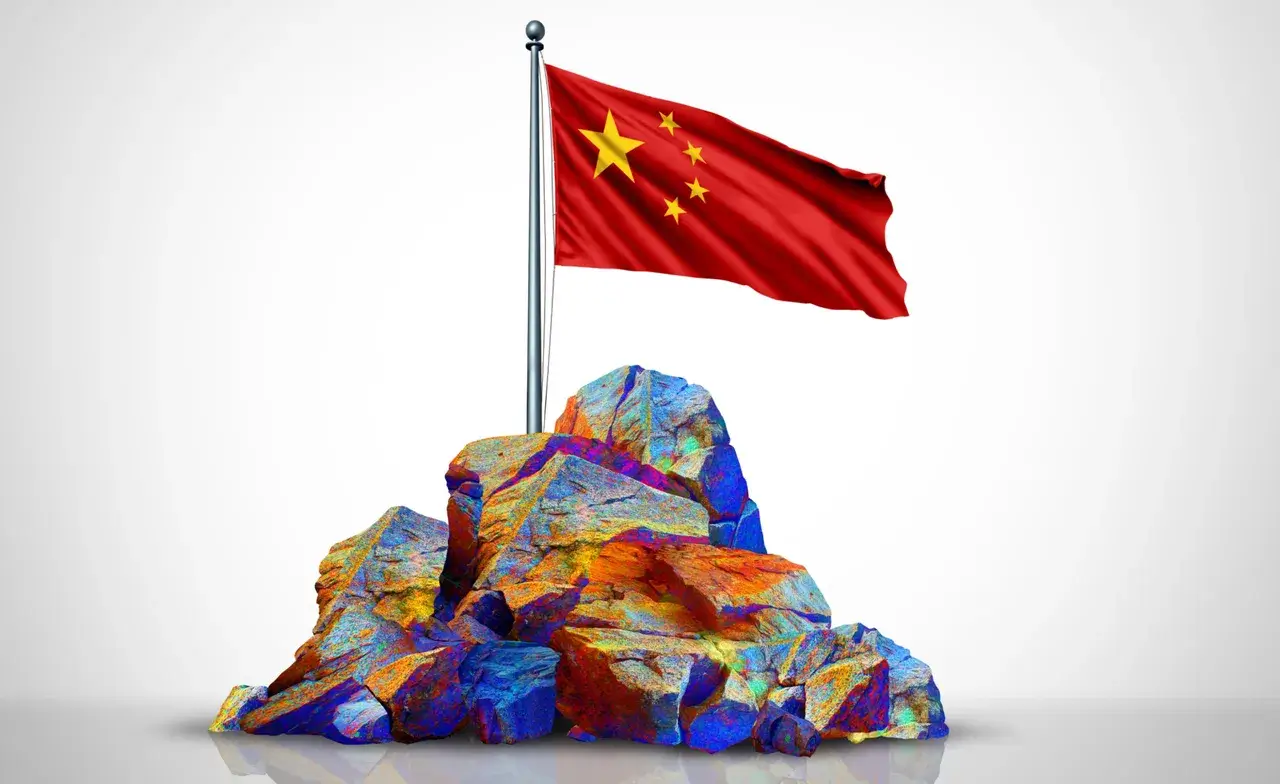
China’s preeminence in the field of rare earth elements (REEs) has evolved into a multi-layered geo-economic policy that extends beyond the “raw materials” aspect of today’s great power competition. REEs are a group of 17 elements consisting of lanthanides, scandium, and yttrium. They are critical intermediate inputs, particularly in high-performance permanent magnets (NdFeB), optical/laser applications, catalysts, sensors, and defence platforms. Consequently, the provision of REEs can be regarded as the “material infrastructure” of the energy transition (wind turbines, electric vehicles), digital transformation (robotics, semiconductor manufacturing equipment, data centres) and defence modernisation. The European Commission has emphasised that demand for REEs is expected to increase sixfold by 2030 and sevenfold by 2050, highlighting that this increase exacerbates supply security risks.
In this context, the REEs policy of the People’s Republic of China is influenced by two dynamics. The initial advantage is that of industrial capacity superiority, which engenders external dependency by controlling the “bottleneck” links in the value chain (separation, refining, metal/alloy and magnet production). Secondly, the regulatory state capacity to translate this superiority into foreign policy through the implementation of tools such as quotas, consolidation, and export controls. The significant developments in 2025 (namely, the decline in quota transparency, traceability/reporting rules, expanded export and technology controls) have indicated that China has conceptualised REEs as a “strategic lever”.
In the context of REEs, geopolitics, the strategic significance extends beyond the geographical locations of raw material extraction to encompass the subsequent conversion processes that transform raw materials into economic value. The processes of separation and refinement are both environmentally costly and time-consuming stages in the production of bioethanol. Conversely, magnet production necessitates advanced materials engineering, standardised quality, uninterrupted supply and large-scale manufacturing. The primary advantage China possesses in this regard is attributable to its substantial experience and the ecosystem it has developed in this field. As stated in the IEA’s assessment of 23rd October 2025, China exported 58,000 tons of rare earth magnets in 2024. This highlights the significance of NRE processing and magnet supply in the context of the ‘clean energy + high technology’ industries.
The monopolisation of REEs by China has been demonstrated to asymmetrize mutual dependence. Many countries remain dependent on China, not because they cannot find REEs at all, but because they lack sufficient scale and cost competitiveness in separation/refining and magnet production. Concrete figures on this point are provided by USGS data on US dependence. From 2020 to 2023, the People’s Republic of China was responsible for 70% of the United States’ imports of REEs and metals. The AP’s comprehensive analysis suggests that, despite its comparatively diminished share of mining activities, China possesses the capacity to exert a ‘near monopoly’ effect during pivotal phases of the supply chain, a feat attributable to its preeminence in processing and separation technologies.
China’s quota system has long been the ‘internal governance’ tool in the REEs sector. What is noteworthy in 2025 is the breakdown in system’s transparency. According to Reuters, Beijing distributed the first mining and smelting/refining quotas for 2025 without a public announcement, unlike in previous years, and instructed companies not to share quota figures “for security reasons.” In the same report, Reuters states that quota access has been restricted, and that only two large, state-affiliated groups were authorised to receive quotas in 2024.
China’s use of REEs as a foreign policy tool is not new, but 2025 marks a threshold in terms of legal design. According to the assessment by the European Parliamentary Research Service (EPRS), China introduced licensing requirements for seven elements on April 4, 2025, and included compounds, metals, and magnets in the scope (EPThinkThank, 2025). The official justification reported by think tank AP states that these steps are justified in the context of “protecting national security and interests” and “non-proliferation.”
The second wave, which came to the fore in October 2025, showed that control extended not only to goods, but also to equipment and technology. The IEA emphasizes that, in addition to the seven elements, five more elements (holmium, erbium, thulium, europium, and ytterbium) have been included in the scope, and that the restrictions have been expanded to include “parts, components, and assemblies,” potentially affecting sectors such as energy, automotive, defense, semiconductors, aviation, and data centers. This points to a strategic line that goes beyond short-term supply cuts and suppresses the “technological inputs” of efforts to establish alternative processing capacity.
China’s dominance in REEs does not imply ‘complete independence’ in raw material sovereignty, as Myanmar-sourced inputs are significant for heavy REEs. Therefore, security dynamics in Myanmar can cause sudden fluctuations in the global REE market. Reuters reports that conflicts in Kachin State have narrowed the flow of heavy REE, with China’s imports of rare earth oxides/metals from Myanmar falling by about half in the first five months of 2025 compared to the previous year, and that this squeeze increases the risk of a supply shortage.
The Myanmar example produces two strategic outcomes. First, while China’s processing capacity creates a global bottleneck, cross-border instability in heavy elements also creates a supply security cost for Beijing, exposing the fragile aspects of its “monopoly power.” Second, because inputs processed in China are dispersed throughout the global industry, companies’ supply chains are indirectly exposed to conflict, economies, environmental destruction, and human security risks. Thus, the REE issue is not only at the centre of inter-state competition, but also of sustainability/ethical sourcing and governance debates.
The approach of the US and the EU in the face of China’s leverage is ‘risk reduction’ rather than complete disengagement. Diversifying supply, building processing capacity, increasing recycling, and encouraging early-stage investment through strategic stocks and public procurement are among these approaches. The EU’s Critical Raw Materials Act (CRMA) is the institutional backbone of this approach. According to the EU Council’s official briefing, the 2030 targets are for at least 10% of annual consumption to be sourced within the EU, at least 40% to be processed within the EU, and at least 25% to be recycled. In addition, the goal is for dependence on a single third country for processed forms of each strategic raw material not to exceed 65%. The same source states that the EU’s dependence on a single country for some critical inputs is very high; for example, the EU’s dependence on China for heavy rare earth elements is stated to be 100%.
The REEs document concretises discussions of “armed interdependence” and geoeconomic statecraft. China’s 2025 policy is two-tiered: Quotas and licences create short-term supply allocation, while equipment/technology controls and extraterritorial applications aim to slow competitors’ medium-term capacity building. In doing so, Beijing establishes a strategic sphere of influence that affects not only today’s supply but also the “birth rate” of alternative supply ecosystems. In terms of international relations, this exemplifies how the ‘asymmetric’ side of economic interdependence generates bargaining power in foreign policy through regulatory tools.
Second, the normative competition dimension is strengthening. While the EU institutionalizes sustainability, traceability, and strategic autonomy goals through the CRMA, China legitimizes its control regime through the rhetoric of national security and preventing proliferation. Thus, competition for critical minerals is conducted not only through price and quantity, but also through standards, internalization of environmental costs, and “responsible sourcing” norms. This demonstrates that the emerging “critical minerals diplomacy” generates norm-setting and governance competition, in addition to classic resource diplomacy.
Thirdly, the example of Myanmar illustrates why geopolitical vulnerabilities have become central to ‘de-risking’ strategies. Although China has strong control capabilities, cross-border supply shocks in heavy metals could increase costs for both China and the global industry. Therefore, the most likely direction going forward to 2026 is alliance-based diversification, rather than complete disengagement, the re-geographical distribution of processing capacity, and accelerated investment in recycling/substitution technologies. However, the critical question here is to what extent the construction of new capacity will be “commercially sustainable”, and what public policy tools will be used to make it permanent, as China’s economies of scale and integrated ecosystem generate competitive advantages not only through financing, but also through technology and market access (IEA, 2025).
To the extent that REEs constitute the physical infrastructure of energy and digital transformation, they are becoming a decisive geo-economic instrument in great power competition, as much as indicators of military capacity. China’s steps in 2025 show that this instrument is designed as a foreign policy mechanism that produces strategic control and coercion capacity, going beyond the logic of commercial regulation, while the West’s response is shaped through institutional de-risking, standard competition, and new supply coalitions.