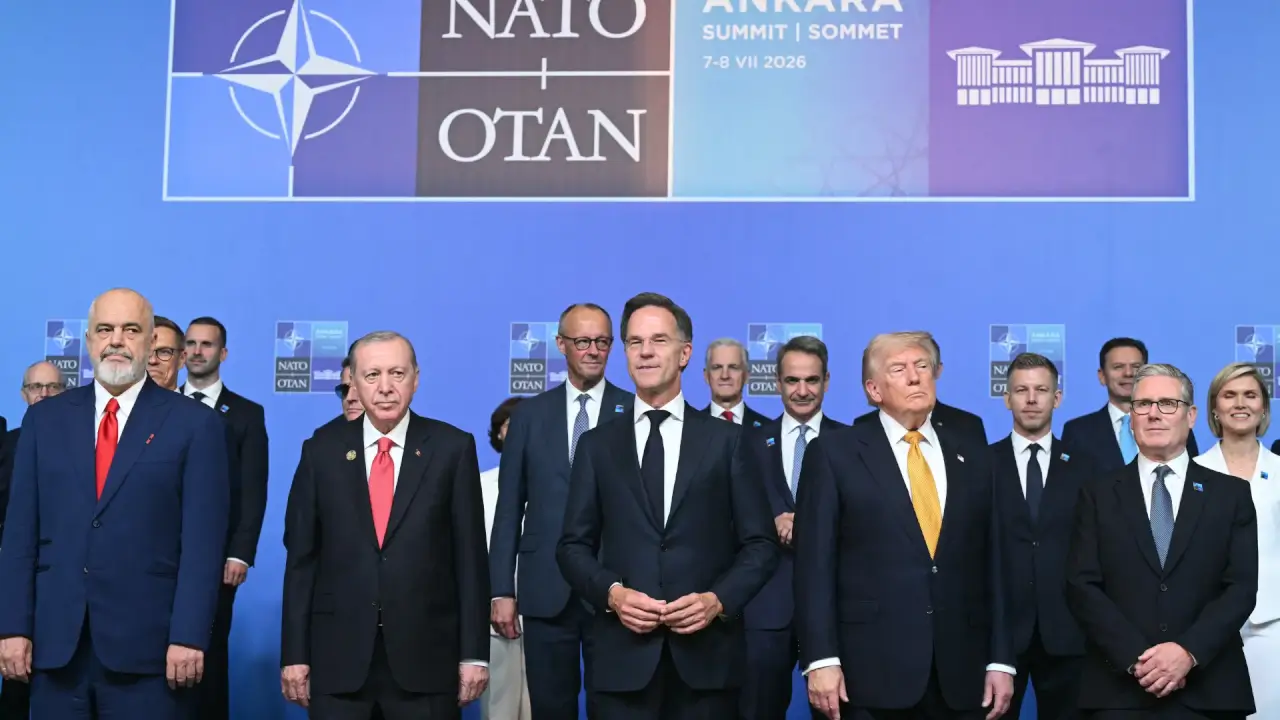
On 7-8 July 2026, NATO’s heads of state and government met in Ankara for the Alliance’s 36th summit. It was the second time Türkiye has hosted this gathering since Istanbul in 2004. The summit came at a difficult moment for the Alliance: a fifth year of war in Ukraine, growing pressure on European allies to turn defense-spending pledges into real industrial capacity, and continuing uncertainty over Washington’s long-term commitment to European security.
The Ankara Summit Declaration reaffirmed the Alliance’s commitment to collective defense under Article 5, noted that in 2025, European allies and Canada have increased core defense investment by more than $139 billion, and announced more than $50 billion in new procurements and committed to working with industry to accelerate innovation. Support for Ukraine and the broader question of Europe’s long-term security architecture also featured prominently on the agenda.
For most allies, Ankara was simply this year’s venue — one stop in a rotating calendar of summits, with the substance of the meeting mattering far more than its location. In Türkiye, however, the hosting itself became the main story. Domestic coverage and official messaging treated the summit as a marker of status, framing 2026 as a “year of summits” for the country. That asymmetry — between how little the host city mattered to most of the Alliance and how much it seemed to matter in Ankara — is itself worth examining.
For this issue of Panorama Asks, we invited members of the Global Academy Political Psychology Hub to reflect on the Ankara Summit through four questions:
Q1. How should we interpret the extensive security and logistical preparations in Ankara ahead of the summit —including the closure of certain areas to the public and the effort to present a particular image of the city? What does this tell us about how host states manage the optics of such events?
Q2. Coming more than two decades after the 2004 Istanbul summit, what did hosting the NATO Summit mean for Türkiye’s sense of status within NATO? Can it be read as an attempt to stabilize a contested identity — as Western ally, regional power, or bridge between blocs — and where did that narrative hold or show strain?
Q3. Was the Ankara Summit a moment that reinforced Türkiye’s usual sense of role and place within NATO, or one that unsettled it and reopened questions about identity?
Q4. Where do you see the clearest gaps between how Türkiye narrated its own role in the Ankara Summit and how it was represented by NATO’s other members, press, or observing publics?
Curating the Capital for the Alliance
Dr. İrem Karamık, Mardin Artuklu University
The preparations that transformed Ankara ahead of the 7–8 July summit are best read not as logistics but as visual politics. The city-wide ban on demonstrations from 28 June to 10 July, the “red zones” sealing off the city’s core, and the beautification drive along delegation routes, repaved arteries, warnings to shopkeepers about visual pollution, even the removal of stray animals together constituted a deliberate curation of the visual field. Host states do not merely provide a venue; they decide what thirty-two delegations and the world’s cameras are permitted to see, and what must remain unseen. This constitutes the politics of seeing and hiding in its purest form: the curated capital performs a claim about the state itself: pretty, modern, sovereign, in control. What was hidden is as constitutive of that image as what was shown. The detention of activists, lawyers, and journalists, as well as barricading certain “ugly and underdeveloped” parts of the city during the summit period, reminds us that every staged visibility rests on an infrastructure of enforced invisibility.
Coming twenty-two years after the 2004 Istanbul summit, hosting carried an unmistakable status dimension — but status, at summits, is something made visible. Through the lens of ontological (in)security, the imagery Ankara produced was less a celebration of status than an attempt to stabilize it. Türkiye’s identity within the Alliance generates chronic anxiety about the state’s autobiographical narrative. The choice of venue was the clearest visual argument: not cosmopolitan Istanbul but the Presidential Complex, the architectural signature of the “New Türkiye,” so that every family photograph, every handshake at the threshold, every camera angle placed the Alliance’s leaders inside the iconography of the state itself. The summit’s most consequential moments, such as Trump’s promise on lifting the CAATSA sanctions, Türkiye’s continued command of KFOR and its scheduled 2028–29 command of the NATO Response Force, were likewise staged as images of recognition, visual and ritual proof that Türkiye sits at the table by right. Yet the narrative strained where the image was not returned in kind: much Western commentary treated Ankara less as host than as backdrop to the Alliance’s own crisis management.
Did the summit, then, reinforce Türkiye’s sense of role or unsettle it? Paradoxically, the visual register is where this paradox is revealed. A state fully secure in its identity does not need to lock down its capital to be seen correctly. The very scale of the staging, the intensity of the effort to control every sightline, can be read as an index of anxiety rather than confidence. The summit provided rituals of belonging that temporarily quiet identity questions. But over-securitization betrayed the fear that the “other” Ankara, the one of protest and precarity, might puncture the frame.
The clearest gaps lie between Türkiye’s self-narration and its external representation. Ankara’s script spoke of a historic summit that boosted Türkiye’s visibility and laid the foundation of a “stronger” NATO. Where the government narrated recognition, many observers saw a partnership of necessity rather than of belonging; where the state showed a gleaming capital, there circulated images of what the gleam concealed. This rift is not incidental — it is the engine of the cycle. Ontological (in)security is reproduced precisely in the gap between the self that the state performs and the self that others reflect back. The Ankara summit narrowed that gap for a photogenic forty-eight hours, yet it did not close it.
Staging Status in Ankara: Türkiye’s Contested Identity at the NATO Summit
Dr. Erman Ermihan, Bilkent University
The NATO Summit in Ankara was not only a diplomatic gathering. It was also a carefully staged performance of order, status, and belonging. The heavy security, the closed streets, and the effort to present Ankara as a calm and governable capital were all part of that performance. None of this is unusual at a high-level summit. But it does show how host states try to shape what these events come to mean.
At such summits, cities become stages. On it, the state shows its capacity to organize, to command, and to matter on the world scene. Public space is rearranged, movement is restricted, and for a few days the ordinary life of the capital gives way to the needs of diplomacy. The message is one of control. This is a host that can protect its guests, run the alliance’s meeting, and put itself at the center of attention. Summit security is never only technical. It is also a language, visual and symbolic, through which a state tells the world who it is.
Choosing Ankara, more than twenty years after the 2004 Istanbul Summit, meant something. Istanbul has always been the country’s showcase to the world. It is cosmopolitan, easy to recognize, and famously placed between two continents. Ankara is a different kind of city. It is the heart of the republic, the seat of political power, the place most closely tied to state sovereignty. To bring NATO to Ankara was to bring the alliance into the very center of the Turkish state.
This mattered because Türkiye’s place in NATO has long been both central and uneasy. Ankara sees itself as an indispensable ally, a serious military power, a regional force, and a bridge between different worlds. At the same time, its ties with other members have often been strained, over defense deals, regional conflicts, questions of democracy, and its push for strategic autonomy. The summit was a chance to calm all this with a simple story of recognition. NATO’s leaders came to Ankara, Türkiye played host, and the country’s importance was affirmed in public.
Seen through the lens of ontological security, hosting the summit was a way of holding a contested identity together. Türkiye tries to be many things at once. It wants to be a Western ally, an independent regional power, a mediator, a security provider, and a voice for the non-Western world. These roles do not always fit. The summit did not resolve the tensions between them. For a moment, it simply made them look as though they belonged together.
It also let the government show Türkiye as firmly inside the Western security order while still stressing its own diplomatic reach and regional weight. In doing so, the summit repeated a story Türkiye likes to tell about itself. It is not a minor or junior ally. It is a pivotal actor, one whose cooperation the alliance cannot do without.
But the story showed signs of strain. Türkiye described the summit in terms of centrality, equality, and being indispensable. Others were less sure. For many allies and observers, Türkiye is strategically necessary but politically hard to handle. It is influential, yet not always predictable. It sits inside the alliance, but often pulls against what the alliance wants.
The clearest gap lies between recognition and trust. Türkiye wanted to be recognized as a major power and an equal partner. Its allies were happy to acknowledge its strength and its geography. They were far more cautious about the larger political self-image that came with them.
In the end, the Ankara Summit reinforced Türkiye’s familiar sense of its own role, but only for a limited time. It did not settle where Türkiye belongs, or what kind of ally it really is. What it offered was a moment of symbolic order, a carefully staged picture in which Western alignment, regional independence, and national status could all seem to fit together. The summit did not resolve Türkiye’s contested identity within NATO. It briefly made that identity look stable.
Fresh Asphalt, Curious Eyes: Ankara hosts NATO
Dr. Vuslat Nur Şahin Temel, Social Sciences University of Ankara
For those of us who live and work in Ankara, the weeks before the NATO Summit of 7–8 July felt strangely familiar, not from international politics, but from family life. It resembled a household preparing for a wedding: the furniture replaced, the walls repainted, the garden hastily replanted before the guests arrive. Roads long in need of repair were resurfaced overnight; facades along the protocol routes were refreshed; seasonal flowers appeared in the medians; escalators that had been idle for months suddenly ran in unison. Even the city’s taxi drivers were given a dress code and encouraged to offer cologne and Turkish delight to visiting delegations. Social media responded the way Turkish society often does: with humor. One viral video showed a resident marveling that his street had been asphalted in a single night, and the punchline circulating online captured the mood of the city: so it could be done after all.
It is tempting to treat all this as trivia, but the gentle irony contains a serious question about how host states manage the optics of mega-events. Erving Goffman’s distinction between “front stage” and “back stage” behavior translates remarkably well from individuals to states. A summit city is a front stage: a curated presentation of the self, performed for an audience whose recognition matters. The route from Esenboğa airport to Beştepe was dressed for the occasion down to its smallest details. Ankara’s residents watched this transformation with genuine astonishment, we are simply not accustomed to public services being delivered at such speed, and that astonishment is itself instructive about the extraordinary mobilizing capacity a summit unlocks.
Why perform so intensely? Here, the literature on ontological security is illuminating. States, like individuals, need a stable sense of who they are, sustained through routines and biographical narratives; disruptions to that narrative produce anxieties that states work to manage. Türkiye’s identity within NATO has long been debated (indispensable ally, regional power, bridge between blocs) and, as Ayşe Zarakol has argued in After Defeat (2011), its relationship with the Western club has historically been accompanied by a sensitivity about status and recognition. Hosting the Alliance’s highest-level gathering, twenty-two years after Istanbul 2004, offered a rare ritual of belonging: for two days, the “significant other” was not merely acknowledging Türkiye but physically assembling in its capital. The intensity of the preparations is best read in these lights; not as protocol run amok, but as identity work: an effort to be seen in a particular way at a moment when “being seen” mattered enormously.
The choice of Ankara itself deserves attention. In 2004, Türkiye showcased Istanbul, its cosmopolitan and touristic face. In 2026, it presented Ankara: the bureaucratic capital, the seat of the republic, hosting the summit at the Presidential Complex itself. It was also a practical choice: Ankara is not a tourist city, and a July summit could be accommodated here in ways Istanbul’s or Antalya’s summer would never allow. One may even speculate that the experience opens new horizons for the capital, which discovered, along with its residents, what it can look like when resources and will align.
What the front-stage metaphor misses, however, is how eagerly the audience joined the play. Once the leaders arrived, residents followed them online with an almost familial curiosity. Clips of the welcoming ceremonies circulated within minutes, set to music and edited like film trailers; the Icelandic prime minister gained tens of thousands of new followers, most of them Turkish; the Japanese defense minister’s detailed travel diary charmed users; even the Presidential Complex’s resident cats became minor celebrities of the international press corps. Political psychology has a name for part of this “basking in reflected glory, the pleasure of association with a successful collective moment”, but there was also something warmer: the hosts inspecting their guests, as families do at weddings. The public, cast as backstage in the preparations, wrote itself into the performance.
These two registers, gentle irony about the preparations and genuine delight in the spectacle, coexisted throughout the summit week, and their coexistence is itself telling. The summit briefly aligned Türkiye’s narrated self with its standing in the Alliance, and Ankara’s residents, whatever their reservations, took visible pleasure in the occasion. The question they now ask, mostly with a smile, is whether some of that wedding-day energy might be folded into the ordinary rhythms of the city.
The Ankara Summit and Türkiye’s Evolving Role in NATO: From Geopolitical Frontline to Security Provider
Dr. Zeynep Şartepe
Since joining NATO alongside Greece in 1952, Türkiye’s relationship with the Alliance has been shaped by changing political environments. During the Cold War, its value rested largely on geography as the Alliance’s southeastern flank confronting the Soviet Union in different crises such as the 1960 U-2 incident and the Cuban Missile Crisis, in which the US committed to its nuclear-tipped Jupiter missiles stationed in Türkiye in October 1962, and later the regional crises largely surrounding the Cyprus issue and the relations with Greece. Following the end of the Cold War, many questioned whether Türkiye’s strategic importance would gradually diminish in a world order that is no longer defined as bipolar. However, the return of geopolitical competition has once again placed Türkiye at the center of NATO’s strategic thinking, albeit under very different political, economic, and social circumstances.
Russia’s full-scale invasion of Ukraine since 2022, wars in the Middle East, renewed great-power rivalry, and growing uncertainty about the future of the world order have transformed the Alliance’s security agenda. Yet the return of geopolitics is accompanied by an equally profound transformation in the character of warfare itself. Artificial intelligence, AI-enabled decision-support systems (DSS), algorithmic targeting, full-spectrum drone warfare (FSDW), commercial satellite constellations, cyber operations, and partnerships between militaries and technology companies such as Palantir and Google are reshaping how wars are planned and fought. At the same time, the military-industrial complex is evolving from one dominated by conventional defense manufacturers to a more hybrid ecosystem in which software companies, AI developers, and commercial technology firms increasingly shape military innovation. All these have demonstrated not only the growing operational significance of drones and AI-enabled systems but also the ethical and political challenges they create, from automation bias and civilian harm to expanding surveillance and algorithmic decision-making.
These transformations have altered the basis of Türkiye’s relevance and status within NATO. Geography remains indispensable, but it is no longer sufficient to explain Türkiye’s increasing strategic role. Today, uncrewed aerial vehicles (UAVs), commonly known as drones, underpin Türkiye’s cross-border operations, geopolitical power projection, and an export-driven politico-economic strategy, with platforms like the Bayraktar TB2 UAV at the forefront. Besides, drawing on lessons from the large-scale, cost-effective use of drones in wars in Ukraine and the Middle East, Türkiye is accelerating the development of kamikaze drones, loitering munitions, drone swarming systems, and AI-enabled weapons systems across land and naval domains, alongside a growing suite of counter-UAS technologies designed to neutralize small drone threats in both urban and rural environments. Thus, Türkiye increasingly presents itself as a security provider rather than merely its strategic geographical location. Its expanding defense industry, operational experience, investments in emerging military technologies, industrial cooperation with European and non-European countries, as well as critical operational infrastructure from air bases and radar installations to NATO land command and maritime facilities have reinforced its status as a key contributor to the Alliance’s deterrence and defense posture. In this sense, the Ankara Summit reflected an important shift: Türkiye is no longer defined solely by where it is located, but increasingly by what it contributes to the Alliance in material, ideational, and political terms.
The summit itself illustrated this evolving identity. Hosting such an event is never simply a logistical exercise; it is also a political performance through which states communicate competence, authority, and belonging. I approach all extensive security measures, such as restricted mobility, heightened surveillance, and controlled public spaces that temporarily transformed Ankara and reconfigured everyday urban life through what Giorgio Agamben describes as the dual body of power: the Kingdom and the Glory. The Kingdom was manifested in the practices of security and governmentality, as exceptional measures reordered the city in the name of protection. The Glory unfolded through diplomatic rituals, military bands, carefully staged ceremonies, and forms of gastrodiplomacy that projected Türkiye’s hospitality alongside sovereignty. The Summit’s Declaration captured this symbolic dimension by expressing appreciation for Türkiye’s “generous hospitality,” recognizing not only the successful organization of the summit but also the performative role of the host state.
Hosting the summit therefore carried significance beyond diplomacy. Coming more than two decades after the 2004 Istanbul Summit, it allowed Türkiye to reaffirm an identity that has often been contested: not simply as NATO’s southeastern flank or as a bridge between the East and the West, but as an indispensable ally in an era of renewed geopolitical competition and technological transformation. At the same time, it highlighted a familiar tension between Türkiye’s narration of its identity, the recognition by allies, and NATO’s self-narrative that underlines unity, deterrence, resilience, and collective defense over the prominence of any individual member. In this climate, the Ankara Summit shows that Türkiye’s place and identity within NATO is being recalibrated rather than merely reaffirmed. As the Alliance adapts to multidomain military operations, AI-enabled warfare, and new forms of strategic competition, Türkiye seeks to redefine the foundations of its relevance through technological capability, operational contribution, and defense-industrial strength.
Türkiye’s Bid for Role and Recognition at the Ankara Summit
Dr. Nasuh Sofuoğlu, Recep Tayyip Erdoğan University
The security cordons, the closure of entire districts, and the refurbishment of protocol routes and public facades should be read as more than logistical preparations. They formed part of a political performance through which Türkiye sought to represent Ankara as a temporary center of allied power. Summits are not neutral gatherings. They are institutional rituals that reproduce and reorder hierarchies within international organizations. For a member whose NATO role has often been narrated through the language of the “southern flank,” burden-sharing disputes, and the recurrent label of a “difficult ally,” hosting thirty-two allied leaders in Ankara symbolically reversed the alliance’s conventional geography. The use of the Beştepe Presidential Complex in the summit’s visual identity further embedded the event in the government’s broader narrative of the “Century of Türkiye.” Yet status cannot be established through self-representation alone. The significance of the summit depended on whether allies and external observers recognized Ankara’s performance as evidence of durable centrality rather than temporary visibility.
Hosting the summit twenty-two years after the Istanbul meeting addressed a question of status and recognition as much as one of diplomatic organization. Ankara interprets the contemporary transformation of the international order –increasingly transactional, capability-oriented, and less consistently governed by liberal-normative criteria– as a permissive environment for role advancement. In this setting, Türkiye’s geography, military capacity, defense-industrial base, operational experience, and willingness to assume regional risk acquire greater strategic value. The summit therefore represented an effort to consolidate this revaluation within NATO’s institutional setting. President Erdoğan’s closing discourse moved from longstanding grievances about abandonment and unequal treatment toward a claim of vindication based on Türkiye’s expanding capabilities. Analytically, this can be understood as elite-led cognitive reappraisal – a position previously framed as geopolitical liminality, neither fully inside nor outside the West, is reinterpreted as strategic centrality. Türkiye’s multi-vector foreign policy follows the same logic. NATO membership enhances its credibility and reach in Africa, Asia, and the wider Global South, while diversified non-Western partnerships increase its bargaining power and strategic weight within NATO. The familiar “bridge” metaphor is thus recast from passive intermediation to an agentic role as a regional hub and autonomous node.
To the extent that identity shaped the Ankara Summit, it operated primarily through national role conceptions. Türkiye has pursued deliberate role-making by seeking to replace externally ascribed roles, such as flank state, security consumer, or difficult ally, with the self-authored roles of security provider, mediator, defense-industrial partner, and geopolitical gatekeeper. The summit offered concrete evidence of role enactment through Turkish F-16 participation in NATO air policing in Estonia, Türkiye’s prospective command of the Allied Reaction Force in 2028-29, its proposal for a NATO-accredited counter-drone Centre of Excellence, and the call for an integrated defense-industrial network “stretching from Texas to Ankara.” These initiatives strengthened Ankara’s claim that Türkiye is not merely located within the alliance but performs functions essential to its deterrence, resilience, and operational capacity.
Role performance, however, does not automatically produce status recognition. The summit exposed three persistent recognition gaps. The first lies between functional relevance and identity-affirming recognition. Ankara presented Türkiye as “not just a host country, but a pivotal ally,” whereas allied responses remained selective and issue-specific –the F-35 question remained unresolved, participation in the EU’s SAFE instrument remained constrained, and renewed European engagement was quickly reconnected to the Cyprus dispute. Türkiye claimed thick recognition of its standing and identity, but largely received thin recognition of its utility.
The second gap lies between institutional recognition and personalist contingency. Ankara interpreted full participation at the leaders’ level as confidence in Türkiye as a state and alliance member, while much external commentary attributed the summit’s political warmth to the relationship between Erdoğan and the POTUS. To the extent that recognition depended on a particular bilateral relationship, the resulting status gain remained contingent rather than institutionalized. The third gap concerns the meaning of belonging. Ankara framed its contributions as evidence that a committed ally was finally receiving appropriate recognition. Many observers, by contrast, interpreted the same contributions as instruments of strategic autonomy pursued from within NATO. From this perspective, Türkiye was not returning to an exclusively Western orientation. It was using its alliance position to deepen Western and non-Western engagements simultaneously.
The Ankara Summit therefore consolidated Türkiye’s national role narrative without fully resolving its recognition deficit. Functional, conditional, and personalized recognition can temporarily validate Ankara’s preferred role, but it also reproduces the cycle of status assertion and deferred recognition. Türkiye demonstrated that it can perform centrality and translate material capabilities into institutional relevance. The more difficult question is whether its allies will convert that relevance into durable status through sustained political inclusion, defense-industrial access, and recognition of Türkiye as a rule-shaping rather than merely task-performing member of the alliance.
Karel Valansi
Karel Valansi, PhD, is an expert with the Global Academy and assistant editor at Global Panorama. She is a lecturer in the Department of International Relations at Istanbul Kültür University. A former journalist and political columnist for T24 and Şalom Newspaper, she specializes in Middle Eastern affairs.
Her academic work focuses on Security Studies, the Middle East, Israel, and Turkish foreign policy. She is a member of the Women in Foreign Policy Initiative and is actively involved in various projects that promote religious minority rights and women’s empowerment.
Dr. Valansi is the author of The Crescent Moon and the Magen David: Turkish-Israeli Relations Through the Lens of the Turkish Public (Hamilton Books, 2018). Her analyses are available at karelvalansi.com, and she shares insights on Twitter and other social media platforms as @karelvalansi.
To cite this work: Karel Valansi, "Panorama Asks: Panorama Asks: The NATO Summit in Ankara – Karel Valansi" Global Panorama, Online, 17 July 2026, https://www.globalpanorama.org/en/2026/07/panorama-asks-the-nato-summit-in-ankara-karel-valansi/
Copyright @ 2025 Global Academy. Design & Development brain.work
All on-line and print rights reserved. Opinions expressed in works published by the Panorama belongs to the authors alone unless otherwise stated, and do not imply endorsement by the IRCT, Global Academy, or the Editors/Editorial Board of Panorama.
Newsletter Subscription
Subscribe to our newsletter to stay informed about updates.