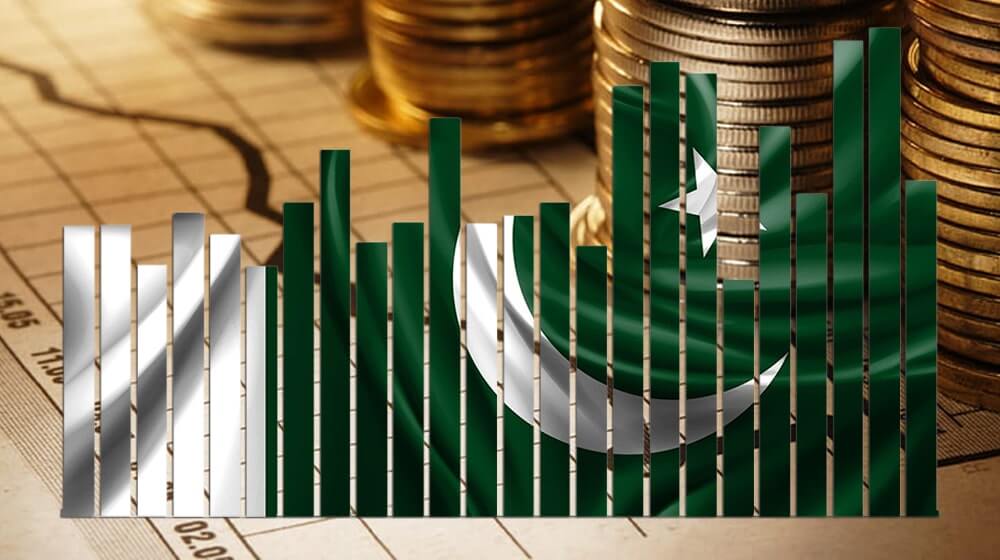
Pakistan’s economic trajectory is taking a noticeable turn in a different direction than before. There was a stretch of inflationary pressure, plus outside financing trouble, exchange-rate uncertainty, and economic buffers that were largely used up. Now though, the main indicators seem to be leaning toward more steadiness and a slow recovery. GDP growth is strengthening, inflation has eased significantly, remittances have climbed to record-ish levels, the current account has shifted into surplus, foreign-exchange reserves are being rebuilt, and the exchange rate has become much more predictable than before.
What matters here is the blended impact of several factors. Economic steadiness takes hold when fiscal, monetary, and external-sector conditions start to support each other, kind of in unison. Pakistan’s recent progress shows that this whole mechanism may be starting to form, at least gradually. GDP growth went up from 2.62 percent in FY23/24 to 3.18 percent in FY24/25, and it is projected to edge toward 3.7 percent in FY25/26. The acceleration indicates that economic activity is recovering. Businesses are operating in a more predictable environment, while lower inflation and improved external conditions can gradually support investment and consumption. Nevertheless, Pakistan should resist declaring victory too early. A 3.7 percent growth rate is encouraging but insufficient to resolve the country’s structural challenges. With a large and growing population, Pakistan needs substantially higher,sustained growth to create enough productive employment and raise living standards. The objective should therefore be to use the current stability to increase the economy’s productive capacity.
Inflation is one of the more telling signs when it comes to the shift in economic conditions. The rate dropped from 23.4 percent to 4.5 percent, and the expected level is about 7.05 percent. That decrease really points to a large step toward better price stability. For households, lower inflation usually means the gradual shrinking of purchasing power happens at a slower pace. For firms it helps with the whole planning process, like estimating expenses, choosing selling prices, and taking investment decisions.
The improvement shows how critical credible macroeconomic management is. Inflation cannot be kept down in a sustainable way just by using administrative measures alone. You need fiscal discipline plus monetary credibility, exchange-rate management, and also some supply-side improvements that work together. Keeping these gains will still demand continued vigilance, especially when it comes to food shocks, energy pressures and imported inflation.
The external sector presents another important source of confidence. Remittances increased from $30.25 billion to $38.30 billion and are projected to reach $41.6 billion. Such inflows provide valuable foreign exchange and help support the balance of payments. They also reduce immediate dependence on external borrowing for meeting foreign-payment requirements. But remittances should not obscure a central weakness in Pakistan’s economic structure: inadequate export capacity. A resilient economy needs to earn foreign exchange through competitive exports rather than depending disproportionately on overseas workers’ incomes. The next stage should therefore focus on increasing the value, diversity and competitiveness of Pakistan’s exports.
The turnaround in the current account is equally significant. A $2.07 billion deficit has been transformed into a $2.11 billion surplus, with a projected surplus of $0.25 billion. This indicates that external payments are becoming more manageable. The improvement cuts the odds of immediate balance of payments stress, and it gives policymakers more elbow room to pursue economic reforms.
Foreign exchange reserves have grown from $9.39 billion to $14.51 billion, and they are expected to rise again to around $23.99 billion. Reserve accumulation is strategically important because it provides protection against external shocks. Higher reserves improve the country’s capacity to finance essential imports and external obligations while reducing vulnerability to sudden changes in global financial conditions.
Exchange-rate stability has complemented these gains. The rupee has remained broadly within the Rs278–284 per dollar range, providing greater predictability for economic actors. Stable currency conditions are particularly important for businesses dependent on imported machinery, raw materials and energy, as well as exporters planning investment and production.
The projected decline in external debt from $131.1 billion to $104.2 billion could further strengthen the recovery. Lower external debt would reduce repayment pressures and create additional fiscal and external space. However, debt reduction must be supported by structural improvements in revenue mobilisation and economic growth. Otherwise, debt pressures could re-emerge.
The current recovery therefore presents Pakistan with a strategic choice. One path is to treat stabilisation as an achievement in itself and gradually return to old patterns of consumption, imports and short-term borrowing. The other is to use the improved macroeconomic environment to implement deeper structural reforms.
The Second Path is Essential
Pakistan needs to crank up domestic investment, tidy up the business environment, and also tighten energy sector governance. It should widen the tax base, reform state-owned firms and raise productivity too. For agriculture, it really looks like greater mechanisation matters, plus better water efficiency and more value addition. In manufacturing, technological upgrading is key, and there is also a need for deeper integration into global supply chains. Meanwhile, the IT and services space will need firmer infrastructure, better skills, and easier reach into international markets.
Human capital has to become a core economic priority. Sustainable growth cannot happen if education is not improved, and if technical training and workforce productivity don’t get attention. A bigger population can turn into an economic asset, but only when people are properly equipped with the abilities modern industries need.
The gains in macroeconomic stability should also be turned into stronger private-sector confidence, in a real sense. Investors need policy predictability, clear regulation, dependable energy supplies, and access to finance. They also want protection from unnecessary bureaucratic delays, you know. Stable macroeconomic indicators make the base, sure, but it’s the institutional quality that really decides whether investment ends up following, or just stays on paper.
The current improvement also provides an opportunity to strengthen Pakistan’s resilience. Bigger reserves, stronger remittance flows, lower inflation and a sounder current account give extra buffers against those geopolitical disruptions, commodity-price surprises, and shifts in global financial conditions. The economic story, therefore, is changing from crisis containment to recovery management. Pakistan is not yet at the destination; it has reached a point from which sustained progress becomes possible.
The next test will be whether macroeconomic stability can be converted into structural transformation. Growth must become faster, exports more competitive, investment stronger, productivity higher and employment more abundant. If policy continuity is maintained and reforms deepen, the current stabilisation can become the foundation of a more resilient and prosperous economy. Pakistan’s recovery should consequently be judged not merely by falling inflation or rising reserves, but by whether the country can break the recurring cycle of boom, external pressure and crisis. The opportunity now is to build an economy that generates its own momentum rather than repeatedly requiring emergency stabilisation. That is the real meaning of sustainable economic recovery.