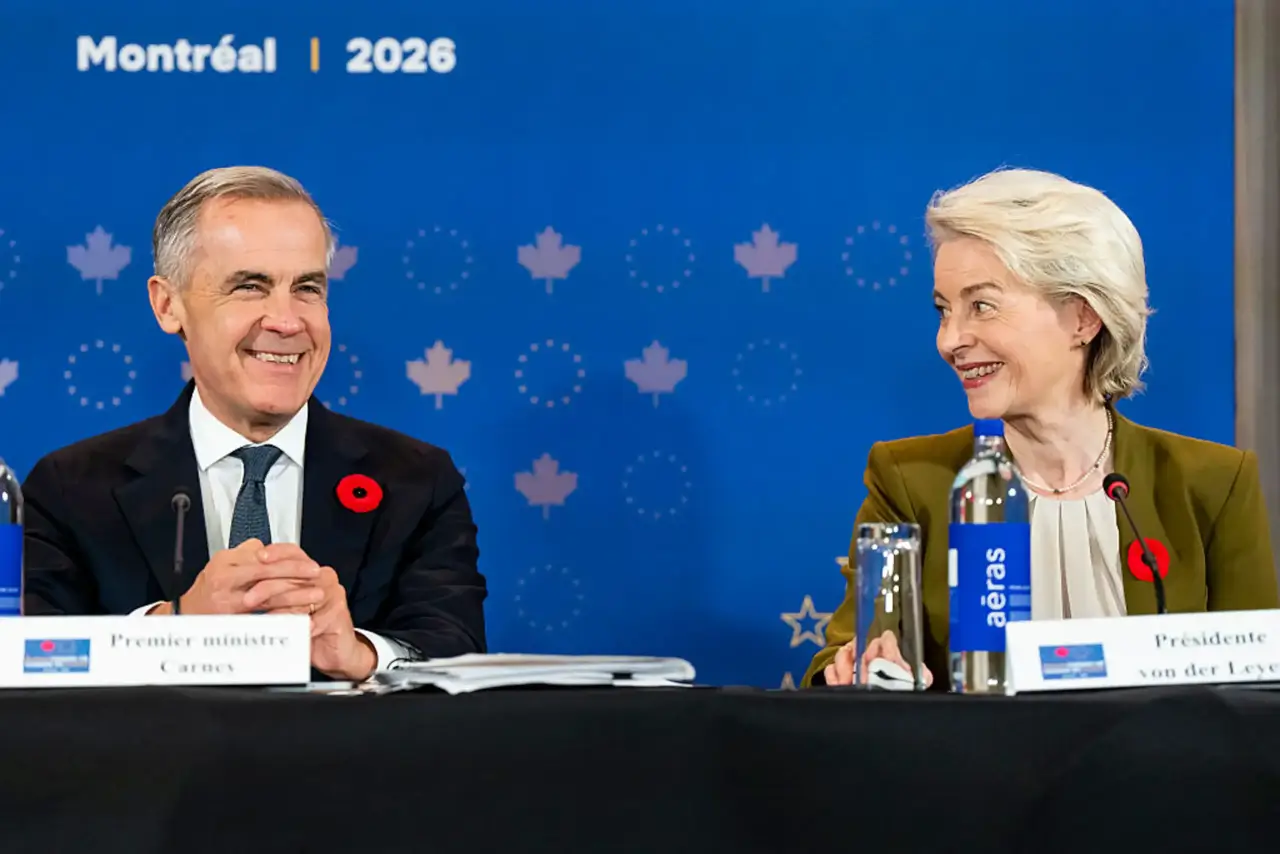
“… Canada is more European than some European member states…” Former German Foreign Minister Sigmar Gabriel
In the second term of Trump’s presidency, international political and economic balances have been heavily disrupted, and global order has lost its meaning and functions. Increasing geopolitical conflicts and the resulting tensions are driving a wedge between the United States and the international community. This is leading to a breakdown in the rule of law and a willingness to use violence and force against allies and China. The leadership in Beijing pursues a radical export policy aimed entirely at Chinese security and power interests, with the aim of making other countries economically dependent on it. As long as the global order continues in this way, Europe and Canada, which are the Middle Powers, will undoubtedly face threats and pressures in political, defense and economic matters among the superpowers. As a result, they will be forced to cooperate with one or both fronts.
Atlantic are becoming closer
More broadly, Canada and the EU work closely together in many international organizations. They are members of the OECD, OSCE, NATO, the World Bank, the IMF, the G7, and the G20. Canada is a constitutional monarchy with the King of England as the symbolic head of state and a member of the Commonwealth. There has been an important development in international relations in recent days. Canadian Prime Minister Mark Carney stated that he wants to make Europe the starting point of a new alliance of liberal middle powers. To this end, he plans to deepen his country’s economic, political and military relations with the EU. Mark Carney put forward hopes for an alliance with numerical strength after EU leaders raised the idea of Canada becoming the bloc’s first “Associate Member with an Association Agreement”. It is to be noted that Turkey signed an ‘Association Agreement’ with the EEC in 1963. In this Association Agreement, Canada’s full membership of the EU is out of the question. The development of trade relations between them is being planned under the CESEF code. Moreover, the Canadian government is expected to take part as an observer in the Commission and Parliament meetings in Brussels.
What were the reasons behind the decision of Canada and the EU to cooperate together?
So, what is the purpose of this convergence of the two sides of the Atlantic Ocean, which are separated by the Gothic towers of the Canadian Parliament in Ottawa, located on two different sides of the Atlantic Ocean, and the glass-fronted modern European Parliament building in eastern France, about 3,700 miles away (6-hour flight time)?
There are two important reasons for this rapprochement. Firstly, President Donald Trump, who is currently in escalating customs talks with Ottawa, has declared his ambition to make Canada an American province several times, much to the deep sadness and resentment of many Canadians. For this reason, Canada is looking for a partner it can trust and with which it can cooperate. Furthermore, the EU should reach an agreement with Canada on how to respond collectively to any further escalation of conflicts on the US side. If the EU were to adopt this collaborative approach, it would effectively transform into a supporter rather than a cooperative partner. Second, for the time being, the U.S. has sharpened the tariffs it had already threatened Canada with. From this point onwards, 50 per cent of the value of a number of Canadian products will need to be paid when they are imported into the U.S. The total value of the goods involved is estimated to be around 20 billion U.S. dollars. This equates to 5.5 per cent of all Canadian exports to the U.S.
Canada recently announced counter-tariffs, which will significantly affect trade. They are to apply from 8 September to US goods such as steel, dairy products, agricultural equipment and electrical appliances.
Canadian Prime Minister Mark Carney in Brussels
While this struggle between Canada and the United States was going on, on September 16, Carney attended Ursula von der Leyen’s annual State of the European Union speech in Strasbourg. Canadian Prime Minister Mark Carney is particularly focused on Europe as he seeks partners for his ‘Central Powers’ strategy: announcing the end of trade negotiations with the US, the Prime Minister also stated that “he will negotiate a ‘stronger and deeper security and economic partnership’ with the EU.” In her speech, European Commission President Ursula von der Leyen said she wanted to “open the door” for Canada to become a “co-member” of the EU – which would require closer ties in various sectors, including manufacturing and energy.
The European Commission and the European Council jointly presented preparations for a historic summit with Canada on 29-30 October and committed to exploring new areas to boost their partnership. This sector includes sectors such as technology, research and innovation, mining of precious rare metals and breaking down trade barriers.
The EU’s position as a major worldwide player would be strengthened by a more united stand against Trump’s attempts to use blackmail, potentially paving the way for increased collaboration in defending the principles of a rules-based international order.
Trade Relations between Canada and the European Union
The EU-Canada Comprehensive Economic and Trade Agreement (CETA) was signed in 2017. It is a broad and inclusive trade agreement.
The CETA aims to expand trade across Europe by removing some customs duties and reducing red tape. It also aims to make it easier for Europeans to work in Canada and to ensure EU companies have access to Canadian markets. By 2024, the vast majority of tariff lines will have been eliminated.
The EU is Canada’s second-largest trading partner after the United States, but before China. In 2025, the EU’s foreign goods trade accounted for 1.8% of the total, with Canada being the 12th largest partner in terms of trade. Note that Turkey is the EU’s fifth largest trading partner. In other words, Turkey is a more important trading partner for the EU than Canada.
In 2025, the EU’s total foreign trade volume with Canada at the goods level totalled € 82 billion. In the same year, its total exports amounted to €49 billion, and imports amounted to €33 billion. In 2025, the EU had a positive trade surplus in goods with Canada of €16 billion.
Canada is the EU’s 11th largest services trading partner and accounted for 1.9% of the EU’s total external trade in services in 2025. In the services sector, the EU’s total trade volume is €49billion, exports are €30 billion, and imports are €20 billion. The EU’s trade surplus in services trade is €10 billion. The EU’s surplus in goods and services trade with Canada is €26 billion. In short, Canada does not have an important position in the EU’s foreign trade.
Unlike foreign trade relations, capital movements between the EU and Canada play an important role in relations. The EU’s total FDI stock in Canada in 2024 is €245 billion, while Canada’s FDI stock in the EU is €230 billion. The result is that there is a surplus of €15 billion in Canada’s favour. In other words, capital inflows and outflows between the two partners are almost in balance.
Conclusion
The foreign policy of the USA under President Trump has led to a decline in the stability of Western alliances, with members seeking to rely less on the USA. Canada could become a central partner in the emancipation of the EU from the USA, which would be beneficial for both parties in terms of special economic relations. The EU can work more closely with like-minded partners if it introduces new forms of integration. But it becomes problematic when different classes of membership and disclassification among members emerge, and states like Canada gain far-reaching access to the EU, while long-standing accession candidates in the Western Balkans and Türkiye continue to wait for the promised accession in the waiting room in Brussels.