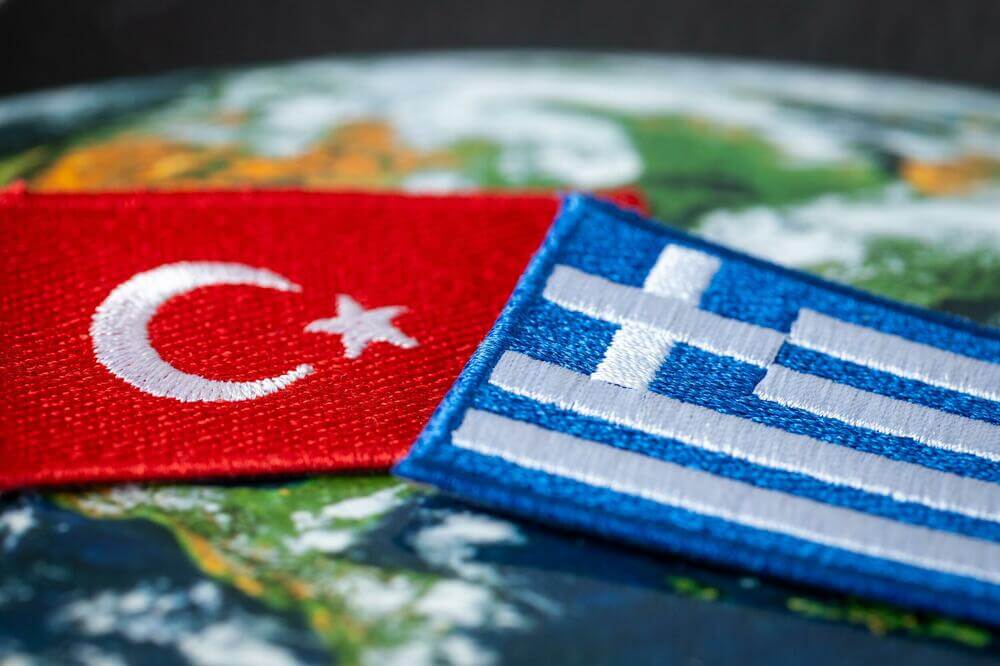
Whenever tensions rise between Türkiye and Greece, the same phrases tend to reappear: “Türkiye is aggressive.” “Türkiye threatens the Aegean.” “Türkiye wants to overturn the status quo.”
It would be neither fair nor intelligent to dismiss Greek security concerns as imaginary. Türkiye is larger, militarily stronger and carries greater regional weight. Greek historical memory includes the Ottoman past, the 1922 Asia Minor catastrophe, the 1974 Cyprus intervention and repeated crises in the Aegean. But Turks have a historical memory too. Over the past two centuries, that memory has been shaped less by expansion than by retreat, loss and a recurring sense of encirclement.
A History of Retreat, Not Just Expansion
Anatolia has been at the centre of Turkish political power for roughly a millennium. Large parts of the Balkans, including much of what is now Greece, remained under Ottoman rule for centuries. Then the direction of history reversed. From the 19th century onwards, the Ottoman Empire retreated from the Balkans. New independent states emerged. Borders were redrawn. Hundreds of thousands died and millions of Muslims and Turks were displaced towards Anatolia, abandoning homes, land and property. Even Thessaloniki, the birthplace of Mustafa Kemal Atatürk, remained outside the borders of the new Turkish Republic. To view modern Türkiye simply through the prism of a former empire seeking renewed expansion is therefore historically incomplete.
When the Megali Idea Reached Anatolia
After Greek independence, the Megali Idea became one of the defining ambitions of modern Greek nationalism: the extension of the Greek state towards territories regarded as historically Hellenic. The landing of Greek forces at İzmir in 1919 carried that ambition into Anatolia. Greek troops advanced deep into western and central Anatolia. Turkish and Greek civilians alike paid a heavy price. Violence, destruction and forced displacement left scars on both societies. The Greek campaign ended with the Turkish victory of 30 August 1922. Its political project ended, but its memory did not. Some of Türkiye’s present-day security reflexes are rooted not in abstract fears, but in lived historical experience.
The Population Exchange: Lives Torn Apart on Both Shores
The 1923 population exchange remains one of the most painful and instructive episodes in Greek-Turkish history. Roughly 1.2 million Orthodox Christians left Anatolia for Greece, while hundreds of thousands of Muslims moved from Greece to Türkiye. They did not merely change countries. They left behind homes, graves, neighbours, vineyards and olive groves.
It was a tragedy for the Greeks of Anatolia. It was also a tragedy for Muslim and Turkish exchangees from Greece. By today’s standards, this was a harsh form of compulsory demographic separation. What happened afterwards, however, is just as important.
In 1922, the two countries were at war. Eight years later, they sat down together. Atatürk and Eleftherios Venizelos did not forget the past. They simply refused to allow the future to remain hostage to it. In 1930, the two countries entered a new era of reconciliation. Four years later, Venizelos nominated Atatürk for the Nobel Peace Prize. That may be the single most important lesson in the history of Greek-Turkish relations: Hostility is not destiny.
What Is the Aegean Dispute Really About?
Today, Athens argues that international law allows Greece to extend its territorial waters to 12 nautical miles. Türkiye emphasises the exceptional geography of the Aegean. Under the present six-mile regime, according to Turkish calculations, Greek territorial waters cover roughly 43.5 per cent of the Aegean and Turkish waters about 7.5 per cent. A Greek extension to 12 miles could raise the Greek share to more than 70 per cent. Athens says sovereign right. Ankara says equity, geography and strategic balance.
Türkiye also argues that the demilitarised status of certain eastern Aegean islands has been eroded. Greece responds by pointing to Turkish military capabilities and its right to self-defence. To pretend that one side possesses the whole legal and strategic truth would be simplistic. The challenge is to reconcile sovereignty with geography, and legal entitlement with equitable balance.
Cyprus Carries Two Traumas
Cyprus is even a more sensitive issue for both sides. The Republic of Cyprus was created in 1960 on a constitutional partnership between Greek and Turkish Cypriots. Intercommunal violence followed from 1963.
In Turkish Cypriot memory, the following decade is associated with political exclusion, insecurity and the threat of Enosis, the union with Greece. In Greek Cypriot memory, 1974 marks the beginning of division and Turkish military presence in the north.
After the Greek junta-backed coup of 15 July 1974, Türkiye intervened militarily, invoking the Treaty of Guarantee. Türkiye regards this as an intervention to protect Turkish Cypriots and the constitutional order. Greek Cypriots regard it as an occupation. No durable settlement can be built by erasing either of these historical memories.
Washington and Brussels Cannot Replace Geography
Greece naturally uses its membership of the EU and its defence relationships with the US and France as strategic leverage. That is understandable. But alliances cannot replace geography. The interests of Washington, Paris or Brussels will not always coincide perfectly with those of Athens. Türkiye, for its part, should not interpret every Greek partnership as an encirclement conspiracy. The more durable truth is simpler. Governments change, alliances shift, priorities evolve, but geography does not. Türkiye and Greece will remain neighbours.
A New Aegean Compact
The answer is not sentimental talk of eternal friendship. Both sides should avoid unilateral, irreversible changes to the status quo. Military confidence-building measures should become permanent. Maritime disputes should be addressed through law and equity rather than nationalist theatre. Cyprus should be approached through the security and political future of both communities, not through the elimination of one side’s historical narrative. The Aegean Sea itself should gradually be transformed from a zone of confrontation into a zone of shared prosperity thanks to energy resources, tourism, shipping, fisheries and common cultural heritage. Climate resilience, wildfires, earthquakes, and environmental protection also require cooperation and solidarity between Türkiye and Greece.
The generation of Atatürk and Venizelos endured far greater suffering than ours. Yet they managed to build peace. Why should we be less capable? Statecraft in Greek-Turkish relations is neither the Megali Idea nor neo-Ottoman nostalgia.It is about knowing the history, recognising suffering, and not abandoning legitimate rights. But it is also about not condemning future generations to fight the wars of their ancestors. The greatest victory Türkiye and Greece can achieve is not winning the next Aegean crisis. It is building a relationship in which the next crisis never needs to happen.