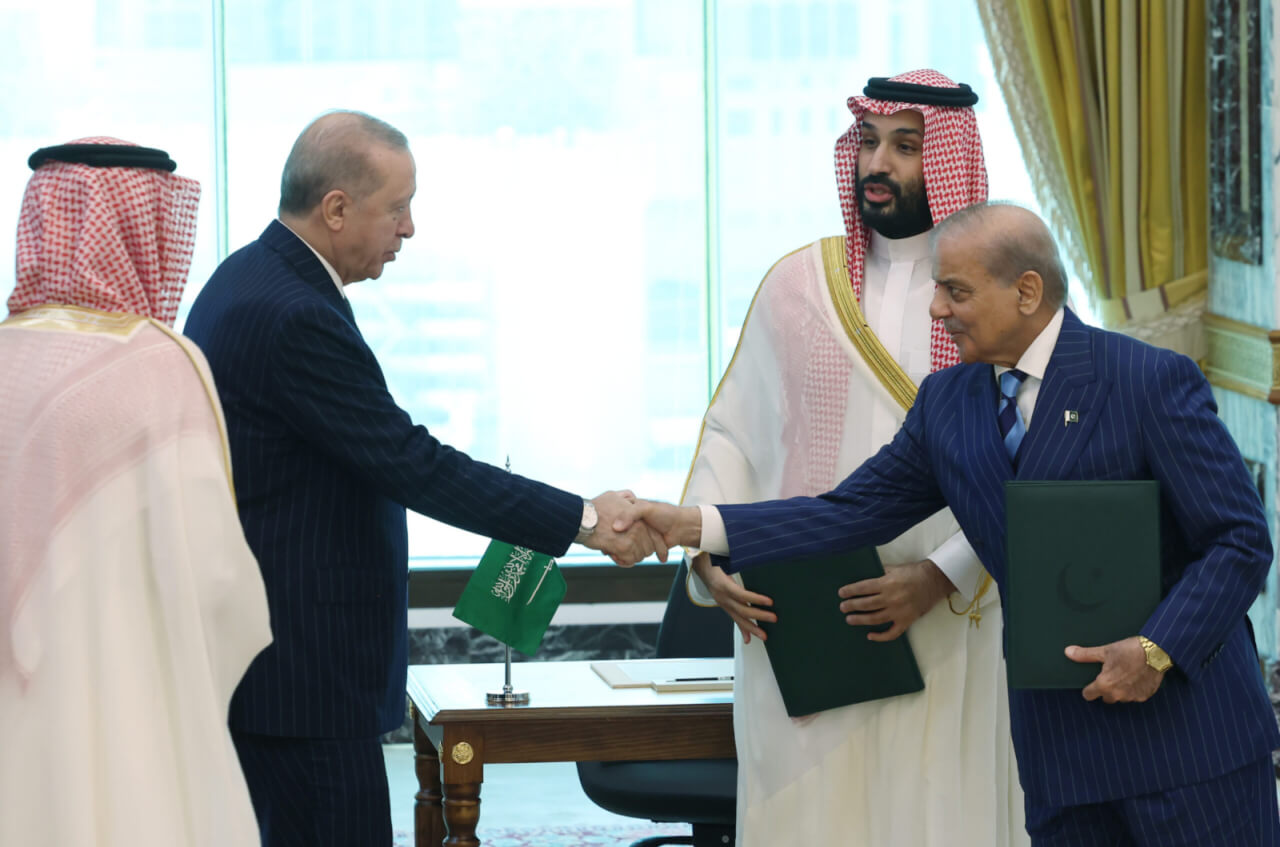
August 7, 2026, marked an important turning point in the highly unstable trajectory of the Middle Eastern security architecture. Three major regional powers, Türkiye, Saudi Arabia, and Pakistan, signed a trilateral military pact entitled the Mecca Joint Defense Agreement. The trilateral agreement followed in the footsteps of the initial Strategic Mutual Defense Agreement (MDA) signed by Saudi Arabia and Pakistan on September 17, 2025. The new pact, officially known as the MDA, was based on three core principles.
The first and foremost element was collective defense. Reminiscent of NATO’s famous Article 5 principle, an armed attack on any member state would be an attack on all three and would trigger a joint military response. The second principle involved regional deterrence. The aim was to contribute to security and stability in a highly volatile and unstable region, marked by conflicts involving the United States, Israel and Iran, as well as shifting geopolitical dynamics. The third principle focused on maximizing joint capabilities by capitalizing on the comparative advantages of the participating states: Saudi Arabia’s financial and energy resources, Türkiye’s large standing army within NATO coupled with its rapidly expanding defense industry, and Pakistan’s nuclear capabilities and deterrent capacity.
The Alliance established an institutional framework to provide an operational basis. A permanent Secretariat was created in Riyadh, and the first Secretary-General was appointed from Pakistan for an initial term of three years. A key component of the Alliance’s early development involved the establishment of the Strategic, Political and Defense Committee, designed to facilitate defense industry cooperation and promote joint technological ventures.
The timing of the MDA coincided with what many analysts have described as a “post-American” Middle East. Unconditional US support for Israel, culminating in the War on Iran, has further destabilised an already highly unstable region. The war, which has continued for six months with no clear end in sight, has been costly in military, economic and human terms. It has also undermined the image of the United States and Israel not only in the Middle East but globally. Furthermore, the inability of the United States to protect its Gulf allies from Iranian attacks or ensure the uninterrupted functioning of the Strait of Hormuz has weakened the core security bargain that long justified its extensive military presence in the region.
A “post-American” Middle East does not mean the withdrawal and eventual disappearance of the United States from the region. The United States will continue to be a pivotal global actor in Middle East affairs. It is likely to maintain, together with its key Western allies, extensive support for Israel while simultaneously pursuing its broader objective of reshaping Iran in line with its strategic interests. Israel, strongly backed by Western powers and possessing substantial economic, military and technological capabilities of its own, will remain a major force in regional politics, particularly in an environment where Iran’s relative power has been significantly weakened. The growing involvement of non-Western global powers such as China and Russia could complicate the regional landscape even further.
Yet, in spite of these considerations, we might well be moving to a “Post-American” Middle East in a different sense. The United States may increasingly seek to reduce its direct military footprint and transfer a greater share of the burden of regional security to key regional powers. A similar pattern is observed in NATO, where European allies have come under increasing pressure to assume greater responsibility for their own defense. The same logic appears to be operating in the Middle East. Consequently, the US response to the MDA was broadly supportive, even if not particularly enthusiastic. American interests broadly coincide with the desire of regional, and in Pakistan’s case, supra-regional powers to achieve greater strategic autonomy, provided that these aspirations do not conflict with fundamental US foreign policy priorities.
The principal actors involved in the MDA themselves do not envisage the Alliance as involving a total break from the United States. Washington will continue to be a critical strategic partner for all three countries. From Türkiye’s perspective, for example, the Mecca Defence Alliance is viewed as complementary to NATO and as part of a broader effort to diversify and expand its security partnerships by building existing alliances. More broadly, the MDA is conceived of as one component of Türkiye’s multi-dimensional foreign policy strategy, which also requires strong interaction with non-Western global powers like China and Russia, as well as with the Shanghai Cooperation Organization (SCO). Indeed, the Turkish leadership participated, on the basis of Türkiye’s observer status, in the SCO Summit held in Bishkek, Kyrgyzstan, at the end of August 2026, shortly after the signing of the Mecca Defense Agreement,
What we observe in the current conjuncture is therefore paradoxical. American setbacks during the Iran War have created a regional vacuum that provides additional space for key regional actors to pursue greater strategic autonomy and play a more active role in the provision of regional security. At the same time, although the United States is not willing to relinquish its central role in the region, it has become more tolerant of regional initiatives in the name of burden sharing, albeit within clear limits.
The MDA is a considerably looser and more flexible entity than NATO. This flexibility may prove to be one of its principal advantages. Nevertheless, the Alliance also carries significant risks. It remains unclear, for example, under what circumstances an Article 5-type commitment would become operational. There is an obvious danger that member states could be drawn into conflicts far beyond their borders and interests. What would happen, for instance, if Saudi Arabia were attacked by Iran? Would Türkiye be expected to become directly involved in a conflict far removed from its immediate neighborhood? For this reason, a relatively loose and flexible security arrangement emphasizing deterrence and defense collaboration may represent a safer path for the MDA than a rigid framework based on automatic collective military action.
One factor that could enhance the effectiveness and long-term viability of the MDA is its ability to become more inclusive through the admission of new members. Indeed, Türkiye appears to be broadly consistent with this perspective, with the expectation that influential regional actors such as Egypt and Qatar could eventually join the organisation.
Finally, and perhaps the most important of all, much will depend on the Alliance’s approach toward Israel. The MDA is likely to play a more constructive role if it adopts a strategy of balanced engagement rather than direct confrontation. This consideration is particularly relevant from the Turkish perspective. Türkiye has legitimate concerns regarding Israeli policies across a broad range of issues, including Gaza, Iran, Syria and the Eastern Mediterranean. Yet a policy based on diplomatic engagement and a more measured tone is likely to be more productive. Such an approach would also facilitate the management of relations with Türkiye’s traditional Western allies and help contain regional tensions. Conversely, if initiatives such as the MDA generate heightened threat perceptions among key regional actors, they could provoke counter-reactions that contribute to further instability and conflict rather than the emergence of a more secure and stable regional order.