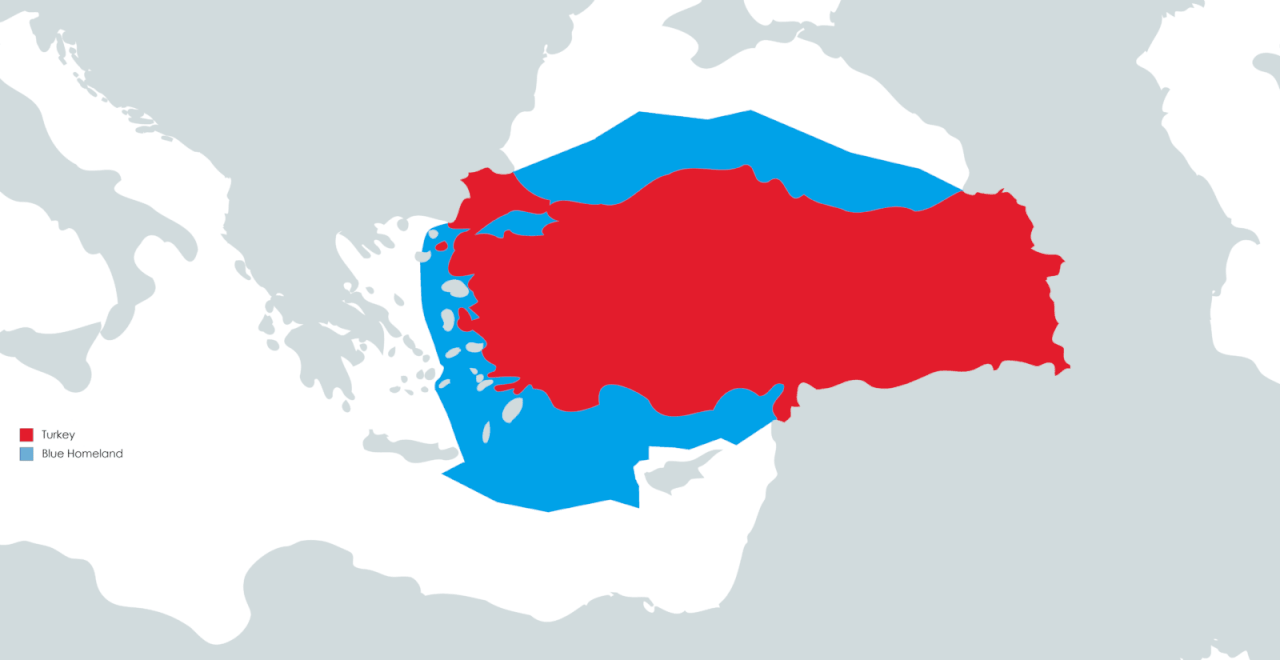
In Türkiye, a country bordered by seas on three sides, there has been no comprehensive legal framework to fully address maritime jurisdiction since the enactment of the Territorial Waters Law in 1982. The draft “law on maritime zones”—which has recently entered the public discourse and is frequently referred to in the press as the “Blue Homeland” law—aims to fill this gap. The legal initiative is rooted in the “Blue Homeland” doctrine, first articulated in 2006 by Turkish naval officers, including Admiral Cem Gürdeniz. The doctrine envisions Türkiye not as a country with a narrow coastline but as a maritime power with jurisdiction over approximately 462,000 square kilometers of sea stretching across the Black Sea, the Aegean, and the Eastern Mediterranean.
The Ministry of National Defense has stated that it contributed to the regulation at the military, technical, academic, and legal levels; the draft aims to make territorial sea boundaries, continental shelf rights, and exclusive economic zone rights legally binding under domestic law. In the coming weeks, the Grand National Assembly of Türkiye is expected to take up this draft law. In this article, I will attempt to provide an overview of the key elements addressed in the draft, based on the information that has been reported in the media so far.
The Diplomatic Context: Rising Aegean Tensions
The timing of the draft law is no coincidence. Recent diplomatic developments suggest that tensions in the Aegean are once again on the rise. While Greek authorities announced fishing exclusion zones in the Aegean and Eastern Mediterranean in April, Athens released maps suggesting it had expanded its territorial waters beyond 6 nautical miles without coordinating with Ankara. The Turkish Ministry of Foreign Affairs dismissed these maps as “fictitious borders violating Turkish maritime jurisdiction,” declaring them null and void. Meanwhile, in May 2026, a Turkish patrol boat warned the Panama-flagged Ocean Link vessel, which was laying a fiber-optic cable between Greek islands in the region. According to Greek sources, this was one of several similar incidents in the Aegean since the beginning of the year.
Of course, the issues between Türkiye and Greece are not new. They are multi-layered, shaped by historical and political grievances that span the Aegean, the Eastern Mediterranean, and Cyprus. The gap between the parties’ positions has long remained unbridged. Maritime disputes between the two states constantly fuel mutual competition, not only in military power but also in politics, law, diplomacy, and academia. Türkiye’s draft legislation appears to be part of a broader legal framework that extends beyond its unresolved disputes with Greece to encompass its interests in the Black Sea and the Eastern Mediterranean.
The Draft Law: Technical and Strategic Dimensions
At a press conference held on May 12, 2026, officials from Ankara University National Center for the Sea and Maritime Law (DEHUKAM) and senior members of the Presidential Security and Foreign Policy Council stated that the draft had not yet been submitted to Parliament as a bill but remained a working document still under development. Accordingly, the draft constitutes a comprehensive framework law intended to codify Türkiye’s maritime jurisdiction and the boundaries of the exclusive economic zone in the Black Sea, and to incorporate the agreements signed with Libya and the Turkish Republic of Northern Cyprus into domestic law.
The draft constitutes a comprehensive framework law with two distinct dimensions. Technically, it aims to address gaps in domestic law by transposing into legislation the principle of “relevant and specific formations” as established by international court rulings — most notably the International Court of Justice’s 2009 judgment in Romania v. Ukraine — and by providing Türkiye with a clear domestic legal basis for its maritime operations and claims. Strategically, the draft is designed to formally assert Türkiye’s positions on the Straits, the Aegean, and the Eastern Mediterranean through a concrete legislative instrument.
The draft also incorporates the maritime delimitation agreements Türkiye has concluded with Libya and the Turkish Republic of Northern Cyprus, enshrining these in domestic law. In the Eastern Mediterranean, where Türkiye has been active through seismic surveys and drilling operations in recent years, the legislation has the potential to provide a legal framework for Türkiye’s energy interests. This dimension takes on added significance given the accelerating pace of offshore gas development in the region, including Cyprus’s ongoing negotiations with major international energy companies.
Implications for International Law and Regional Stability
Although Türkiye has not ratified the 1982 United Nations Convention on the Law of the Sea (UNCLOS), it largely follows those of its provisions that are reflected in customary international law. The draft bill appears to aim at enshrining Türkiye’s position in domestic law within the framework of international law, rather than binding Türkiye to a convention it has not ratified. Rather than foreclosing negotiation over the Aegean, the draft law seeks to reduce ambiguity at the negotiating table, signaling that Türkiye’s characterization of the Aegean as a “semi-enclosed sea” —a position specific to this region— remains operative.
The draft also has the potential to define the legal framework for Türkiye’s interests and rights in the Eastern Mediterranean energy competition, where it has been active through drilling and seismic research operations in recent years. Additionally, the draft enshrines in law Türkiye’s position that the waters of the Dardanelles, the Sea of Marmara, and the Bosphorus constitute its internal waters; by placing Turkish authority over property rights, security, and transit restrictions within these waters on a statutory footing, the draft directly bears on the interpretation of the Montreux Convention. The draft, therefore, carries significant strategic implications for NATO members with Black Sea access and for Russia alike. Türkiye’s invocation of the Montreux Convention to restrict warship passage during the war in Ukraine had already demonstrated the convention’s strategic salience.
Conclusion
Ultimately, it would be incorrect to interpret this codification effort — which aims to establish a legal framework for Türkiye’s maritime zones — as a geopolitical revision or an act of aggression. In its current draft form, the regulation defines sovereignty claims, fills gaps in domestic law, and provides Türkiye with the legal instruments to assert its maritime claims in diplomatic and legal forums. That said, it carries significant implications for Greece and other European Union member states; Ankara’s move to establish a legal basis for asserting jurisdiction in the Aegean could escalate future disputes.
At the same time, given that maritime law is an inherently contested and evolving domain, codifying Türkiye’s positions could lend them greater legal clarity and weight. This move should therefore be seen as a concrete step toward addressing what I have previously described as “sea blindness” in Türkiye. Much remains to be done, however, in cultivating a broader appreciation of the sea — not only as an instrument of power, but as a domain of scientific inquiry and commercial opportunity.