This year’s BRICS summit was held in New Delhi on 12-13 September, with India assuming the chairmanship. The summit was organized around the broad and relatively non-controversial theme of “Building Resilience, Innovation, Cooperation and Sustainability.” Despite the differences among its eleven member states, the New Delhi Declaration was adopted unanimously and reflected the bloc’s shared vision regarding multilateralism, global governance, geopolitics, peace and security, as well as concerns relating to technology, agriculture, and sustainability.
India-China-Russia Triangle
At the risk of doing insufficient justice to a 140-point declaration spanning 45 pages, several key outcomes of the summit merit particular attention. The central theme was reform of the United Nations Security Council. China and Russia, as permanent members, expressed support for a greater role for India and Brazil within the Council. BRICS also advocated substantial reform of major global institutions such as the IMF and the WTO to make them more representative and provide a stronger voice for the Global South. Another critical element that received considerable attention throughout the summit was the call for peace and restraint in the Middle East. The declaration also underscored the importance of responsible AI governance and the need to strike a balance between innovation and social stability.
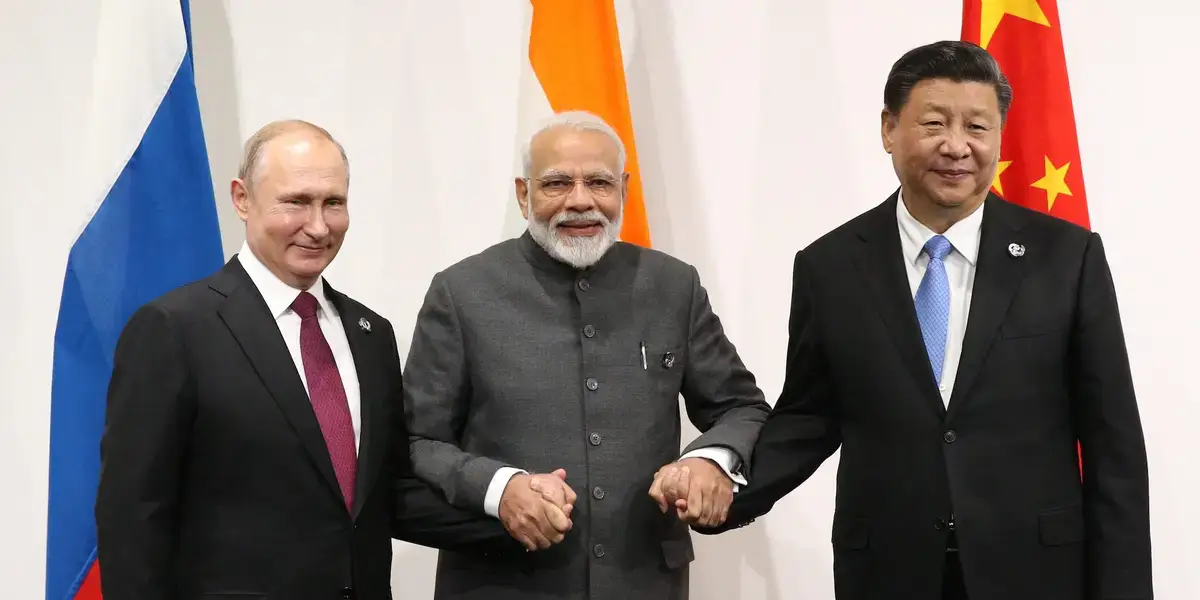
Looking beyond the official declarations, the New Delhi Summit revealed several noteworthy features concerning the interaction among different BRICS members. Although all eleven member states were represented, with Saudi Arabia still awaiting full ratification of its membership status, the proceedings were dominated by three core states: India, China, and Russia. The family photographs taken during the summit clearly illustrated this pattern, with India’s Narendra Modi, China’s Xi Jinping, and Russia’s Vladimir Putin occupying center stage. Trump administration policies appear to have played an important role in drawing India closer to the established Russia-China axis, thereby strengthening the emerging India-China-Russia triangle at the core of BRICS grouping.
It was quite striking that the Chinese President Xi Jinping made his first official visit to India in seven years. It was equally striking that this was the first BRICS summit that Putin had attended since the onset of the war in Ukraine in February 2022. The enlarged BRICS, which expanded from five to eleven members over the course of 2024 and 2025, but dominated by the big three, projected an image of cohesion at a time when the Western alliance appeared increasingly fragmented and internally divided, with an increasingly unpopular Donald Trump both domestically and globally, and a progressively more inward-oriented and defensive Europe concerned with its domestic problems and the challenges posed by the far right.
Modi’s Performance
The Indian Prime Minister Narendra Modi was unquestionably the central figure of the summit. Modi invested considerable effort in the summit. He delivered a confident and effective address to the summit and made a critical remark highlighting the importance of ending the war and achieving peace in the Middle East. He also criticized the unilateral use of tariffs and warned against the “weaponization” of technology and critical minerals. Furthermore, he was involved in a series of bilateral meetings with heads of state and, in some cases, with foreign ministers. Modi played an instrumental role in bringing Iran and the United Arab Emirates, on opposing sides of the Iran war, to the negotiating table leading to reproachment between the two sides. Hence, the New Delhi summit could be considered a major diplomatic achievement for Modi.
In contrast, Xi Jinping’s presence was important but more subdued. He made an important speech emphasizing the critical the role that China and BRICS could play in negotiations to end costly military conflicts. Yet, he stayed only briefly and held no bilateral meetings with individual heads of states, apart from his meeting with Modi. Xi is likely to assume a more prominent role when China hosts the BRICS summit next year.
The New Delhi summit was also a notable success for Vladimir Putin. The summit provided a further opportunity for Putin to re-establish himself as a legitimate actor in world politics, a process which was helped by the War on Iran, despite the continuation of the war in Ukraine. The summit was also instrumental in strengthening the diplomatic and economic ties between India and Russia, with Russia emerging as a progressively more important source of energy and trading partner for India following the Iran war.
The relative absence of Brazil and South Africa deprived the summit of what might be described as the more democratic and socially progressive dimension of BRICS politics. Brazilian President Lula could not attend due to his preoccupation with the forthcoming elections in October. Brazil was represented by its Foreign Minister, Mauro Vieira. Not surprisingly, therefore, more controversial topics such as dealing with global inequality and ending the dominance of the US dollar through its replacement by alternative currencies were effectively sidelined from the agenda. There is no doubt that key BRICS leaders in the summit wanted to avoid retaliatory action by the United States, as occurred after the previous Rio summit.
Peace and Contradictions
Turning to the theme of ending violent conflicts and achieving peace, the messages conveyed by the Chinese and Indian leadership were important and occupied center stage at the summit. The tone of the deliberations reflected in the final declaration, however, was quite muted. To reach consensus, Iran and the United States were not explicitly named. Indirect references were made to the Iran war. The summit statement condemned unilateral military actions as well as attacks on peaceful nuclear infrastructure without pointing the finger at a particular nation. Paradoxically, however, the declaration explicitly criticized Israel for its actions and violence in Gaza and Lebanon. Xi Jinping, in his speech, emphasized the role that China could play as a mediator in efforts to end the war in the Middle East. However, the plea for peace was expressed in broad terms, lacking a clearly defined roadmap or action plan.
Moreover, the position of India, China and other major BRICS members as peacemaking actors was confronted with a major paradox, namely the role of Russia in instigating and prolonging a costly and unprovoked war in Ukraine. Russia was effectively restrained from direct criticism, given its founding member status in BRICS and the importance of energy trade with Russia for major BRICS members such as China and India. However, the lack of active opposition to the Ukraine war clearly undermined the status of BRICS as a key peace-promoting actor, viewed from a broader, global perspective.
On a separate note, the signs of unity and rapprochement involving India and China should not obscure serious underlying tensions and differences between these two major powers. The New Delhi summit clearly demonstrated that India under Modi is increasingly positioning itself as a global power. Whilst China and India are likely to cooperate on a broad set of issues, their economic and geopolitical rivalries are likely to continue and will shape the future of BRICS, creating an uneasy mixture of cooperation and competition amid continued tensions.
Finally, it is important to emphasize that BRICS, in a summit dominated by India and driven by the Indian perspective, carefully avoided an “anti-Western” stance. Modi was quite explicit in his plea that BRICS would aim to expand the opportunity space for the Global South in economic and diplomatic terms, without necessarily taking an anti-Western position. This is clearly in line with India’s vision of trying to play a balancing role between the key Western states and BRICS as part of a multidimensional foreign policy. Beyond long-term strategic vision, this approach is also driven by the desire to avoid confrontation with the Trump Administration at a time of continued imposition of US tariffs and sanctions affecting all major BRICS.
Conclusion
The New Delhi Summit clearly took place under the shadow of Trump, although Trump and the United States were not explicitly part of the dialogue. The influence of Trump was felt in a paradoxical fashion. It helped drive greater BRICS unity and brought India closer to the original Russia-China axis. At the same time, key powers involved were careful to refrain from direct confrontation with the United States. Key elements of the Trumpian order came under criticism, albeit indirectly and in a moderate tone.
As a final observation, the New Delhi summit was successful in projecting an image of BRICS unity and in presenting the grouping as a constructive actor capable of addressing major global challenges. Beneath this appearance of cohesion, however, important divisions remain. One of the most significant concerns is the nature of relations with the West. Countries such as India and Brazil continue to favor a more balanced and pragmatic relationship with Western powers, whereas other members, most notably Russia and Iran, adopt a much more explicitly anti-Western stance. How BRICS manages these divergent strategic orientations will play an important role in determining its future trajectory and coherence as a political and economic coalition.