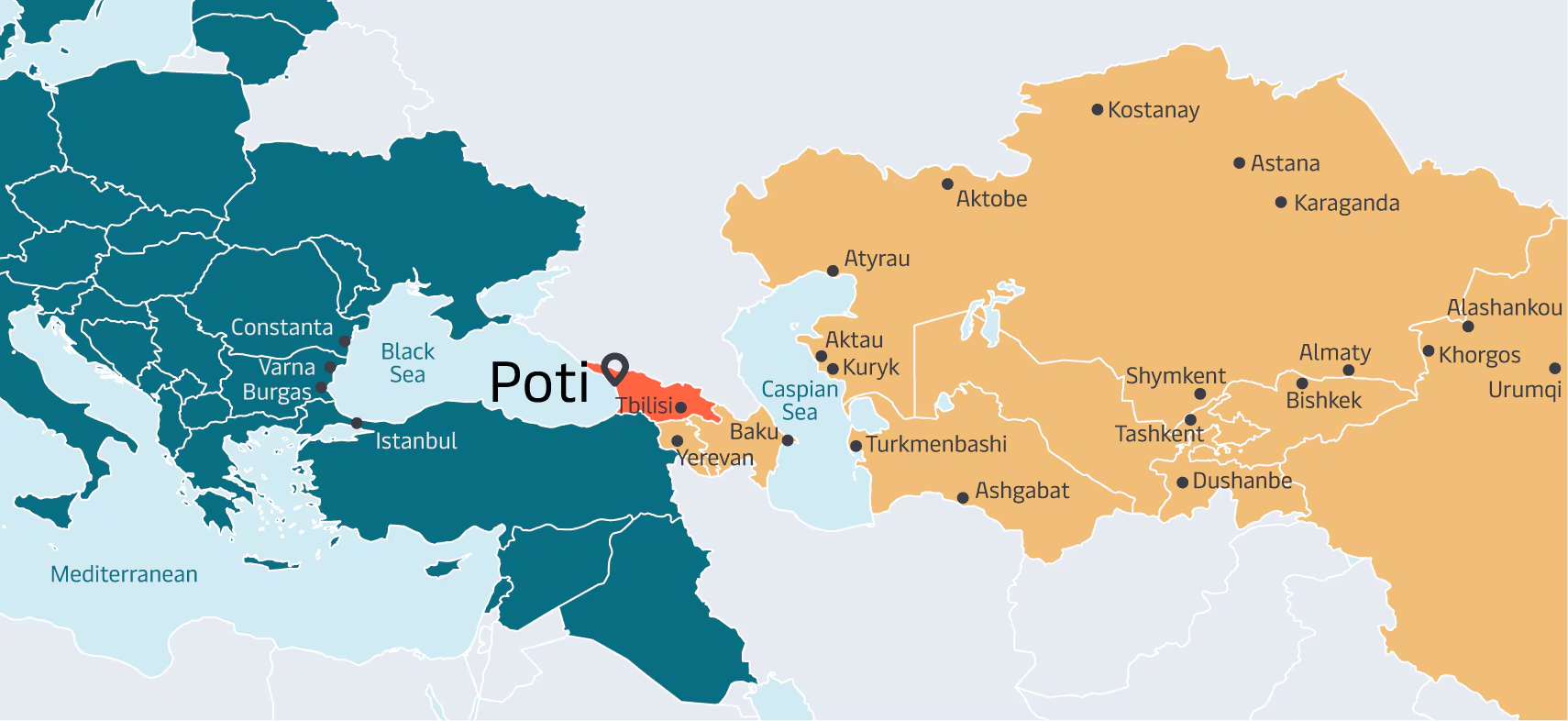
Against the backdrop of ongoing conflicts in the Middle East, crises along key maritime routes and supply chain disruptions have sharply escalated demand for secure overland and regional corridors. By extending transit times and driving up fuel, insurance, and tariff costs, the deepening maritime crisis has induced cost inflation across global supply chains. Concurrently, the heightened focus on the Middle Corridor connecting China to Europe presents a historic opportunity for Georgia, situated at one of the route’s critical junctions. While Georgia’s role as a regional logistics and distribution hub is expanding, the country simultaneously faces severe existing infrastructure constraints. Naturally, these emerging opportunities have brought long-standing logistical bottlenecks into sharp focus. Consequently, the government is actively evaluating the operational capacity of the Port of Poti, its structural limitations, and the urgent strategic choices facing the country.
The Current Operational State of the Port of Poti
Historically handling up to 85% of Georgia’s cargo before recent regional disruptions, the Port of Poti serves as the backbone of the national logistics system. Positive trends stemming from increased demand are clearly reflected in official data. “APM Terminals Poti” recently published its operational figures for the first nine months of 2026, recording growth across containerized, general, and ferry freight.
From January through September 2026, the Port of Poti processed 525,211 TEUs of container cargo, a 9% increase compared to the same period in 2025. The highest monthly turnover was recorded in July, with 65,759 TEUs handled. Vessel traffic saw a corresponding surge: during the first nine months of 2026, the port received 336 container ships, compared to 268 during the same period in 2025, with 45 container vessels processed in September alone. General cargo throughput demonstrated particularly robust growth, reaching 324,656 tons in the first nine months of 2026, a 61.7% year-on-year surge. Ferry operations also maintained positive momentum, handling 162,843 tons of cargo compared to 123,350 tons during the corresponding period of 2025.
Operational and Structural Challenges Facing the Port
Despite growing demand, a proposed $300 million investment project aimed at expanding the Port of Poti has remained pending since 2018. Zviad Chkhartishvili, Head of the Poti Sea Port Administration, acknowledged that the port is struggling to process the volume of cargo redirected due to Middle Eastern conflicts. He attributed this primarily to severe throughput limits, noting that the port currently operates at maximum capacity. Although container throughput reached record highs in 2025, growth continued into the first quarter of 2026, rising by approximately 5% year-on-year.
Under the latest development framework for port expansion and terminal construction, a final agreement between the government and investors was slated for 2023, construction was scheduled to start in 2024, and APM Terminals was expected to receive its first vessel at the expanded facility by 2026.
At present, discussions regarding the Port of Poti revolve around three core challenges:
Despite operating at peak capacity, the influx of rerouted cargo from Middle Eastern and southern routes has exacerbated delays, creating an operational bottleneck. Furthermore, the port’s early 20th-century layout struggles to satisfy modern, large-scale commercial logistics requirements. To manage the ongoing flow, dockworkers are operating under emergency schedules, frequently forfeiting routine rest breaks. Moreover, because operational priority is assigned to containerized freight, overall capacity constraints are steadily eroding the handling of non-containerized cargo. As port authorities admit, while current throughput is being managed through extreme effort, a failure to perform timely dredging and expansion risks compromising the port’s competitive advantage against rapid cargo flows from the south.
Georgia’s Infrastructural Constraints in World Bank Analysis
In its report on Middle Corridor development, the World Bank evaluated Georgia’s transport infrastructure, identified operational constraints, and outlined development perspectives through 2040. World Bank calculations indicate that addressing primary infrastructure bottlenecks across the region will require at least $25 billion in investments by 2040, alongside an additional $30 billion dedicated to port and highway projects aimed at maximizing corridor-related economic activity.
The report notes that successfully executing these projects could boost Georgia’s GDP by an additional 3.61% (approximately $1.2 billion) and increase national employment by 0.79%, with the construction sector benefiting most significantly via a projected 23.6% growth rate. Furthermore, Georgian exports could rise by 1.61% ($70 million) and imports by 8.21% (approximately $1.48 billion).
Among Georgian ports, the World Bank singled out severe overcrowding at Poti as a critical concern. In 2025, against a total container capacity of approximately 650,000 TEUs, actual throughput reached 636,466 TEUs, representing an operational saturation rate of nearly 98%. The World Bank emphasizes that operating at near-total capacity poses severe congestion risks, making port capacity expansion an urgent necessity. As a short-term intervention, the World Bank recommends expanding capacity within Poti’s existing footprint: a targeted $250 million investment in modern equipment, operational systems, and terminal management optimization could expand container handling capacity by 200,000 TEUs, raising total capacity to 800,000 TEUs.
Strategic Initiatives and Ongoing Port Developments
Expanding the Port of Poti offers several clear strategic advantages. Dredging the existing port represents a significantly lower-cost, pragmatic, and commercially viable alternative for Georgia. Moreover, dredging initiatives can be financed through private investment, and deep-water capability would suffice to accommodate current cargo surges.
In June of this year, construction broke ground on a new berth at Poti Port following a $25 million loan agreement between the U.S. International Development Finance Corporation (DFC) and local firm Pace Group, building upon a prior $50 million U.S. commitment to the “New Poti Sea Port” initiative in 2022. This expansion coincides with elevated international interest in the Middle Corridor and the ongoing development of the deep-water port at Anaklia. Upon completion, the project is projected to expand port handling capacity by 1 million tons while improving trade security and efficiency across the Trans-Caspian route. At the groundbreaking ceremony, Prime Minister Irakli Kobakhidze stated that “Georgia has taken another step toward establishing itself as a regional logistics hub.”
According to Irakli Tateishvili, CEO of Pace Group, Phase II of the Poti Port development project is scheduled for completion by late 2027. This phase involves constructing an additional quay to expand bulk cargo capacity. The plan calls for a 250-meter quay with a depth of 13 meters, dredging the approach basin, installing a modern ship loader, and building a 700-meter conveyor system that connects the existing urea storage facility directly to the new berth. Concurrently, APM Terminals Poti announced a comprehensive modernization program aimed at dredging the entrance channel and all 15 berths.[1] The operator plans to deploy an additional container crane in 2026 to accelerate cargo handling, with the overarching goal of increasing port capacity to 650,000 TEUs while maintaining stringent safety standards.
Conclusion
Statistical indicators and World Bank analyses demonstrate that record cargo throughput at the Port of Poti offers substantial economic potential for Georgia. However, an operational saturation rate reaching 98% creates an “hourglass” bottleneck, underscoring that existing infrastructure is pushed to its limits. While Phase II of the Pace Group project (backed by the DFC) and APM Terminals’ targeted dredging operations offer temporary relief, sustainable long-term growth requires comprehensive, large-scale structural solutions. Ultimately, accelerating public-private dialogue and decisive action on Poti’s expansion remain imperative to preserve Georgia’s position as a regional transit hub. Failing to address operational bottlenecks risks driving shippers toward alternative trade routes due to mounting delays and elevated logistics costs.
[1] APM TERMINALS-ი ფოთის პორტის შესასვლელი არხისა და ნავმისადგომების დაღრმავებაზე მუშაობს 13.01.2026 https://bm.ge/news/apm-terminals-i-fotis-portis-shesasvleli-arkhisa-da-navmisadgomebis-daghrmavebaze-mushaobs