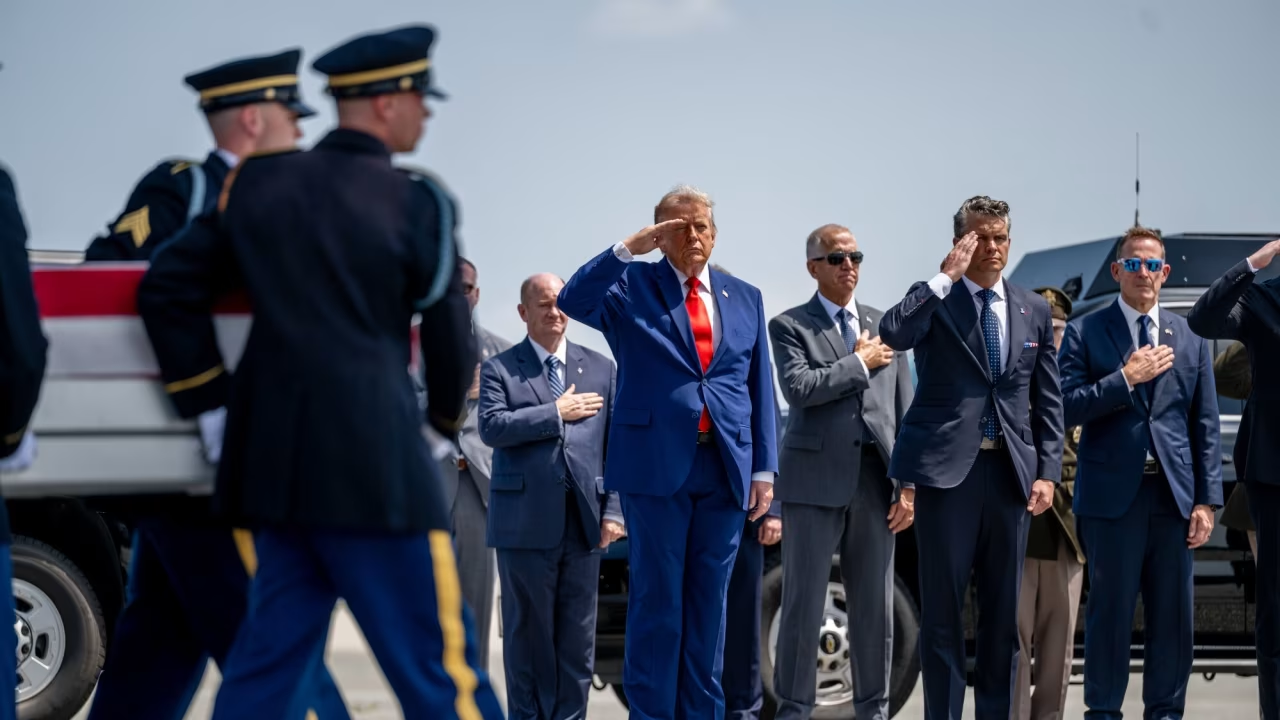
The morning after the ceasefire, the scoring started. Cable panels, op-eds, group chats, all asking the same thing: had Washington won or lost? Tehran was still standing, so some filed it under failure; others counted the damage and called it a win. Everyone shared the question, and the question is the problem. It treats one round as the whole match and one opponent as the whole board.
History runs only once and keeps no control group, so the most disciplined way to test a claim about it is the old trick of the thought experiment : hold the world steady, change a single thing, and watch what moves. Let me change the boldest thing I can. Suppose Washington got not a near-miss but everything it wanted. Run the tape forward a few years and grant the US its best case. The surprise is what the best case turns out to be about. Mostly, not Iran.
Run the tape forward
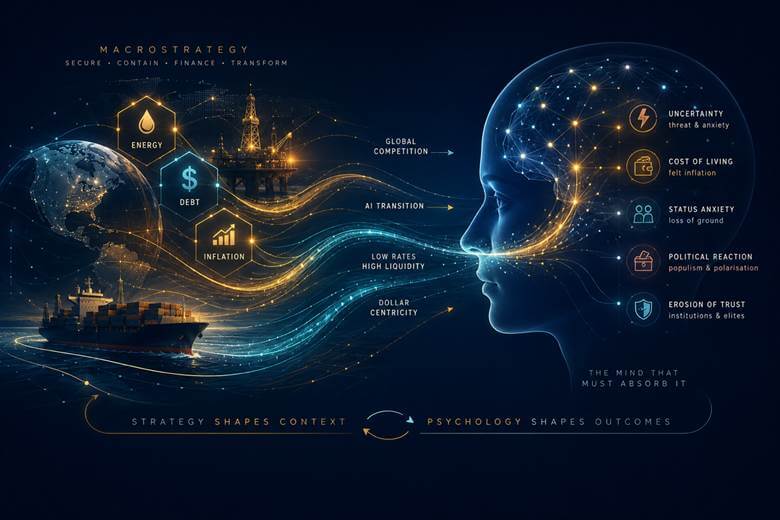
Step back far enough, and the regional crisis shrinks to one square on a much larger board. A superpower this deep in debt, stepping into the AI era, is not really hunting for a fallen regime in Tehran. Its real needs are duller: energy cheap and steady enough to run the data centers, money cheap enough to build them, and a slow inflation that wears down its debt without unsettling the dollar. From up there, Iran, Venezuela, Panama, and Cuba stop being separate stories. They are points on the map of energy and the routes it travels. Iran sits beside the Strait of Hormuz; Venezuela holds some of the largest oil reserves on the planet. The deeper aim is less to win a war than to quietly close the side doors through which a rival like China has been buying discounted, dollar-light energy, and with it, time.
None of this requires a secret room. The incentives simply point one way, and behavior follows, the way a market coordinates without a conductor. Secure the energy, deny rivals the cheap alternative, keep capital cheap enough to fund the transition, and let a little inflation do the slow work on the debt. Grant all of it. In the experiment, the strategy works: the books balance, and by every measure a treasury or a war college would recognize, America wins. The honest limit of the exercise is that aligned incentives are not the same as a plan; what it buys us is not proof of intent but a clearer view of the stakes.
A thought experiment earns its keep only if it can be checked. Start with three facts. Markets expect the Fed (Central Bank of the US) to raise rates. The new FED chair, Kevin Warsh, says he will watch different gauges. And the election is in November. Together, they mean one thing. Iranian and Venezuelan oil floods in, and crude settles into the $70-80 band. The new chair finds the gauges that make inflation look like it is falling, and the talk turns from hikes to cuts. America goes into November with a booming stock market. Afterwards, with inflation declared tamed and rates falling, the huge debt rolls over cheaply, and the AI race keeps being fed.
The kitchen table
Now move the camera. Leave the war room and the trading floor, and set it down on a kitchen table, on a Tuesday, in front of the electricity bill.
From here, the same victory reads as something else entirely. The inflation that lightened a national debt arrives as rent, groceries, and a number at the pump that keeps climbing while the news insists prices are under control. The official figure and the felt one have come apart, not because anyone fakes the data, but because in an inflationary world the measures that read coolest are the ones that get quoted. No one feels a statistic. People feel the rent and the checkout line, and they notice when the official number no longer matches their own.
This is the part the scoreboard cannot see, and it is where a century of psychology earns its place. We register a loss far more sharply than an equal gain; uncertainty reaches the nervous system as a threat, and pushes people toward whoever promises to make it stop. What unsettles a society has never been the size of the loss so much as the loss of control. People grow restless less because their wages have fallen than because they can no longer see where things will come to rest.
An unreadable victory
Hold the two cameras side by side, and a strange object appears between them: a victory that is real and unreadable at the same time. Here is the catch that the planners rarely price in. The very features that make the strategy work are the features that make it impossible for a citizen to read. Its gains are national, abstract, and delayed; its costs are personal, concrete, and now. Its central instrument, a tolerated inflation, is built to be quiet. Its scoreboard is kept in a statistical language most people were never taught. So a government can win the material game in a dialect its own citizens cannot translate.
The mind will not sit with that gap for long. Denied a legible cause for a loss, it can feel, it goes looking for one. This, I suspect, is the real engine of the conspiratorial turn, less stupidity or malice than a hunger for a story that fits the feeling. Herbert Simon warned that an abundance of information would buy a poverty of attention; the AI age threatens a poverty of meaning to match, and meaning, once denied, is exactly what a conspiracy rushes in to supply. When the official number says calm, and the kitchen says siege, a villain is easier to read than a balance sheet, and the authoritarian demagogue’s real gift is not a solution but a story short enough to hold.
There is a quieter cost underneath. What lets large societies work at all is a thin, almost invisible layer of trust, the long-earned human habit of extending good faith to strangers and to institutions . Scarcity and fear are precisely what thins that layer; a frightened population draws its circle of concern inward, toward its own. The same inflation that balances the national books can quietly spend down the one national asset that never appears on them.
The real battlefield
So, did the United States lose in Iran? On the board, probably not; by the only aim that mattered, easing that oil back into the world, it has likely already won.
But a country and its president can part ways here. The win is structural and slow; an election is local and soon. Before the November vote the president needs the victory to be legible, and a voter checks the pump, not the chessboard. Left hidden, the strategy quietly costs him his majority; only if its relief turns concrete in time, gas down, rates cut, savings up before people vote, does the win convert into votes. The nation’s success and the incumbent’s survival are not the same bet.
That is the trap in miniature. Grand strategy once moved by fleets and pipelines; now it moves, just as much, by whether someone at a kitchen table can make sense of their week. Which leaves the question the morning-after panels forgot to ask: what is a victory worth if the people who won it cannot read it?
Highlights:
(1) The Iran crisis was really about energy, debt, China, and the cost of money, not Iran alone.
(2) People feel the cost of living and the loss of control, not “grand strategy.”
(3) The real danger is a strategy that succeeds economically while leaving society insecure and distrustful.
(4) A victory written in a language its own citizens cannot read will be experienced as a defeat.
Onurcan Yılmaz
Onurcan Yılmaz is Professor of Psychology at Kadir Has University, Istanbul, and Director at MINT Lab. His research integrates moral psychology, cultural evolution, and political psychology to understand how cognitive and cultural processes shape morality, cooperation, and institutions. His work examines the origins of moral judgment, the cognitive architecture of moral consistency, and the mechanisms through which reflection, cultural learning, and social norms interact to sustain or transform moral systems. He also studies authoritarianism, democratic resilience, and ideological conflict, bridging basic psychological research with contemporary social and political challenges.
To cite this work: Onurcan Yılmaz, "Did the United States Really Lose in Iran? Macrostrategy Meets Political Psychology – Onurcan Yılmaz" Global Panorama, Online, 23 July 2026, https://www.globalpanorama.org/en/2026/07/did-the-united-states-really-lose-in-iran-macrostrategy-meets-political-psychology-onurcan-yilmaz/
Copyright @ 2025 Global Academy. Design & Development brain.work
All on-line and print rights reserved. Opinions expressed in works published by the Panorama belongs to the authors alone unless otherwise stated, and do not imply endorsement by the IRCT, Global Academy, or the Editors/Editorial Board of Panorama.
Newsletter Subscription
Subscribe to our newsletter to stay informed about updates.