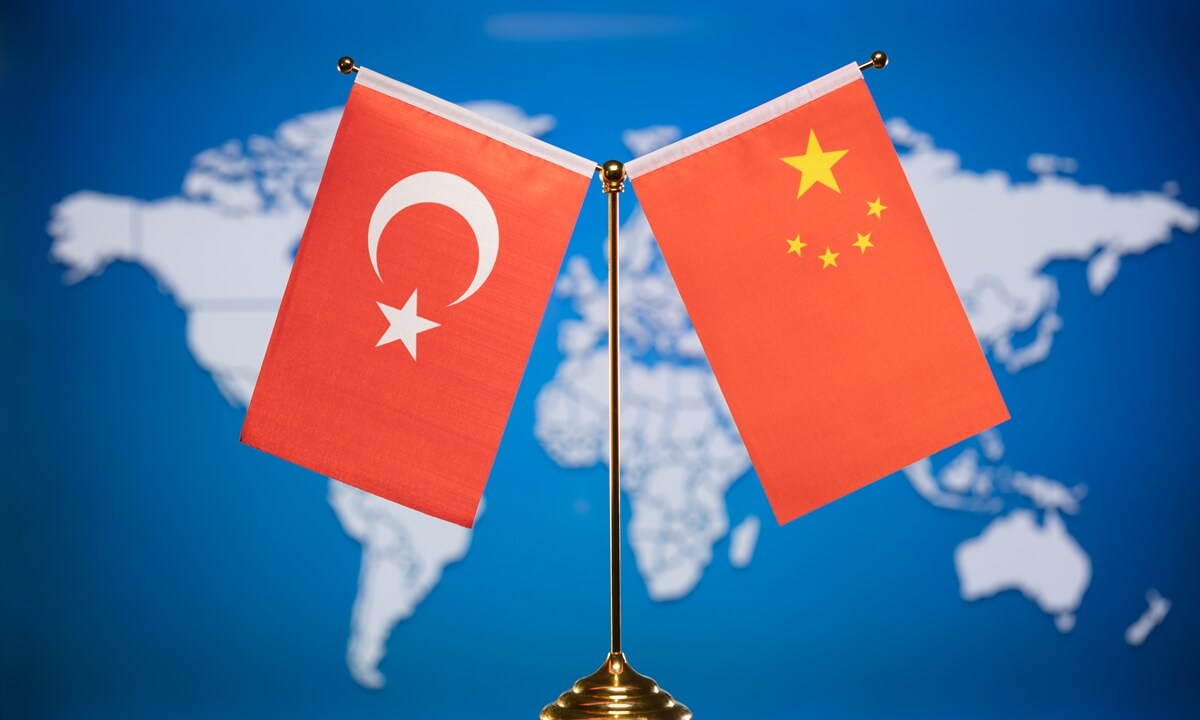
Turkish-Chinese relations have expanded considerably in the last few decades and are now firmly rooted in economic cooperation. The main interest of the Chinese business community in Türkiye stems from its large domestic market and profitable investment opportunities, which are attractive to investors.
The primary goal of this opinion piece is to analyse Türkiye’s political and economic relations with China. The first part of the study summarises the trade relationship between the two countries. Next, we examine the inflows and outflows of foreign direct investment (FDI) between the two countries. Finally, we will draw conclusions regarding the impact of economic cooperation with China on the Turkish economy and make recommendations for enhancing Türkiye’s competitiveness in international markets.
Political Relations
A significant landmark in the political and diplomatic relations between Türkiye and China was the establishment of a friendship treaty on 4 April 1934, followed by Türkiye’s recognition of the People’s Republic of China (PRC) on 5 August 1971.
The establishment of a consultation mechanism between Türkiye and the People’s Republic of China (PRC) in the 1980s was a key factor in strengthening the two countries’ relations. In 2010, bilateral relations were elevated to the level of ‘strategic cooperation’, which represented a significant development in relations between the two countries.
Since 2010, Türkiye’s Grand National Assembly has passed a dozen laws related to China. These have been designed to improve cooperation between the two countries in areas such as energy, trade, infrastructure, health, logistics, technology, culture, railway construction, the Belt and Road Initiative (BRI), and the construction of the Middle Corridor. The document states that Türkiye should play a role in realising shorter, cheaper transport routes via the Middle Corridor of the BRI to Europe.
Türkiye, a member of NATO, has taken on the role of ‘dialogue partner’ in the Shanghai Cooperation Organisation (SCO).
Trade Relations
Trade figures indicate that the total value of exports to China between 2020 and 2025 reached almost USD 20 billion, while the total value of imports from China amounted to USD 236 billion. Therefore, Türkiye’s trade deficit with China was USD 216 billion.[1]
In 2025, China accounted for only 1.2% of Türkiye’s total exports, while the share of
imports was 13.6%. Therefore, for Türkiye, China as an export market is insignificant. Trade relations between Türkiye and China have resulted in one of Türkiye’s most unstable trade balances, accounting for 50.3% of Türkiye’s total trade deficit with the world in 2025.
The composition of Türkiye’s trade with China is as follows:
Main Export Items from Türkiye: Marble and travertine, other precious metal ores and concentrates, lead, chromium, copper, iron, zinc, natural borate ores, boron oxides and boric acids.
Main Import Items to Türkiye: Phones for cellular/other wireless networks, automatic data processing machines and units, tools for receiving, translating and exporting audio-video and other information, compressors, converters.
Trade between China and Türkiye is based on inter-trade specialization. It means both sides export and import different types of goods. Türkiye mainly exports primary products and minerals and imports manufacturing and high-tech products.
China’s Investments in Türkiye
The American Enterprise Institute’s Chinese Investment Report predicts that between 2005 and 2025, China’s investments have reached a total of USD 20 billion, with the energy sector leading the way at 57.0%, followed by metals at 9.6%, finance, logistics, and technology at 7.2%, chemicals and transport at 7.0% each, and real estate at 5.6%. However, China is not among the top 30 countries for Turkish investors in 2025, and their investments in China are insignificant compared to those in European countries.
Conclusion
There are three main reasons why Türkiye is seeking to strengthen its political and economic ties with China. The first reason is the serious political and democratic differences that have caused strain in Türkiye’s relations with the European Union following Brussels’ decision to suspend accession negotiations with Türkiye. In light of this move, Ankara wishes to demonstrate that it is capable of pursuing an autonomous foreign policy towards Russia and China.
Secondly, Turkey is currently facing significant economic challenges; this situation makes it difficult for Turkey to raise the necessary funds at normal interest rates from the financial markets of the US and the European Union in order to offset the current shortfall in its foreign exchange reserves and the current account deficit. For this reason, China plays a vital role as a lender and investor in the Turkish economy.
Thirdly, in recent years, Turkey has been a key focus for the Chinese government, owing to its strategic location in the Eastern Mediterranean, its proximity to the European market, and the deepening of its economic ties with the Middle East and the Eastern Mediterranean region. For Chinese investors, Turkey holds significant importance for the ‘Belt and Road Initiative’ (BRI), particularly the ‘Middle Corridor’.
It is clear that China’s economic influence over Türkiye is growing, as is Türkiye’s trade deficit with China. The likelihood is high that this deficit will keep on rising in the years to come. To put it another way, the current economic relationship between Ankara and Beijing is likely to become even more favourable for China. The first step is to reduce reliance on imports and protect domestic industries from cheap Chinese imports. To this end, Ankara should pursue a selective trade and investment policy in response to China’s aggressive trade policies. This would help achieve a more balanced trade relationship with China. The country should avoid becoming overly dependent on another nation, as this could potentially compromise its national sovereignty and jeopardize its long-term interests.
The results of the empirical studies show that China will not be able to catch up with the European Union in the areas of trade, investment and tourism in the near future. Despite the ups and downs in the relationship between Brussels and Ankara, it is vital that trade and business ties between Türkiye and the EU continue to be strong in the long term.
The road to transformation for the Turkish economy into an internationally competitive economy in the coming years lies in its successful integration into the European single market. This will require collaboration with European businesses and the modernization of the customs union, with the aim of creating an economy driven by innovation. Simply because Türkiye is already an integral part of the European single market thanks to its membership of the European Customs Union.
It is widely accepted that Türkiye cannot withstand the fierce competition from the Chinese economy on its own. Therefore, it would be advisable for Ankara to form an economic alliance with the EU not only regarding China but also the Indo-Pacific region. Of course, the creation of new institutional frameworks and cooperation between Ankara and Brussels must align with EU requirements and legislation within the Customs Union agreement. Such partnerships could enable Ankara to pursue its core interests more effectively in both Europe and Far East.
Over the coming decades, if Türkiye wants to compete effectively with the Chinese and European economies, it will have to change the way it does this, moving from a low-cost manufacturing economy to one that is export-oriented and innovative. To ensure sustainable growth, the OECD has made some key recommendations. To implement these, Türkiye needs to make some structural reforms to its superstructure. This will raise living standards and establish a functioning economic framework based on inclusive economic and political institutions. The region will make a significant step forward with the establishment of an innovation-based high-tech economy.
An innovative economy ought to be established by Ankara, with its house being put in order. The first step for Turkey is to carry out radical, comprehensive reforms to its education system. This is the only way to create a high level of human capital, excellent educational institutions and well-equipped research centres. It is important to remember that new strategies are required at each stage of development. Transitions are very challenging, and the process is never-ending.
[1] Source: Bilateral trade between Türkiye and China Trade Map -, author’s own calculations.