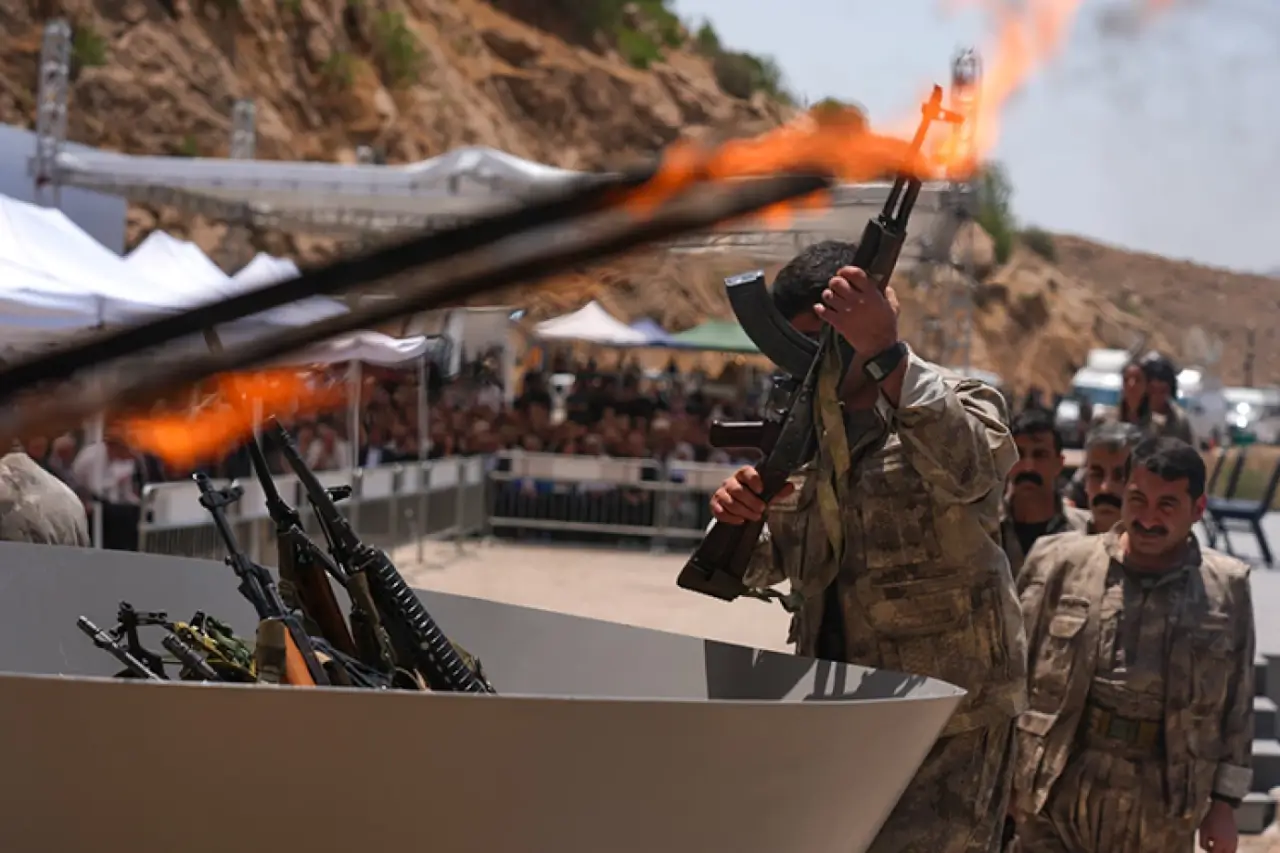
Peace processes are often judged by their most visible moments. Weapons are handed over. Armed groups announce dissolution. Governments pass legislation. Political leaders speak of a historic turning point. These moments matter enormously. After more than four decades of conflict between Türkiye and the PKK, genuine and verifiable disarmament would itself represent a major achievement. Yet disarmament raises another question that receives far less attention: what happens to the people after the weapons are gone?
Former combatants do not simply disappear. Some return to towns and cities. They work, live in apartment buildings, establish families and become part of ordinary social life. A person who yesterday belonged to an armed organization may tomorrow be someone’s colleague, neighbour or relative by marriage. This is where a peace process leaves the negotiating table and enters society.
New findings from MetroPOLL’s August 2026 Turkey’s Pulse survey suggest that this could become one of the most difficult dimensions of Türkiye’s emerging “Terror-Free Türkiye” process. The survey was conducted among 1,244 respondents across 28 provinces between 19 and 25 August, using computer-assisted telephone interviewing, with an overall margin of error of ±2.72 percentage points.
Its findings reveal something more profound than political disagreement over the current process. They expose a substantial social reintegration gap.
Legal Reintegration Is Not Social Reintegration
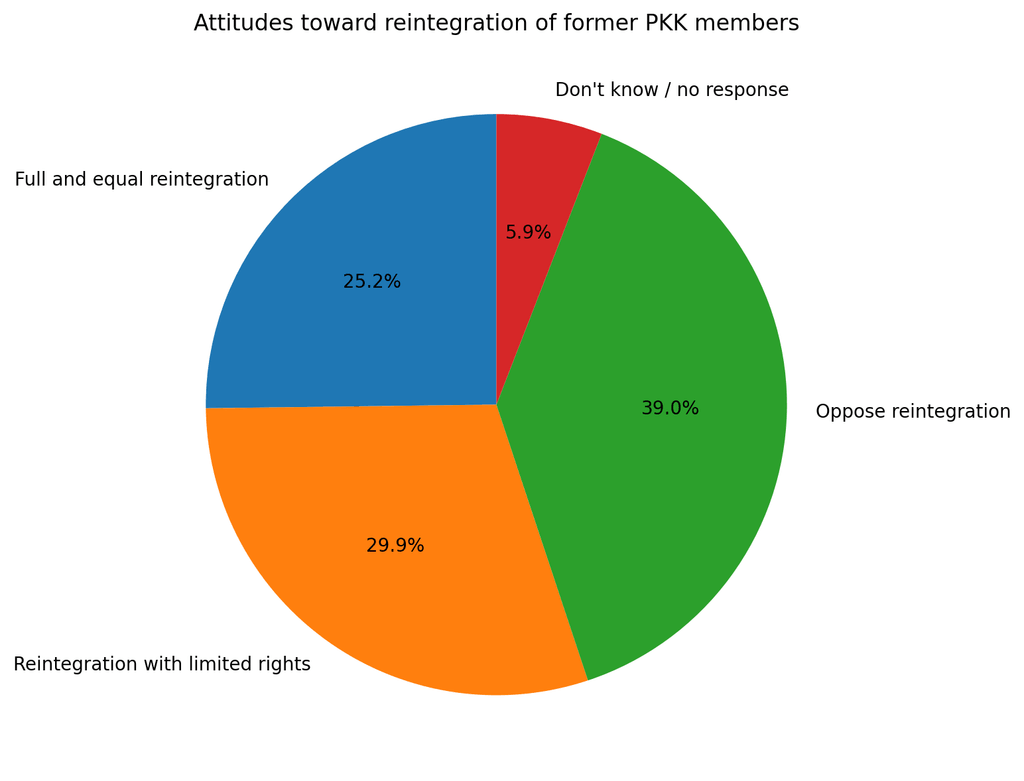
MetroPOLL asked respondents what should happen to former PKK members who had laid down their arms and served their sentences. Only 25.2 percent said they should be fully reintegrated into society with the same rights as other citizens. Another 29.9 percent would accept reintegration, but only with limited rights. Most strikingly, 39 percent opposed their reintegration altogether.
That last figure deserves particular attention because of the way the question was formulated. These were not individuals who remained armed or had escaped punishment. Respondents were explicitly asked about former members who had laid down their weapons and served their sentences.
In formal legal terms, such people would have completed the punishment imposed on them. Yet for a large part of society, this evidently does not settle the question of belonging. This is an important distinction for any peace process. A state can change someone’s legal status through legislation. It cannot legislate social acceptance quite so easily. The problem becomes even clearer when the survey moves from abstract principles to everyday life.
Figure 1: Attitudes toward reintegration of former PKK members
Would You Live Next Door?
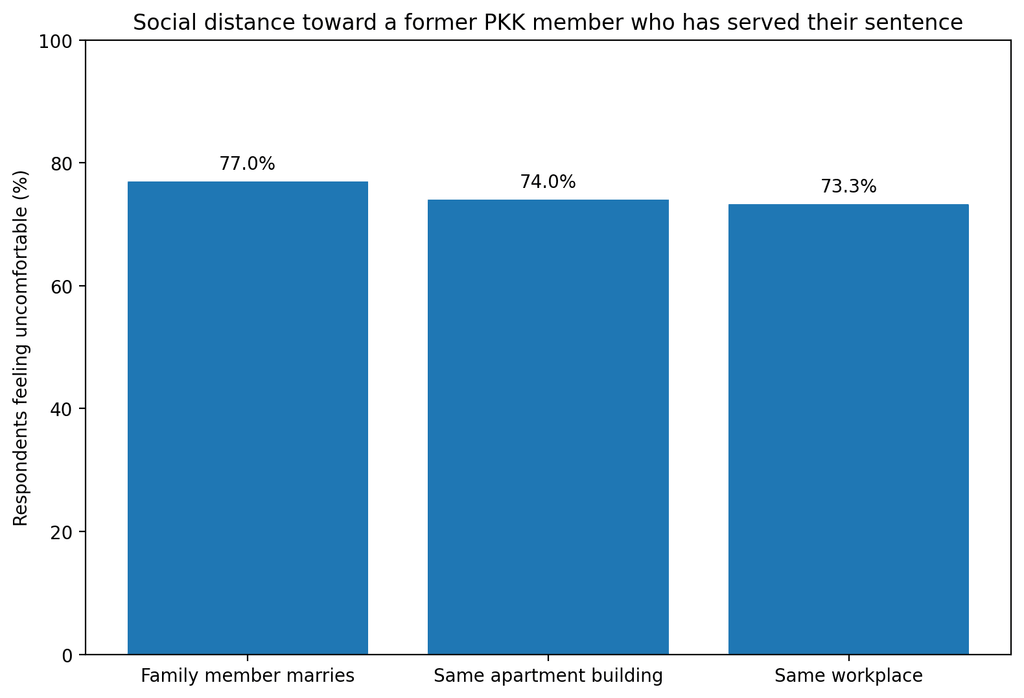
When respondents were asked whether they would feel uncomfortable living alongside a former PKK member who had served their sentence, the results were striking. Seventy-four percent said they would be uncomfortable living in the same apartment building. 73.3 percent would be uncomfortable working in the same workplace. And if a member of their family married such a person, the figure rose to 77 percent.
These figures take us beyond conventional discussions of disarmament, demobilization and reintegration. A government can provide documentation, employment programmes, financial support or legal guarantees. All of these may be necessary. But reintegration ultimately takes place in ordinary spaces: the office, the neighbourhood, the school gate, the family. And according to this survey, roughly three quarters of Turkish society currently express discomfort with precisely that kind of everyday proximity.
Figure 2: Social distance toward former PKK members
The political differences are also revealing, although party-level results need to be treated cautiously because the margins of error are considerably larger for smaller voter groups.
Among AK Party voters, 72 percent said they would feel uncomfortable living in the same apartment building as a former PKK member who had completed their sentence. The figure was 84.1 percent among CHP voters, 63.6 percent among MHP voters and 89.4 percent among İYİ Party voters. DEM Party voters were the clear outlier: only 28.9 percent expressed discomfort, while 66.7 percent said they would not.
Türkiye therefore appears to contain very different social understandings of what post-conflict coexistence should mean. This matters because a peace settlement ultimately has to operate across all of them.
The Political Door is Even Narrower
The resistance becomes stronger when political participation enters the picture. Only 17.3 percent of respondents said members returning to Türkiye should be allowed to participate in political life; 77.2 percent said they should not. This result requires some caution because the survey question combines former and current members of the organization. Respondents might reasonably view an active PKK member differently from someone who has genuinely left the organization and renounced violence. Nevertheless, the overall level of resistance is unmistakable. A separate question concerning political participation by Abdullah Öcalan and PKK members produces an even stronger result: 85.9 percent oppose it, compared with 81.7 percent in June 2025. Support fell from 12.8 to 10.7 percent. This creates another dilemma that Türkiye will eventually need to confront.
The objective of ending an armed conflict is not merely to remove weapons. It is also to establish that political goals must henceforth be pursued through non-violent, democratic channels. But what happens when society remains deeply suspicious of those channels being used by former members of the armed organization?
The answer cannot simply be that every former combatant should automatically acquire a political role. That is neither necessary nor desirable. Individual criminal responsibility and legal restrictions still matter. The more important principle is that there must eventually be a credible route from armed politics to unarmed politics. Otherwise, disarmament risks becoming the end of one process without a clear beginning for another.
The Most Interesting Contradiction in the Survey
Yet the same MetroPOLL survey contains another finding that changes the picture. Respondents were asked what was most important for PKK disarmament to result in lasting peace. The largest share – 31.6 percent – selected “strengthening social trust between Turks and Kurds.” This came ahead of including the families of martyrs and veterans in the process, chosen by 24.9 percent; strengthening democratic rights and freedoms, 11.6 percent; addressing regional economic inequalities, 6.8 percent; and meeting the expectations of Kurdish citizens, 5.7 percent.
This may be the most revealing result of all. Turkish society seems to recognize that lasting peace ultimately depends upon rebuilding social trust. However, the same society expresses very high levels of discomfort at living or working alongside a former PKK member. There is no need to dismiss this as hypocrisy. It tells us something much more important about post-conflict societies: people can support peace in principle while finding the social consequences of peace much harder to accept.
There is also growing pessimism about what the current process will do to society. In August 2025, 32.5 percent believed the peace process would strengthen solidarity and a sense of brotherhood; by August 2026 this had fallen to 26.3 percent. Over the same period, those expecting the process to increase social tensions rose from 34.8 to 38.9 percent. That trend should concern anyone invested in the process.
From Disarmament to Living Together
Peace scholars often distinguish between ending direct violence and building what Johan Galtung called “positive peace.” Whatever terminology we use, the basic point is straightforward. Weapons can stop killing people without repairing the relationships that decades of violence have damaged. Türkiye may therefore soon face two very different measures of success. The first will be relatively visible: Has the PKK genuinely disarmed? Have its armed structures been dismantled? Is the process irreversible? The second will be much harder to measure: Can people who have lived through four decades of conflict begin to imagine the former enemy as part of the same political community?
MetroPOLL’s findings suggest that Türkiye is still a considerable distance from answering that second question positively. This does not mean disarmament should wait for social reconciliation. Quite the opposite. Ending armed violence is the necessary starting point. But it would be a serious mistake to assume that the disappearance of weapons will automatically produce social peace. Political leaders can negotiate disarmament. Parliament can build its legal architecture. Courts can determine sentences and rights. However,eventually, peace has to enter the apartment building, the workplace, and the family. And that may prove to be the hardest part of all.
Alpaslan Özerdem
Alpaslan Özerdem is Dean of the Jimmy and Rosalynn Carter School of Peace and Conflict Resolution and a professor of peace and conflict studies. Dr. Özerdem has over 25 years of field research experience in Afghanistan, Bosnia and Herzegovina, El Salvador, Indonesia, Kosovo, Lebanon, Liberia, Nepal, Nigeria, the Philippines, Sierra Leone, the Solomon Islands, Somalia, South Sudan, Sri Lanka, Tajikistan, and Turkey, specializing in conflict resolution, peacebuilding, and post-war reconstruction.
Dr. Özerdem has published extensively (16 books and numerous journal articles, book chapters, and op-eds), including Managing Emergencies and Crises (2011 & 2022); Peace in Turkey 2023 (2013); Human Security in Turkey (2013); Youth in Conflict and Peacebuilding (2015); Local Ownership in International Peacebuilding (2015); Routledge Handbook of Turkish Politics (2019); Comparing Peace Processes (2020); Routledge Handbook of Peace, Security and Development (2020); Routledge Handbook of Conflict Response and Leadership in Africa (2021); A Companion to Modern Turkey’s Centennial (2023), and Identity and Religion in Peace Processes (2024). He is also co-editor of the University of Edinburgh’s Modern Turkey Series.
Dr. Özerdem has also initiated and managed consultancy and applied research projects for various national and international organizations such as the United Nations and international NGOs. He is also a member of the Scientific Committee of the Anna Lindh Foundation. He received the title of Professor Extraordinary in Politics from Stellenbosch University in 2017 and the title of visiting professor from Jiangsu University and Coventry University in 2019.
To cite this work: Alpaslan Özerdem, "After Disarmament: Can Türkiye Live with the Former Enemy? – Alpaslan Özerdem" Global Panorama, Online, 7 September 2026, https://www.globalpanorama.org/en/2026/09/after-disarmament-can-turkiye-live-with-the-former-enemy-alpaslan-ozerdem/
Copyright @ 2025 Global Academy. Design & Development brain.work
All on-line and print rights reserved. Opinions expressed in works published by the Panorama belongs to the authors alone unless otherwise stated, and do not imply endorsement by the IRCT, Global Academy, or the Editors/Editorial Board of Panorama.
Newsletter Subscription
Subscribe to our newsletter to stay informed about updates.