For years, Pakistan’s accusations that terrorist groups operate from Afghan territory have followed a familiar pattern: Islamabad points to cross-border attacks, Kabul denies responsibility, and the dispute returns to diplomatic confrontation. But American weapons recovered from terrorists in Pakistan have introduced a new dimension to the controversy. Rifles that Washington supplied to Afghanistan’s security forces have resurfaced in terrorist arsenals. Their appearance raises a difficult question: how did weapons from the former Afghan military reach organizations attacking Pakistan, and what have the Taliban authorities done to prevent their diversion?
The evidence extends beyond diplomatic accusations. Washington Post investigation traced 63 weapons recovered from terrorists in Pakistan to American supplies previously delivered to Afghan forces. Separately, a United Nations Security Council report documented accounts of Taliban commanders supplying Tehrik-e-Taliban Pakistan with advanced rifles and optical equipment. These findings do not establish that the 63 recovered weapons passed through Taliban commanders. Instead, they reveal multiple potential routes of proliferation, including illicit markets and reported transfers involving Taliban officials.
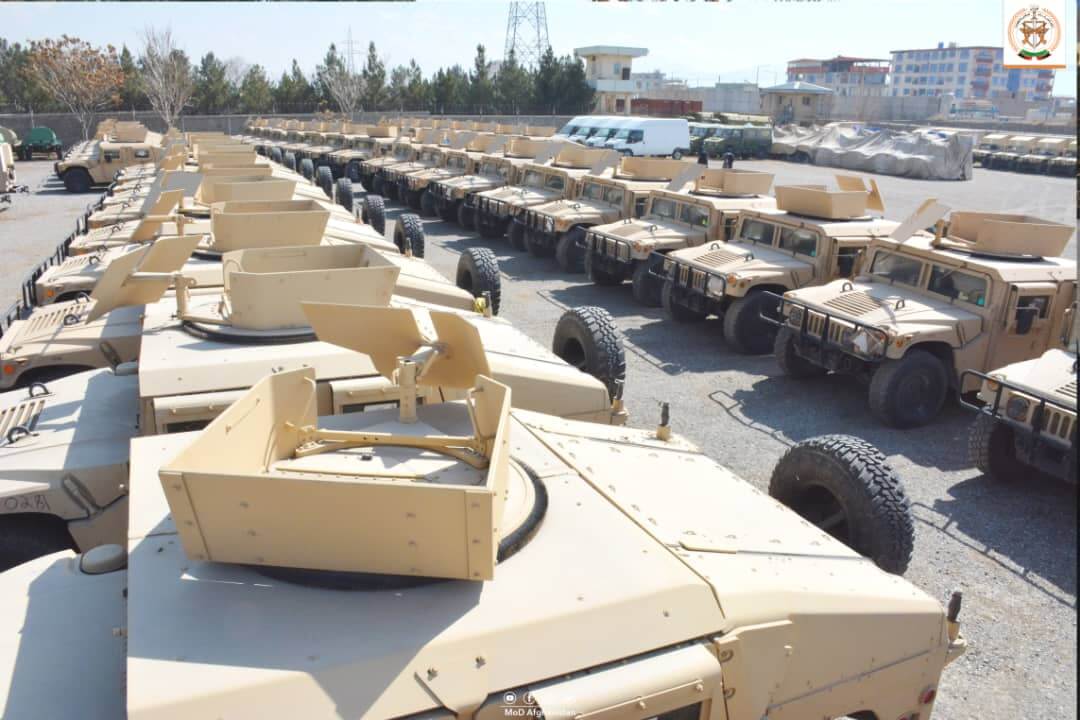
The scale of Afghanistan’s abandoned military inventory makes the problem more consequential. According to the Special Inspector General for Afghanistan Reconstruction, the American Defense Department estimated that at least $7.1 billion worth of American-funded military equipment remained in Afghanistan when the Taliban returned to power in August 2021. The inventory included weapons, vehicles, aircraft, and communications equipment. Their operational condition varied, while incomplete records prevented American officials from establishing the final disposition of every item.
Afghanistan’s military collapse left substantial supplies beyond American oversight. Some weapons entered illicit markets, while reports implicated Taliban commanders in other transfers. The Washington Post investigation also identified an American-made rifle that Pakistani forces recovered following the March 2025 Jaffar Express hijacking in Balochistan. The Balochistan Liberation Army carried out the attack. Investigators traced the weapon to American military assistance for Afghan forces, although the evidence did not establish its complete subsequent transfer history.
The United Nations Security Council Monitoring Team also reported that Taliban commanders provided Tehrik-e-Taliban Pakistan with M24 sniper rifles, M4 carbines equipped with advanced optical scopes, and M16A4 rifles fitted with thermal sights. These findings raise concerns about weapons control under Taliban rule, but they do not establish a single distribution chain linking every recovered American-origin weapon to Taliban authorities.
Advanced equipment has increased the danger. Night-vision devices and thermal optics allow terrorists to observe troop movements, identify targets in darkness, and conduct attacks with greater precision. The United Nations Monitoring Team identified night-vision equipment as a factor contributing to the lethality of attacks against Pakistani security personnel.
Weapons alone, however, do not explain the resurgence of terrorism. Their impact increases when terrorists also have access to sanctuaries, logistical networks, and cross-border routes. Successive United Nations reports have documented the activities of Tehrik-e-Taliban Pakistan, Al-Qaeda-linked organizations, and Islamic State Khorasan Province in Afghanistan. Pakistan accuses the Taliban authorities of allowing terrorists to recruit, train, and organize attacks from Afghan territory. Kabul denies supporting cross-border terrorism. Nevertheless, United Nations findings concerning terrorist operating facilities and access to weapons raise questions about the Taliban’s ability and willingness to restrict such organizations.
Pakistan has suffered a sharp deterioration in security. According to the Pak Institute for Peace Studies, terrorists carried out 699 attacks in Pakistan during 2025, a 34 percent increase over the previous year. These attacks killed at least 1,034 people and injured 1,366. Security and law enforcement personnel accounted for more than 42 percent of fatalities. The violence has also intensified tensions between Islamabad and Kabul. Cross-border confrontations in 2026 demonstrated how disagreements over terrorist sanctuaries could escalate into direct military conflict. On October 12, the Associated Press reported that Pakistan had urged Taliban authorities to prevent terrorists from launching attacks from Afghan territory. Kabul rejected accusations that it supported groups targeting Pakistan.
American-origin weapons do not explain Pakistan’s entire terrorism crisis. Domestic terrorist networks, political grievances, and Islamabad’s historical relationships with Afghan armed organizations remain important factors. Pakistan previously sought influence through the Taliban and expected their return to power to accommodate its security interests. Those expectations have increasingly clashed with the Taliban’s priorities. Yet these competing explanations do not diminish the weapons problem. Afghanistan’s military collapse created opportunities for equipment diversion, while established terrorist networks provided possible routes for redistribution. The recovery of American-origin weapons demonstrates the limitations of equipment accountability after the collapse of a partner military.
For Washington, the implications extend beyond Pakistan. Instability involving nuclear-armed Pakistan and Taliban-controlled Afghanistan complicates regional counterterrorism cooperation. More importantly, Afghanistan exposes a weakness in American security assistance: when recipient institutions collapse, terrorists can acquire equipment originally intended to strengthen national security. Washington cannot realistically recover every American-supplied weapon remaining in Afghanistan. Instead, American and Pakistani authorities should establish a structured weapons-tracing mechanism. American defense agencies retain procurement and transfer records, while Pakistani security agencies possess recovered weapons and information about their seizure.
Investigators could compare serial numbers, establish documented recovery histories, and identify recurring patterns across multiple seizures. A verified match could establish a weapon’s original supply destination, but investigators would need additional evidence to determine subsequent transfers or identify trafficking intermediaries. This distinction matters because accusations alone cannot establish responsibility. The initiative should produce actionable intelligence rather than another inventory. Verified findings could support criminal investigations, financial tracing, targeted sanctions, and coordinated enforcement against active trafficking networks. Incomplete records and repeated resale would limit the process, but investigators could still identify recurring patterns of diversion.
Washington should also seek verifiable counterterrorism commitments from Taliban authorities while recognizing its limited leverage. Pakistan must provide credible recovery evidence and confront domestic terrorist infrastructure. Neither weapons tracing nor diplomatic pressure can replace broader counterterrorism efforts. Afghanistan offers a warning that extends beyond South Asia. Military assistance without effective inventory controls and contingency planning can create security risks long after the original mission ends. The collapse of Afghan security institutions demonstrated how quickly weapons intended for stabilization can escape institutional control. For American policymakers, the lesson is clear: security assistance must include long-term equipment accountability and safeguards against diversion, because the consequences of losing control can outlast the war itself.