Before the Göktürks: Who Were the First Turks—and Where Did They Come From?
From the mysterious Xiongnu and the rise of the Göktürks to the forgotten cities of the Silk Roads, the Battle of Talas and the encounter with Islam, the early history of the Turks is far more complex—and far more fascinating—than conventional narratives suggest. The real story is not simply about warriors conquering territories, but about languages spreading, civilisations meeting, religions changing and new worlds emerging.
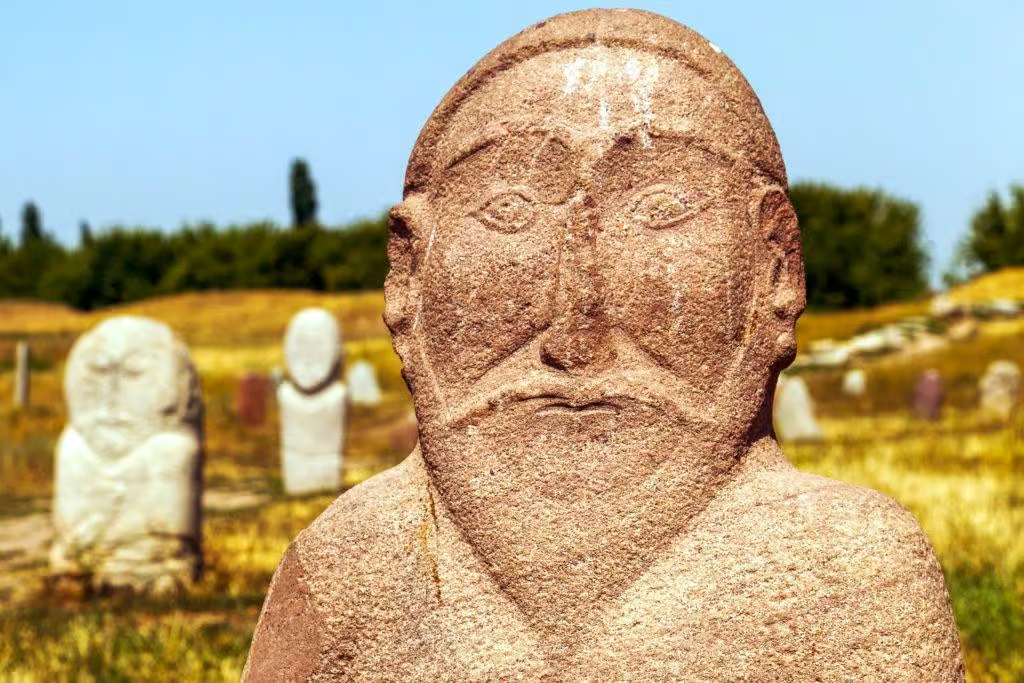
The first Turk may never have known he was a Turk
Who was the first Turk?
Was he a horseman crossing the Mongolian steppe? A tribal leader in the Altai Mountains? A merchant travelling between the oases of Central Asia? Or a member of a community whose language would eventually evolve into what linguists now call Proto-Turkic?
We do not know.
And perhaps the most important intellectual step in understanding Turkish history is to admit that we do not know.
Nations often seek a precise beginning: a founding ancestor, an original homeland, a first ruler or a decisive battle. Such stories provide continuity and emotional reassurance. But history rarely offers such neat beginnings.
The Turks did not suddenly appear on the Eurasian steppe in 552 CE, when the Göktürk Khaganate was established. Nor did they emerge fully formed as a single people speaking one language, sharing one religion and possessing one political identity.
Their origins lie in a much older and less clearly documented world.
Proto-Turkic, the reconstructed ancestor of the Turkic language family, must have existed before our earliest substantial surviving written records in Turkic. But scholars continue to debate where its speakers lived and how their communities developed.
Southern Siberia, the Altai region, Mongolia and adjoining parts of Inner Asia feature in different scholarly reconstructions.
There is no archaeological discovery, genetic signature or ancient chronicle that conclusively identifies one community as the first Turks.
That uncertainty should not disappoint us.
It should make the search more interesting.
The Xiongnu, the Huns and the danger of convenient ancestry
Long before the Göktürks, Chinese historical records described powerful confederations inhabiting the northern frontiers of China.
Among the most significant were the Xiongnu, who established a formidable steppe empire beginning in the late third century BCE.
Their military organisation, diplomatic relations, mobility and ability to challenge Chinese dynasties reveal a sophisticated political world.
But were the Xiongnu Turks?
The answer remains contested.
Their confederation probably incorporated communities of different linguistic and cultural backgrounds. Scholars have proposed Turkic, Mongolic, Yeniseian and other connections, but the surviving linguistic evidence is too limited to establish a universally accepted classification.
The relationship between the Xiongnu and the Huns who later appeared in Europe is similarly complex.
Political, cultural and demographic connections are possible, and some recent research has strengthened the case for links between particular populations. Yet the evidence does not justify identifying every European Hun as unquestionably Turkic.
This is where historical discipline matters.
A shared style of warfare does not establish a shared language. Similar burial practices do not prove common ethnicity. Genetic connections cannot automatically determine what language an ancient population spoke.
The Xiongnu and Huns belong in the investigation of early Turkic history. But they should not be turned into Turks merely because doing so would make our historical timeline longer.
A great history does not become greater by claiming certainty where the evidence remains uncertain.
The Göktürks: When the name becomes visible
The establishment of the First Turkic Khaganate in 552 CE provides a much firmer historical landmark.
Under Bumin Qaghan and his successors, the Göktürks built a political power that extended across vast areas of Inner Asia.
Chinese sources referred to them as Tujue. Their own later inscriptions used the name Türk, offering exceptionally important evidence of political self-identification.
The eighth-century Orkhon inscriptions, associated especially with Kül Tigin, Bilge Qaghan and Tonyukuk, reveal a remarkable tradition of political reflection.
They discuss the rise and decline of states, the dangers of internal division, relations with China, the duties of rulers and the welfare of the people.
These are not merely monuments commemorating military victories.
They are statements about political legitimacy, leadership, collective memory and the survival of a state.
One message runs through them with striking force: A people may lose its independence not only because an external enemy is powerful, but because its own leadership fails and its internal cohesion collapses.
That warning has lost none of its relevance.
Yet the inscriptions also raise a fascinating question.
How could such a developed political vocabulary and literary expression emerge without earlier intellectual foundations?
The surviving texts do not reveal every stage of that development. Earlier traditions of oral expression, political organisation and perhaps writing must be investigated without assuming that we already know their precise form.
The Göktürks represent the first securely documented major political formation bearing the Turk name.
They do not represent the beginning of all Turkic-speaking human history.
Beyond the horsemen: The civilisation hidden beneath the steppe
Traditional narratives of early Turkish history are dominated by rulers, battles, migrations and empires.
But what about ordinary people?
How did women participate in family life, property relations and political authority? How did pastoral communities trade with agricultural settlements? Who manufactured weapons, textiles, pottery and jewellery? How were markets organised? What happened to children, craftsmen, merchants and religious communities when an empire collapsed?
The answers may be found in places that national histories have too often overlooked.
An ordinary grave can tell us about diet, mobility and social status.
A merchant’s account can reveal trading networks extending across thousands of kilometres.
An irrigation channel can expose generations of cooperation and technical knowledge.
A manuscript fragment can preserve the language, beliefs and imagination of people whose rulers have long been forgotten.
We cannot reconstruct the history of a civilisation through the biographies of its khagans alone.
And nowhere is that lesson clearer than in Kashgar and Turfan.
Kashgar and Turfan: Where the steppe met the city
During my travels in Kashgar and Turfan, I encountered a world that challenged the familiar image of Turkish history as an endless procession of mounted warriors.
The Tarim Basin was a meeting place of Chinese, Indian, Iranian and Inner Asian civilisations.
Its oasis cities were connected through the Silk Roads—not one continuous highway, but a changing network of commercial, cultural and religious routes.
Merchants transported silk, horses, textiles, metals and other commodities. Monks carried Buddhist teachings and manuscripts. Diplomats negotiated alliances. Languages, artistic styles and technologies crossed political frontiers.
Texts discovered in the region preserve evidence of Turkic, Chinese, Sogdian, Sanskrit, Tocharian and other linguistic traditions.
Not all ancient inhabitants of the Tarim Basin were Turkic-speaking. Indeed, several important communities and cultural traditions preceded the substantial Turkic presence.
The Uyghurs subsequently became central to the region’s cultural transformation.
Their Buddhist and Manichaean manuscripts, translations and literary works reveal an intellectual world far removed from the stereotype of an exclusively nomadic civilisation.
In Turfan, I was particularly struck by the underground karez irrigation channels.
Imagine the engineering challenge: transporting precious water through underground passages to sustain agriculture and settlements in an arid environment.
Such infrastructure required technical expertise, labour organisation, maintenance and long-term planning.
The history and development of these systems must be studied through archaeological and historical evidence; they cannot simply be attributed to one modern ethnic community.
Yet their existence illustrates something important.
The history of Inner Asia is not merely the history of conquest.
It is also the history of people learning how to make difficult landscapes habitable.
And the cultural inheritance of Kashgar and Turfan belongs to the wider history of humanity, not exclusively to any one modern nation.
Talas, 751: A battle that did not convert an entire people
Few events in popular Turkish historical narratives have acquired greater symbolic importance than the Battle of Talas in 751.
An Abbasid-led army and its allies defeated Tang Chinese forces near the Talas River. The Karluks played an important role in the military and political developments surrounding the battle.
In some accounts, Talas is presented as the moment when the Turks collectively embraced Islam.
That interpretation is misleading.
Contacts between Muslims and Turkic-speaking communities began before Talas. Conversion occurred gradually, unevenly and through multiple channels over several centuries.
Trade, diplomacy, military service, urbanisation, dynastic patronage and religious networks all contributed.
Nor can the decline of Tang influence in Central Asia be explained by Talas alone.
The An Lushan Rebellion, which began in 755, severely weakened the Tang dynasty and profoundly altered its capacity to maintain influence across Inner Asia.
Talas was significant, but it was not a civilisational switch that transformed millions of people overnight.
The conversion of Almish, ruler of the Volga Bulgars, and his diplomatic engagement with the Abbasid caliphate in 922 marked another important stage.
The Islamisation of the Karakhanid ruling elite during the tenth century had especially far-reaching consequences.
Yet a ruler’s conversion does not mean that every subject immediately adopts the same faith.
Religious transformations unfold across generations.
And not all Turkic-speaking peoples became Muslims.
Buddhist Uyghurs, Christian Turkic-speaking communities and others who maintained different religious traditions remained part of the wider Turkic world.
Islamisation transformed Turkish history.
But Turkish history did not begin with Islam.
Islam changed the Turks. How did the Turks change Islam?
This question deserves equal attention.
The encounter between Turkic-speaking peoples and the Islamic world was not a one-way process in which one civilisation simply absorbed another.
Turkic military commanders became influential within the Abbasid political order. Turkic-origin dynasties established major centres of power. Their political traditions interacted with Islamic religious authority and Persian administrative culture.
The Ghaznavids and Seljuks illustrate this transformation particularly clearly.
Tughril Beg’s entry into Baghdad in 1055 marked an important turning point in the relationship between Seljuk political power and the Abbasid caliphate.
But the Seljuk state cannot be understood as a purely Turkic creation isolated from its surroundings.
Persian bureaucratic institutions, Arabic scholarship, Islamic law, urban economies and local political traditions all contributed to its development.
The same complex interaction is visible in literature.
Yusuf Khass Hajib’s Kutadgu Bilig, completed in the eleventh century, brought together ideas of kingship, ethics, social order and political responsibility in a Turkic literary language.
Mahmud al-Kashgari’s Dīwān Lughāt al-Turk, compiled in the same century, preserved an extraordinary record of Turkic vocabulary, dialects, poetry and cultural knowledge.
These works remind us that the encounter with Islam did not extinguish Turkic intellectual traditions.
It helped create new settings in which they could develop.
What later generations call Turco-Islamic civilisation emerged through the interaction of Turkic, Persian, Arabic and numerous other traditions.
Its greatness lay not in ethnic exclusivity, but in synthesis.
The missing history is not behind us alone
We began with a seemingly simple question: Who was the first Turk?
We end with a more important realisation.
The history of the Turks cannot be reduced to identifying one original tribe, one ancestral homeland or one uninterrupted bloodline.
Its early chapters concern languages that evolved, populations that interacted, political identities that emerged and societies that repeatedly reinvented themselves.
The Göktürks gave us a securely documented political name. The Orkhon inscriptions gave us a powerful expression of statecraft and historical memory. The Silk Roads reveal cultural exchange and intellectual diversity. Islamisation demonstrates the depth of religious transformation. The Seljuks show how these different inheritances could be combined into new political orders.
But none of these developments occurred in isolation.
The Turks did not simply move across Eurasia carrying an unchanged civilisation. They encountered other worlds, absorbed their knowledge, challenged their institutions and helped create new ones.
That is a far more compelling achievement than the claim that every ancient civilisation was secretly Turkish.
It is also the starting point for the next chapter of our journey.
For once we move beyond the search for the first Turk, another question demands our attention:
How did peoples emerging from the political and cultural worlds of Inner Asia become builders of states and empires stretching from Central Asia to Anatolia, the Middle East and beyond?
Next in the eight-part series: Part III — From the Steppe to the Palace: How the Turks Learned to Rule Empires.