Timur: The Man Who Built Samarkand and Broke the Ottoman Empire
One conqueror, two national memories. In Uzbekistan, Timur is celebrated as a visionary empire-builder whose dynasty helped make Samarkand a centre of civilisation. In Türkiye, he is remembered above all as the man who defeated Sultan Bayezid and plunged the Ottomans into a succession crisis. Both memories contain truth. Neither tells the whole story. The paradox of Timur reveals why writing a shared history of the Turkic world is far more difficult than assembling a procession of national heroes.
One man, two histories
Imagine walking through Samarkand, beneath the turquoise domes and monumental façades associated with the Timurid age.
Here, Timur is everywhere. His name evokes imperial ambition, architectural magnificence and a period when Central Asia stood at the crossroads of Eurasian power and culture.
Now travel westwards to Ankara.
Ask about Timur, and the conversation takes a different turn. The date that comes to mind is 1402. The event is the Battle of Ankara. The memory is one of defeat, humiliation and the near-disintegration of the Ottoman state.
How can the same man be celebrated as a national hero in one country and remembered as a destroyer in another?
And which account should we believe?
Both, I would argue. But only if we are prepared to look beyond the selective memories that modern nations construct around their past.
Timur forces us to confront an uncomfortable truth: History does not change when we cross a border. What changes is the story we choose to tell about it.
The conqueror who emerged from two worlds
Timur was born in 1336 near Kesh, today’s Shahrisabz, in present-day Uzbekistan.
He emerged from the Barlas, a tribal grouping whose origins lay in the Mongol imperial world but which, by his lifetime, had become substantially integrated into a Turkic-speaking and Islamic cultural environment.
This distinction matters.
Timur was not an Uzbek in the modern national sense. Nor can he be adequately described simply as Mongol or Turk according to contemporary ethnic categories.
He belonged to a Turco-Mongol political world shaped by the legacy of Genghis Khan, the traditions of the Eurasian steppe and the institutions of the Persian-Islamic civilisation.
Timur was not himself a descendant of Genghis Khan. Yet Chinggisid legitimacy remained so powerful that he ruled as an amir, exercised authority through nominal Chinggisid khans and reinforced his dynastic standing through marriage into the Chinggisid line.
His title Gürgän, commonly understood as “son-in-law”, reflected that connection.
He understood something that ambitious rulers throughout history have recognised: military power can conquer territories, but political legitimacy helps hold them.
From his consolidation of power in Transoxiana around 1370 until his death in 1405, Timur constructed an empire extending across much of Central Asia, Iran, Afghanistan, Mesopotamia and neighbouring regions.
His armies reached India, the Caucasus, Syria and Anatolia.
But this was not the steady expansion of a modern nation-state. It was an empire built through personal authority, military alliances, coercion and the political traditions of its age.
And its extraordinary achievements came at an extraordinary human cost.
Samarkand: The beauty built on conquest
Timur transformed Samarkand into an imperial capital intended to proclaim the reach of his power.
Architects, craftsmen, artists and skilled workers were brought from conquered territories to contribute to its monumental buildings and courtly culture.
The Bibi-Khanym Mosque, the Gur-e Amir complex and other Timurid monuments became enduring symbols of architectural ambition.
Yet the beauty of Samarkand cannot be separated from the circumstances that helped produce it.
Some of the craftsmen and specialists who enriched the capital had been forcibly relocated from conquered cities.
The empire accumulated not only wealth and artistic talent but also the consequences of violence.
Timur’s campaigns included devastating assaults on Delhi in 1398, Aleppo and Damascus in 1400–1401, and Baghdad in 1401. Contemporary and later chroniclers described massacres, destruction and the displacement of populations. The precise numbers reported in medieval accounts often cannot be independently verified and should not be repeated uncritically.
The larger reality, however, is beyond serious dispute: Timur’s conquests inflicted immense suffering.
The celebrated Timurid cultural flowering also requires chronological care.
Some of the dynasty’s greatest intellectual achievements occurred after Timur’s death.
His grandson Ulugh Beg, who ruled Samarkand in the fifteenth century, became an important patron and practitioner of astronomy. His observatory and astronomical tables belong to the wider Timurid scientific legacy, not to achievements personally completed by Timur.
The same dynasty that emerged from devastating conquest later fostered extraordinary achievements in architecture, literature, mathematics and astronomy.
There is no need to deny either side.
The splendour of Samarkand and the suffering of conquered cities are not competing versions of history. They are inseparable parts of it.
Ankara, 1402: When two imperial ambitions collided
For Türkiye, Timur’s most consequential intervention came in Anatolia.
By the beginning of the fifteenth century, Sultan Bayezid I—Yıldırım Bayezid—had considerably expanded Ottoman power in Anatolia and the Balkans.
His ambitions increasingly conflicted with Timur’s claims to authority and his relationships with Anatolian principalities whose rulers had lost territory to Ottoman expansion.
The confrontation was therefore more than a personal rivalry between two formidable commanders.
It reflected competing claims to sovereignty, political allegiance and regional supremacy.
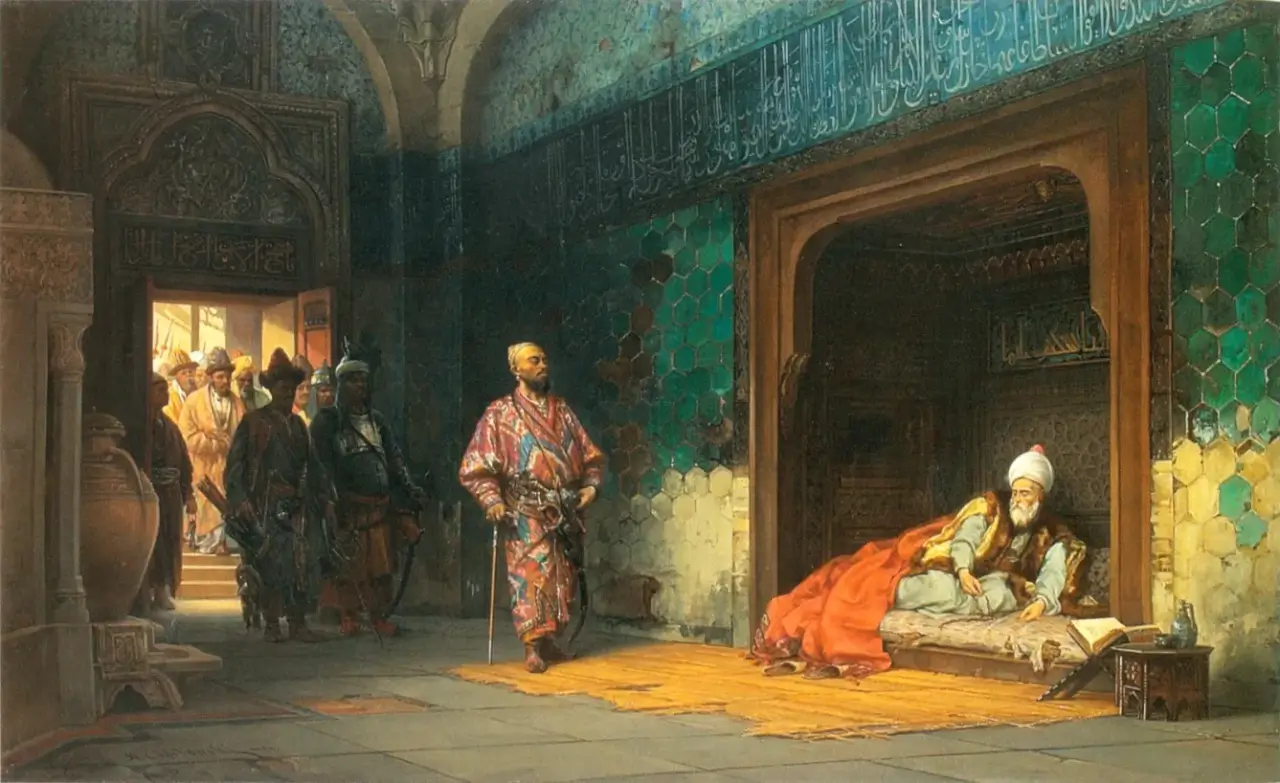
On 28 July 1402, their armies met near Ankara.
Timur emerged victorious.
Bayezid was captured and subsequently died in captivity in 1403.
The defeat shattered the immediate political structure Bayezid had built. Several Anatolian principalities regained their positions, while rival Ottoman princes struggled for power during the period known as the Fetret Devri, or Ottoman Interregnum.
The dynastic conflict lasted until Mehmed I consolidated his rule in 1413.
The Ottoman state survived, but its recovery was neither automatic nor inevitable.
The Battle of Ankara delayed Ottoman consolidation and profoundly altered the balance of power in Anatolia.
Yet it did not permanently extinguish Ottoman ambitions. Within half a century, Mehmed II would conquer Constantinople in 1453, opening another decisive chapter in world history.
There is an irony here.
Timur defeated the Ottoman ruler who had sought to unify much of Anatolia. But the dynasty he nearly destroyed eventually constructed an empire that outlasted Timur’s own political creation by centuries.
History rarely grants its conquerors the final word.
Why Uzbekistan celebrates the man Türkiye distrusts
Centuries later, Timur’s legacy acquired a new political life.
Following Uzbekistan’s independence in 1991, the Timurid past became an important element in the construction of national historical identity.
Timur offered a powerful historical symbol: a ruler associated with Samarkand, imperial sovereignty, military strength and cultural achievement.
His image appeared in monuments, public commemorations, museums and official narratives.
For a newly independent state seeking to establish its place in history, the attraction was understandable.
But we should distinguish the historical inheritance of a territory from the modern nationality of its former rulers.
Timur did not think of himself as an Uzbek citizen, because neither modern Uzbekistan nor modern Uzbek national identity existed in his lifetime.
Indeed, the relationship between the Timurids and later Uzbek political formations was often one of rivalry and conflict.
In the early sixteenth century, Muhammad Shaybani Khan and his Uzbek forces challenged and displaced Timurid power in much of Transoxiana. Babur, a Timurid prince who later founded the Mughal Empire in India, was among those whose political fortunes were transformed by these struggles.
The historical connection between the Timurid world and modern Uzbekistan is profound.
But connection does not mean identical national identity.
Türkiye’s more reserved memory of Timur is equally understandable.
Modern Turkish historical consciousness has been shaped substantially by the Ottoman experience. From that perspective, Timur appears as the ruler who interrupted an expanding empire’s rise.
Yet this Ottoman-centred narrative presents its own difficulty.
If we exclude Timur from the wider history of the Turks because he defeated an Ottoman sultan, are we writing Turkic history—or merely selecting the episodes that flatter the Ottoman dynasty?
The distinction is fundamental.
When shared ancestry does not produce political unity
Timur and Bayezid were not representatives of two neatly separated modern nations.
Their worlds overlapped through language, religion, political institutions, military traditions and the wider cultural environment of Eurasia.
Yet they fought a devastating war.
That should remind us that shared cultural or linguistic connections have never guaranteed political unity.
The history of the Turkic world contains alliances, rivalries, migrations, dynastic marriages, commercial relationships and violent conflicts among states and communities connected by overlapping traditions.
It would be misleading to imagine a continuous political solidarity stretching uninterrupted from the earliest Turkic-speaking communities to modern Türkiye, Uzbekistan, Kazakhstan or Azerbaijan.
Modern national borders did not exist in Timur’s lifetime.
Neither did the political loyalties that we now associate with them.
The rulers of that age pursued dynastic legitimacy, territory, tribute, strategic routes and military advantage.
Religion and cultural affinity mattered, but they did not eliminate the struggle for power.
This is why the history of the Turks must be written as the history of a changing and interconnected world, rather than as a single national family tree.
Can we admire a civilisation without glorifying its conqueror?
This question extends far beyond Timur.
Many historical empires produced extraordinary artistic, scientific and institutional achievements while also relying on conquest, coercion and inequality.
The Romans, Mongols, Ottomans, British and numerous others present historians with versions of the same dilemma.
We can admire the architecture of Samarkand without celebrating the destruction of Delhi.
We can recognise Timur’s military and organisational abilities without excusing the violence of his campaigns.
We can understand why Uzbekistan honours its Timurid inheritance without accepting every element of its national mythology.
And we can acknowledge the suffering inflicted on the Ottomans without treating Timur as an outsider to the wider Turco-Mongol historical experience.
Historical maturity requires precisely this ability to hold competing truths together.
A serious history does not need flawless heroes.
It needs accurate evidence, intellectual independence and the courage to examine greatness alongside cruelty.
The empire disappeared. The questions remain.
Timur died in 1405 while preparing a campaign against Ming China.
His vast empire soon experienced succession struggles and political fragmentation.
The Timurid dynasty nevertheless continued to shape Central Asian and Iranian cultural life, while its descendants carried elements of that inheritance into South Asia.
Samarkand’s monuments survived. So did memories of destruction.
In Anatolia, the Ottomans recovered and eventually built a larger, more enduring imperial system.
In Uzbekistan, Timur became a central symbol of national pride.
One man, two memories—and a history that belongs exclusively to neither.
This is the lesson I draw from Timur’s extraordinary life.
We do not honour the history of the Turks by turning every successful conqueror into a national hero or every opponent of the Ottomans into a foreign enemy. We honour it by understanding the world those rulers inhabited, the institutions they created, the people they governed and the consequences of their actions.
Timur did not belong to a modern nation. He belonged to a historical world that helped shape several modern nations.
His story reminds us that the Turkic past is not a collection of separate national possessions.
It is a shared, contested and sometimes painful inheritance.
And that brings us to the next challenge in this eight-part journey.
If Timur’s empire combined steppe political traditions, Persian administration and Islamic legitimacy, how should we understand the other great states associated with Turkic-speaking dynasties?
Were they simply Turkish empires?
Or were they something more complex—and historically more interesting?
Next in the series: Part IV — Who Really Built the Turkic Empires? Dynasties, Peoples and the Making of Eurasian Power.