A country may retain its parliament, courts, and constitutional procedures even as political authority becomes increasingly concentrated. Although these institutions may continue to perform their administrative functions, they may become less able to constrain political leaders. Understanding this diversification requires examining how institutions operate, who exercises power through them, and which ideas justify changes to their authority.
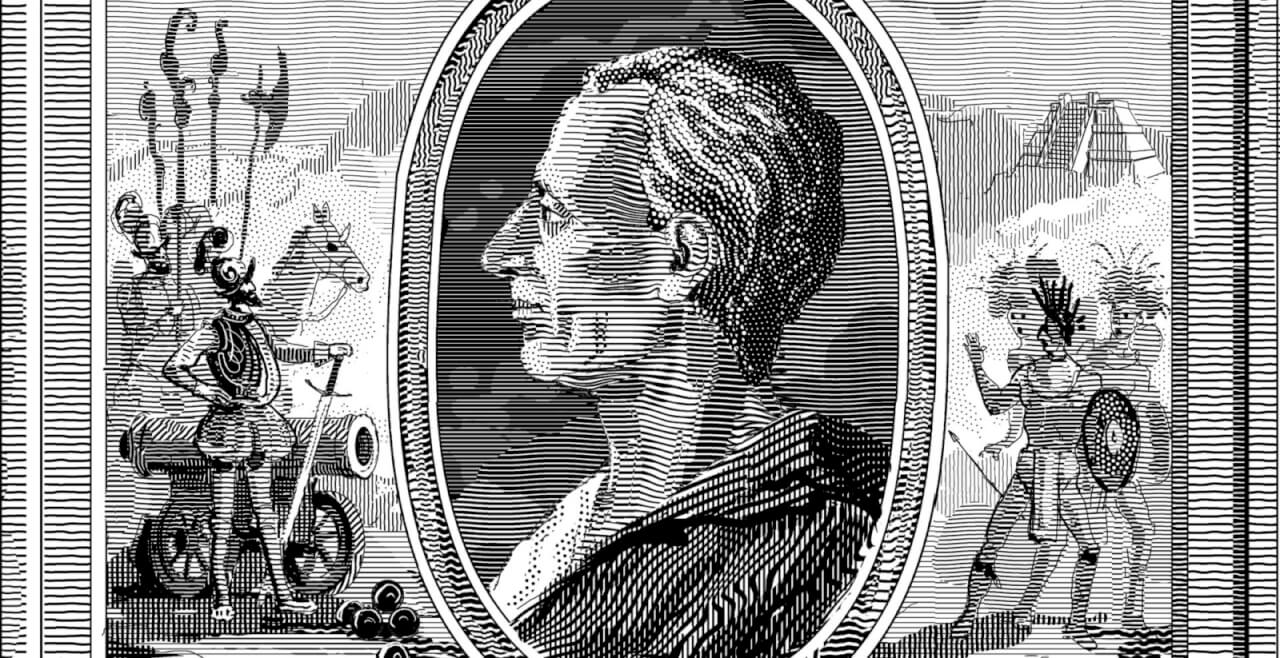
Montesquieu recognized the dangers of concentrated power. In The Spirit of the Laws (1748), he argued that liberty becomes insecure when legislative, executive, and judicial authority are united. His enduring insight was that political freedom requires arrangements that enable power to restrain power. In other words, the separation of powers argues that unchecked, unlimited power can be misused or used to manipulate legitimacy and authority. This raises a practical question: what enables separate offices to exercise independent judgment?
Constitutional design provides part of the answer, but formal divisions of authority do not explain why checks restrain political leaders in some circumstances while becoming instruments of political concentration in others. Explaining that variation requires attention to the actors who operate institutions and the ideas through which they justify their choices.
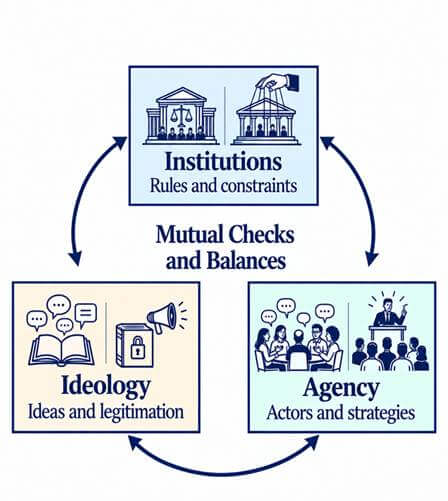
I propose the Institutions–Agency–Ideology (IAI) model as an integrative analytical framework for examining this problem. Building on established insights about institutions, political actors, and ideas, it examines how their interaction sustains or transforms the domestic distribution of power. In other words, the IAI model offers a framework for rethinking the separation-of-powers model in a century marked by democracy’s decline and the rise of populism and populist demands.
Figure 1. The Institutions–Agency–Ideology (IAI) Model: Democracy and Autocracy
Institutions allocate authority, establish procedures, and provide resources for oversight. Agency concerns how leaders, legislators, judges, and party officials exercise, contest, or modify those arrangements. Ideology supplies competing understandings of legitimate government, helping actors justify either institutional restraint or concentrated leadership at the national and international stage.
The central proposition is conditional: institutional checks depend partly on whether political actors can and will exercise their formal powers, and whether influential understandings of legitimate authority support that exercise. Leaders may seek to weaken constraints, but their success depends on institutional opportunities, the cooperation or resistance of other actors, and the credibility of their justifications. Institutional changes can, in turn, redistribute resources among actors and strengthen the ideas used to defend the emerging order. In other words, interactions among institutions, agency, and ideology that sustain effective checks and balances can support democratic gains. At the same time, those that weaken accountability and concentrate authority can contribute to democratic erosion.
Hungary: Constitutional Restructuring and the Legitimation of Illiberal Rule
Viktor Orbán lost the recent elections, ending the long era of Orbánism (1998-2002 and 2010-2026). Still, many lessons from his reign remain. Hungary under Orbán illustrates how imbalanced relationships among institutions, agency, and ideology can contribute to democratic erosion. Freedom House downgraded Hungary from “Free” to “Partly Free” in its 2019 report, citing sustained attacks on democratic institutions by Orbán’s Fidesz party. Its 2026 report assigned Hungary a score of 65 out of 100, comprising 24 out of 40 for political rights and 41 out of 60 for civil liberties. These assessments document declining democratic safeguards, consistent with the institutional concentration examined through the IAI framework.
In its 2013 opinion on the Fourth Amendment to the Fundamental Law, the Venice Commission criticized measures weakening constitutional review and the system of checks and balances. It also questioned the entrenchment of governing choices through constitutional provisions and cardinal laws. The issue extended beyond particular policies to the rules under which political authority could be challenged.
These developments reveal a distinction between institutions that organize government and institutions that constrain it. A parliament can continue legislating while changing the rules governing judicial scrutiny. The existence of institutional activity therefore tells us less than the distribution of authority that activity produces.
Agency concerns the choices through which these opportunities are used. Orbán and his governing parliamentary coalition used their constitutional amendment capacity to reshape the rules that limit government. Their institutional position made this strategy possible, but did not make it inevitable. The IAI question is how governing actors coordinated their choices and how far judges, opposition parties, and other actors could contest them.
Ideology supplied a public interpretation of this reconstruction. In his July 2014 speech at Băile Tușnad, Orbán presented electoral victories as authorization to develop a new form of state organization and explicitly advocated an illiberal state. Delivered after the 2013 amendment, the speech offers a later articulation of the governing project, rather than proof of the motives behind each earlier reform.
From an IAI perspective, this argument links a political mandate to a claim not only to legitimate but also to democratic institutional authority. If electoral victory is interpreted as authorization to reconstruct the governing order, independent review may be portrayed as obstructing that mandate. The proposed mechanism is that such claims help governing actors defend changes that reduce external scrutiny. Whether they persuade citizens or overcome organized resistance requires separate evidence; articulating a justification does not establish its public acceptance or democratic achievement.
Russia: Presidential Continuity and the Legitimation of Personalized Authority
Russia’s 2020 constitutional amendments reveal a related process in a different institutional setting. An exception allowed Putin’s previous presidential terms to be disregarded, enabling him to seek two additional terms and potentially remain president until 2036. In Resolution 2519 in 2023, the Parliamentary Assembly of the Council of Europe endorsed the Venice Commission’s criticism of the waiver benefiting the incumbent.
Term limits constrain authority over time by setting an expected departure point for an officeholder. An exception benefiting the incumbent changes the relationship between the presidency as an enduring institution and the individual temporarily occupying it. The formal existence of a two-term limit thus needs to be assessed alongside the exemption governing its application.
The agential dimension concerns how Putin and supporting political actors secured authorization for continued leadership. In March 2020, State Duma deputy Valentina Tereshkova proposed resetting the presidential term count. Putin publicly accepted that possibility subject to Constitutional Court approval. This sequence identifies distinct political choices: a legislator introduced the proposal, the president endorsed it, and institutional actors were asked to authorize it. It does not require that every participant acted independently or shared identical motives.
Institutions were therefore part of the process through which continued personal leadership acquired legal authorization. Parliamentary adoption and constitutional review supplied formal decisions rather than disappearing from the political process. The analytical issue is whether these procedures constrained the initiative or accommodated it. The Venice Commission’s criticism of the incumbent-specific exemption illustrates why procedural activity alone cannot establish effective restraint.
Ideology enters through the public justification of political continuity. Defending the proposal in March 2020, Putin emphasized stability and Russia’s continuing recovery from the Soviet Union’s collapse. This linked presidential tenure to an interpretation of national vulnerability and an unfinished recovery. The broader idea of restoring Russian strength should therefore be distinguished from a literal project to reconstruct the Soviet Union. For this constitutional episode, the more immediate argument was that continuity of leadership served stability. This is evidence of a justification, rather than evidence that citizens accepted it or that it alone produced the amendment.
A related conception of authority appears in the Venice Commission’s account of the Russian authorities’ presentation of the president as standing outside the three branches, despite the office’s extensive executive powers. This constitutional interpretation places the presidency in an exceptional relationship to the branches expected to balance public authority. It shows how ideas about legitimate leadership can be embedded in interpretations of institutional roles.
Rethinking Checks and Balances through the IAI Model
The IAI relationship is consequently reciprocal. Political actors pursue an extension of leadership through institutional procedures; ideological claims about stability help justify that extension; and the resulting rules expand the incumbent’s future opportunities to exercise authority. These connections do not imply that leadership preferences or ideological claims automatically produce constitutional change. However, when institutions enable political leaders to accumulate excessive power and ideological narratives mobilize public acceptance, their interaction can give concentrated authority a formal legal basis. The three dimensions can thus form an alliance conducive to democratic erosion. Mutual checks and balances weaken as the capacity to exercise power and oversee its use becomes concentrated in one leader’s hands. Institutions are tailored to the incumbent’s interests, while ideology is adapted to legitimize personal leadership, privileging immediate political advantage over durable accountability. Responsibility for this erosion often lies with a leader, a ruling party, or a coalition of actors whose decisions weaken institutional constraints and concentrate political authority, frequently justified in the name of national unity, sovereignty, or nationalist objectives.
The comparison, however, neither makes nor needs to make Hungary and Russia equivalent. Their constitutional structures, political histories, and forms of competition differ. In the Hungarian episode, the central institutional opportunity was a governing coalition’s capacity to amend the constitution; in the Russian episode, it was an exemption that allowed the incumbent to remain in office. Both show why analysis must connect political strategies, institutional authorization, and legitimizing arguments.
The IAI model also directs attention to resistance. Judges may defend their jurisdiction, legislators may reject executive proposals, and competing political movements may dispute claims that concentrated authority serves the public interest. Their ability to act depends on institutional protections and resources, while their ideologies can help sustain oversight’s legitimacy. Explaining the weakening of checks therefore requires examining both the opportunities available to opponents and the strategies of governing leaders.
For democratic reform, the implication is practical. Constitutional rules require institutions that can enforce them, actors willing and able to exercise oversight, and public arguments that defend accountability, not populism, as legitimate. Elections authorize governments to govern, not to own the country or merge government with the state. Accordingly, elections should not place governments beyond effective, sustained scrutiny.
Montesquieu’s warning remains essential. The IAI model provides a framework for examining how the restraints he advocated are sustained, contested, or weakened. Institutions distribute authority; political actors exercise and contest it; ideology shapes the grounds on which its use is defended. The balance of power depends on how these relationships develop in practice. When interactions among institutions, agency, and ideology sustain effective checks and balances, they can strengthen democratic governance; when these constraints weaken, they can facilitate authoritarian rule. Democratic progress becomes more likely when institutions uphold impersonal rules and accountability, ideological commitments support democracy, human rights, and freedom, and political actors respect pluralism and accept limits on their authority. These conditions can reinforce one another, helping protect democratic governance against the personalization of power, exclusionary appeals, and political polarization.