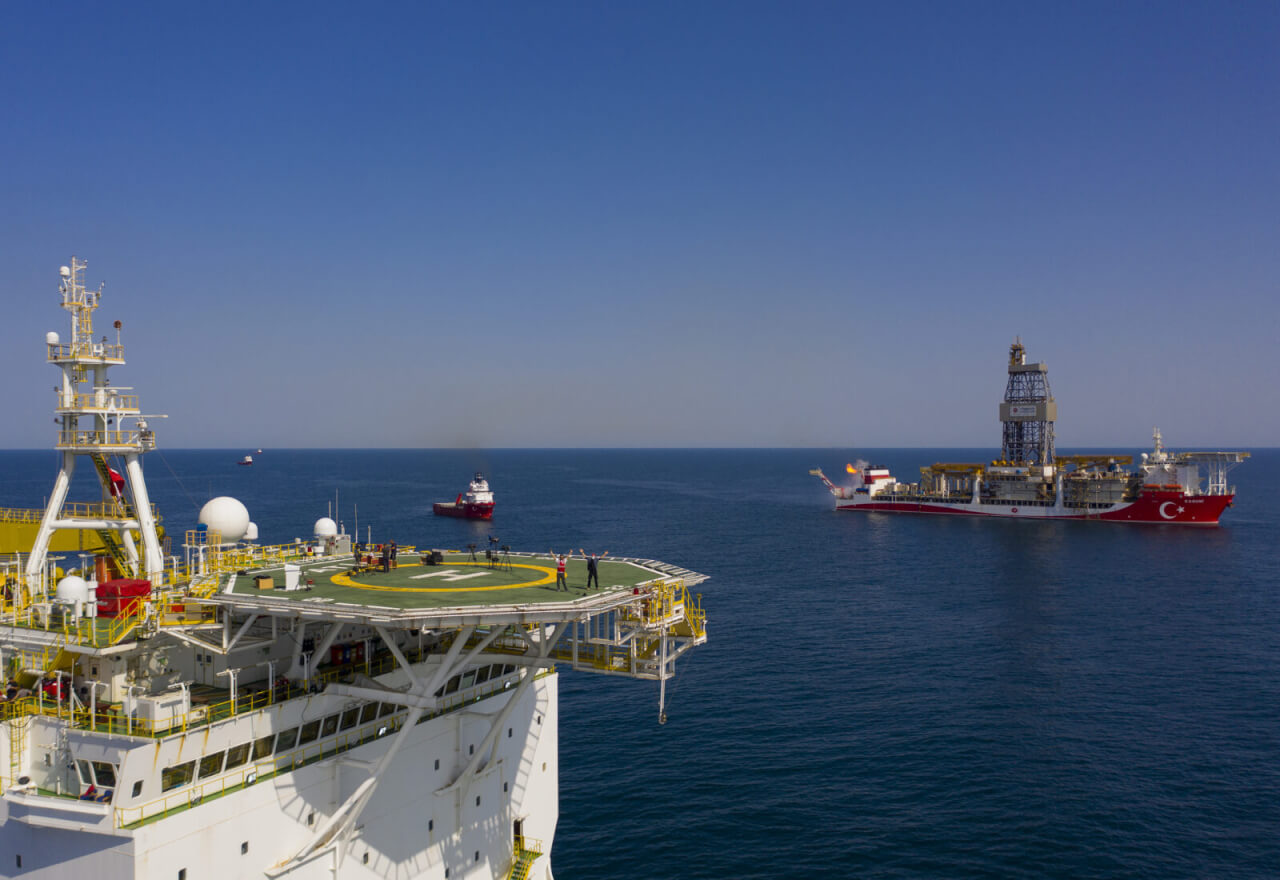
The Eastern Mediterranean is sitting on a geological fortune. Beneath its contested waters lie hydrocarbon reserves that, depending on whose estimates one credits, could reshape the energy map of the region for decades. Yet the two countries best positioned to benefit from this wealth — Greece and Türkiye — are locked in a strategic posture that virtually guarantees neither will extract a single barrel in peace. They are, in effect, competing over a prize both are helping to bury.
This article proposes a way out of that impasse: a bilateral framework for joint hydrocarbon exploration and revenue-sharing in the Aegean and Eastern Mediterranean, anchored on the one legal and political boundary that both sides already accept — the six-nautical-mile territorial sea limit. It is not a perfect solution. But it is a realistic one. And in a neighborhood growing more volatile by the month, realism is the most serious form of ambition available.
I. The Case for Joint Exploration: What Both Sides Stand to Gain
The starting point of any serious proposal must be the existing common ground. Both Greece and Türkiye acknowledge, de facto, the six nautical mile limit as the operative boundary of territorial waters in the Aegean. Beyond that line lies a vast grey zone — legally disputed, diplomatically paralyzed, and economically dormant. The proposal here is straightforward: whatever hydrocarbon resources are discovered beyond six nautical miles should be treated as jointly owned, with revenues shared equally between the two states, regardless of proximity to one coast or the other, and regardless of unresolved questions of continental shelf delimitation and exclusive economic zones.
The advantages of such an arrangement are substantial and mutually reinforcing.
Economic gain where none currently exists. Under the present status quo, neither country is extracting hydrocarbons from the disputed zones. The legal and political uncertainty is itself a deterrent to investment. A joint framework transforms that uncertainty from a barrier into a shared asset. Fifty percent of a producing field is infinitely more valuable than one hundred percent of a contested seabed that no one will touch. The arithmetic of cooperation is compelling.
Stability and confidence-building. A working economic partnership in the Aegean would, for the first time in decades, create a structural incentive for both governments to keep relations stable. Joint ventures require joint institutions — licensing bodies, revenue management mechanisms, and dispute resolution procedures. These are exactly the kinds of functional ties that make conflict more costly and cooperation more habitual. Every platform drilled together is a small but real stake in the other side’s stability.
Foreign direct investment. International energy majors and their financiers are acutely sensitive to geopolitical risk. A bilateral joint exploration framework, backed by an intergovernmental agreement, would signal to global markets that the Aegean is open for business under a predictable legal framework. The FDI that would follow — not only in energy but in associated infrastructure, logistics, and services — would benefit both economies. Greece, still managing the long shadow of its debt crisis, and Türkiye, navigating inflationary pressures and currency vulnerability, would both gain from the injection of long-term capital that only stable, bankable projects attract.
Tourism and people-to-people relations. It is easy to underestimate the knock-on effect of strategic tone. When the two governments are publicly accusing one another of provocations, militarising islets, or violating airspace, the psychological atmosphere poisons the broader relationship — including tourism, trade, and the civil society contacts that sustain bilateral normalcy. A visible, functioning cooperation in the energy sector would alter that atmosphere. It would give political leaders in both capitals a narrative of partnership to sell to their publics, rather than one of perpetual confrontation.
A counterweight to external triangulation. The deepening strategic alignment between Israel, Greece, and Cyprus — including defense cooperation, intelligence sharing, and the EastMed corridor concept — is a source of legitimate concern for Ankara. A Greek-Turkish energy partnership would complicate that triangulation by giving Athens a stake in a productive relationship with Türkiye that, at least partially, competes with the logic of the Israel-Greece-Cyprus axis. It would not dissolve that alignment, but it would introduce a powerful economic variable into Greek strategic calculations.
II. The Obstacles: Why This Has Not Happened, and Why It Will Not Happen Easily?
Intellectual honesty requires acknowledging why this proposal, self-evidently sensible on its economic merits, has not been adopted. The obstacles are real, and some of them are formidable.
The delimitation deadlock. The core legal problem is that Greece and Türkiye cannot agree on where their maritime jurisdictions begin and end. Greece insists on the full continental shelf rights for its islands regardless of their location, including those lying close to the Turkish coast, ignoring the principle of equity in delimitation embodied in articles 74 and 83 of UNCLOS. Emphasizing the difference between the entitlement and delimitation, Türkiye contests this Greek position and claims that all Greek islands lying on the wrong side (east) of the equidistant line between the mainland of both countries should be enclaved, or in other words, be given no continental shelf rights. Any joint exploration framework would need to bracket these disagreements rather than resolve them — a concept international lawyers call ‘joint development zones’ or ‘provisional arrangements.’ Both states would need to accept that economic cooperation does not prejudge the outcome of eventual delimitation. This is legally feasible; it has been done elsewhere, including in the Timor Sea and the North Sea. But it requires political courage to sell domestically.
Domestic political constraints. In Greece, public opinion and a significant portion of the political class view Türkiye’s maritime claims as fundamentally illegitimate — not a matter for compromise but for resistance. Proposing to share revenues from waters, Greece considers its own exclusive zone risks being framed as a surrender. In Türkiye, the ‘Blue Homeland’ doctrine — the assertion of maximalist maritime claims extending deep into the Aegean and Eastern Mediterranean — has become embedded in nationalist discourse and military planning. Any Turkish government that appeared to accept the six-nautical-mile framework as a ceiling rather than a floor would face serious internal criticism.
Third-party entanglements. The Israel-Greece-Cyprus strategic axis is not merely a diplomatic alignment; it is an increasingly institutionalized defense relationship with its own momentum. Israel’s security interests in reliable Mediterranean partners, Cyprus’s desire for a great power patron to balance Turkish influence, and Greece’s incentive to leverage this alignment against Ankara all create structural resistance to Greek-Turkish rapprochement. Athens’ recent maritime jurisdiction legislation only deepens these entanglements, raising the political cost of a bilateral accommodation with Türkiye.
Military build-up dynamics. Both sides are investing heavily in their armed forces. Greece has dramatically accelerated defense procurement — Rafale aircraft, Belharra frigates, upgraded Patriot systems — with explicit framing around deterrence against Türkiye. Türkiye has expanded its naval doctrine, drone capabilities, and expeditionary posture. When military establishments on both sides are designing force structures around the contingency of armed conflict with the other, the political bandwidth for cooperative economic ventures shrinks. There is a risk of a self-fulfilling security dilemma: the more both sides arm for the worst case, the harder it becomes to work toward the better one.
Energy market uncertainty. The global energy transition casts a long shadow over any hydrocarbon development project with a time horizon of ten to twenty years. European climate commitments, shifting demand patterns, and the accelerating cost-competitiveness of renewables mean that the window for a large-scale Mediterranean hydrocarbon project to be commercially viable is not unlimited. Both governments would need to move with a sense of urgency that bilateral diplomacy rarely achieves.
III. Political Will: The Only Variable That Matters
All the above obstacles are real. None of them is insurmountable. What they share is a common dependence on a single variable: political will.
Joint development zones in disputed maritime areas have been created between countries with far more intractable disputes than Greece and Türkiye. The Australia-Indonesia Timor Gap Treaty was negotiated against a backdrop of deep historical grievances and was operational for years before being superseded by a more permanent delimitation. China and Japan have discussed — though never fully implemented — joint development in the East China Sea. The concept exists precisely because it was recognized decades ago that geopolitical deadlocks should not be allowed to permanently foreclose economic opportunity.
The Greek-Turkish case is, in some respects, less intractable than those precedents. Both countries are NATO allies, trade partners, and linked by deep people-to-people ties. The exploratory dialogue track — CBMs, the NATO channel, the bilateral High-Level Cooperation Council framework — already exists, even if it has been underused. The political architecture for a deal is there, waiting for the political ambition to use it.
The argument for that ambition is simple: the status quo is not neutral. It is actively costly. Every year of continued confrontation is a year of foregone revenue, foregone investment, and marginally elevated risk of an incident that could escalate in ways neither capital wants, but neither is fully equipped to prevent. The choice is not between joint exploration and some better alternative in which one side prevails and extracts all the resources unilaterally. That outcome does not exist. The realistic alternatives are joint development, permanent paralysis, or armed conflict — and only one of those produces any economic return whatsoever.
Fifty percent of something is not a concession. It is a rational preference over one hundred percent of nothing — or, worse, the catastrophic arithmetic of war, in which both sides pay the full cost and neither receives anything at all.
The Greek-Turkish Forum exists precisely to build the kind of informal trust and creative thinking that can, over time, translate into a formal political movement. The proposal advanced here — joint exploration beyond six nautical miles, shared revenue, brackets on the delimitation question — deserves to be on that agenda not as a utopian aspiration, but as the most hardheaded, realistic, and mutually beneficial option currently available to both governments.
The Eastern Mediterranean does not have to be a theatre of confrontation. With sufficient political will on both sides, it can be a source of shared prosperity. That will not resolve every dispute, end every tension, or dissolve every threat. But it would be a beginning — and, given where the region is heading, a beginning matters.